When the hallowed moment finally arrived, Irenaeus couldn’t remember his name. The priest stood over him, a wine-filled spoon balanced precariously in one hand. “It’s Luke*,” he said, incorrectly. He had changed his name on Lazarus Sunday earlier this year, but hadn’t used it much since. The Priest was new and didn’t know him. After a few seconds, he remembered it: “I’m Irenaeus.” He opened his mouth, and received the spoonful of unleavened breadcrumbs mixed with the communion wine. Then he walked back to his seat in the Agias Sophias, a Greek Orthodox Cathedral on the Moscow Road in West London.
You could tell Irenaeus, a 23-year-old banker, was a convert. Unlike the cradle Christians, who rocked up towards the end of the service for the Eucharist and a natter over coffee and muesli, Irenaeus arrived on time and sat through two hours of inscrutable Byzantine chanting. He even prayed like an Anglican, leaning forwards with his hands pressed together and crushed into his skull, revealing the cuffs of his starched white shirt and gold Bulgari cufflinks. There were around 400 people in the church, but he was the only one in a pin-striped suit.
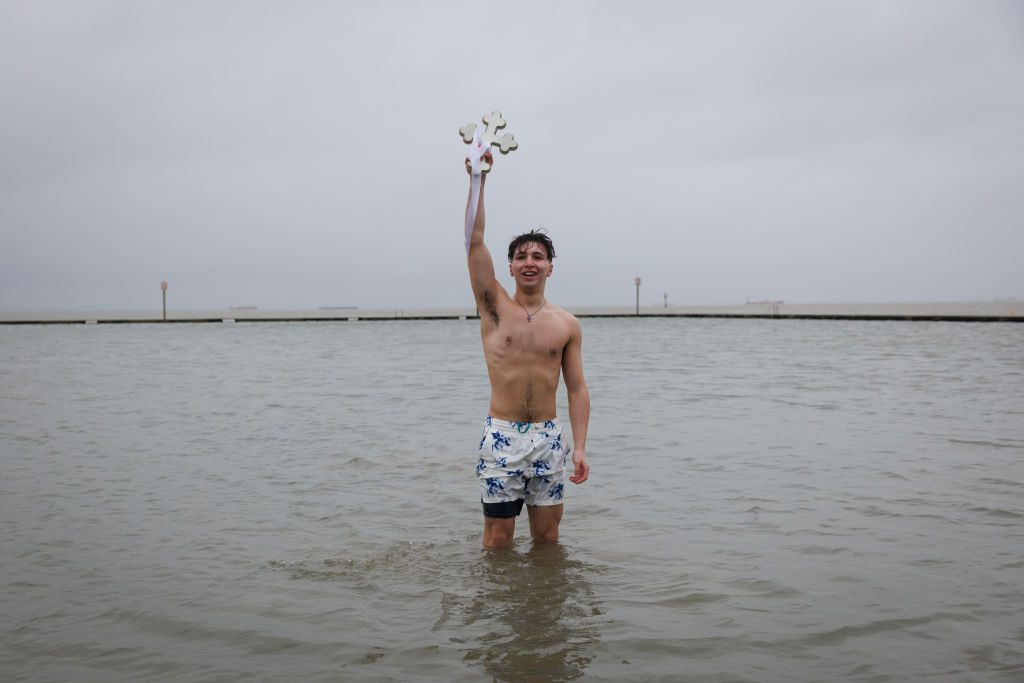
Irenaeus was received into the Orthodox Church in April this year, during a mass baptism at the Twelve Apostles church in Hatfield, Hertfordshire — the nearest church to London with a baptismal pool deep enough to drown a man in. To drown him, and let him be reborn. His head was forced underwater three times. Once for the Father, once for the Son, and once for the Holy Spirit.
The Orthodox Boom has arrived in Britain. That day, Irenaeus was baptised by His Eminence Nikitas, the Archbishop of Thyateira and Great Britain, along with 200 other people. Only three years earlier, in that same service, the Archbishop had baptised merely 13. Next year, he expects 400. “It’s something that has taken us by surprise,” he tells me, “as if these people were thirsting, and all of a sudden we’ve come with the living waters.” He says that in parishes as diverse as Bath and Birmingham, Falmouth and Edinburgh, the pews are packed with people in their mid-20s. The Orthodox Boom was still too small to be noted by The Bible Society’s “Quiet Revival” report earlier this year, but its author Rob Barward-Symmons tells me that, “anecdotally, we are hearing that the Orthodox Church is growing at quite a rate”.
The boom started in America, as such trends often do. A wave of conversions to the Eastern Church swelled there around the time of the pandemic, as the number of adult converts doubled between 2019 and 2022, and is now crashing onto Britain’s shores. A recent New York Times article suggests that it has been precipitated by a loose band of online influencers called the “Orthobros’ — hyper-online, hyper-masculine, hyper-Right-wing Orthodox Christians who have, in most cases, fled a Protestant church which they deemed too irredeemably woke, or woman-led, or amenable to the secular world. The archetypal Orthobro chose Orthodoxy because of its trad aesthetics (the icons, the incense, the Byzantine chants, the twice-weekly fasts). He often quotes the Church Fathers and early Saints, especially when they agree with him — like Saint John Chrysostom, the fourth-century Archbishop of Constantinople, who said that Jews are “lower than the vilest animals”. Within the Orthodox Church, the Orthobros are frowned upon —often because they rarely show up to worship.
Does this explain the rising number of Orthodox converts in Britain? Father Nikitas, whose flourishing church in Falmouth has 13 young, male catechumens, doesn’t think so. He is looking to relocate since his church is now “a bit of a squeeze”. But, he tells me, he doesn’t “think any of [the converts] have been coming for politics. This is what people want it to be who look at it from the outside.” Likewise, one convert tells me that he’s “never known anybody who has come politically”.
And yet, online preachers are successfully converting people in Britain. In her recent book, Don’t Forget We’re Here Forever, Lamorna Ash describes a conversation with one convert who became Orthodox after watching the YouTuber Father Spyridon Bailey. Not long before, his partner had had an abortion. This created an emptiness, an emptiness which the preacher fills. Father Spyridon is an aging English priest, one who claims to have cottoned onto “the sexual deviance of Hollywood long before the Harvey Weinstein case hit the media”. On YouTube, he asks whether “THIS IS THE AGE OF WHICH WE WERE WARNED”, “THIS VERY NIGHT YOUR SOUL MAY BE DEMANDED OF YOU”, and “DO CHRISTIANS HAVE A DUTY TO SUPPORT ISRAEL”, on a quiet bridlepath in the Shropshire hills. He is extreme, but his emphasis on demons and spiritual warfare — a belief which, to the secular observer, seems conspiratorial to the point of paranoia — is commonplace in Orthodoxy. It is also part of its attraction. “For many people,” Father Damick, an American Orthodox priest, has said, “they’re not so much concerned about whether God exists or not. They want to know about the demons that they actually are experiencing.” Irenaeus tells me that he must fight “the forces of sin, which are part of life in a post-lapsarian world”. Another convert tells me that “demons are angels that want to stop you from serving God”. They attack him with “thoughts”. But he will persist: “[Demons] always exist, until the end of the world… You can’t be like: ‘I went 15 years without temptation’.”
But Father Seraphim, a monk based in a monastery on Iona, an island off the west coast of Scotland, is worried about a different sort-of demon: ideology. In a 2024 YouTube video titled “‘Protestant Orthodoxy’ and its Demons”, he says that he recently visited a booming mainland parish and despaired at what he saw. Christian Nationalism. Christian Misogyny. Christian War. Christian Murder. Someone told him that an Orthodox Christian is a Christian who is “not afraid to protect [their] country with a gun”. He is exasperated. This is not Orthodoxy. “It is beyond low: it is evil, it is demonic, to reduce Orthodoxy to a faith where women are some sort-of second-class Christian, second-class souls, that have to be kept away from education.” He then cites a prophecy made by his namesake, Saint Seraphim of Sarov, an 18th-century ascetic. A time will come when the people will flock to the Church and the pews will be filled with worshippers, the saint foretold. And yet, one would struggle to find a single Christian soul among them. He fears that time has come. Others have noted this trend, even if they’re not quite as concerned. George Lapshynov, a researcher at the think-tank Theos, tells me: “If I’m being honest, most of it is young people with some reactionary view towards the West, whether it’s LGBTQ+ or fourth-wave feminism.”
Church leaders take this very seriously. Bishop Irenei, head of the Russian Orthodox Church Outside of Russia (ROCOR) in Britain, delivered a speech last May titled “Seeking After Worldly Visions of ‘Masculinity’ is Not an Orthodox Pursuit”. He stressed that “masculinity, so far as I am aware, is not an Orthodox term… if you are here because you think this is a place where you can reinforce some cultural masculinity, if you’re here because you think this is the place to rebel against what you see going on politically around you or socially around you, please keep on going — go somewhere else.”
It’s much the same in the Greek Church. Lapshynov tells me that “the Greek Orthodox are very worried, and will reprimand clergy for doing things online… Some young converts are even issued with sheets saying these are the online influencers to avoid — which, naturally, just inspires their curiosity.” There is even a WhatsApp group for Orthodox priests who want to know how to deal with young men converting for political reasons. Elsewhere I hear of Orthobros being denied communion. Archbishop Nikitas tells me that he doesn’t want “disgruntled people, people who are angry with their Church and coming [here] for the wrong reasons. We do not want that.”
The problem is, these churches are so offline. It makes them vulnerable. Orthodox priests don’t stand on shoeboxes, or hand out pamphlets on street corners. Nor do they “cattle rustle”, the Archbishop says, which means they’re not very online. (I spent weeks trying to navigate the Archdiocese website, never managing to click off the home-page.) “The less online one can make one’s life as an Orthodox Christian the better,” says John Shinkwin, who works for the diocese. But Lapshynov points out that this can leave them exposed. “Most Orthodox priests don’t have an online presence,” he tells me, “which creates a vacuum into which less official voices can enter. That means the [online] space is saturated with people not eligible to preach.” More often than not, that space is filled by the Orthobro.
But for all the fear, most of the converts I speak to didn’t fit the Orthobro mould. They were normal. That said, most of them are somewhat political — at least, from the secular point of view. They are disenchanted with the modern West; they are disillusioned with the hollowness of the secular world; they are either fleeing dumbed-down churches or else the atheism of their parents. In The Discarded Image, C.S. Lewis described how medieval Christians experienced the world: it is a place where everything is connected by God, where everything is enchanted. That’s what these converts are searching for: enchantment. And they can’t find that in the Church of England. The Orthodox Church offers an escape: so much of its teaching emphasises “mystery” — which, according to the Orthodox Catechism Manual is “something that is revealed for our understanding, but which we never understand exhaustively because it leads into the depths or the darkness of God”.
Irenaeus wanted mystery. Until recently, he was a lapsed Anglican. He lived in “a world where anything could mean anything”, he tells me, and he was confused. He wanted to “re-establish his Christian life” as a bulwark against this indeterminacy, but he didn’t know where to go. The Church of England was too political, too wilfully “representative of the age”, and too disinterested in God. Even its leader, King Charles, he says, had no “particular desire to preserve the Christian faith”, let alone strengthen it. (That same Charles doesn’t disagree: in 1998, he expressed a preference for the Orthodox Church, albeit in a private letter, because it’s the only Christian denomination untouched by “abhorrent political correctness”.) Then, in his second year at university, Irenaeus studied the foundation of Constantinople and early Christianity. The more he studied, the more it appealed to him. “I like the tradition element of it,” he says. “I want faith to be mysterious and otherworldly and non-temporal.” He visited the Agias Sophias and felt some dazzle of blessing. “The iconostasis there, the wall of icons, and the incense, and the apostles above you… It’s beautiful there.”
“I want faith to be mysterious and otherworldly and non-temporal.”
But an Orthodox friend of his was worried. Irenaeus was too angry. He told Irenaeus the story of an Anglican who had once sought to join the Orthodox Church. He visited an Orthodox priest and said that he hated the Church of England, that it wasn’t a real church, only for the priest to say: “We don’t want you until you can understand the good that the Anglican Church gave you. We don’t want your bitterness. If the flame burns too bright at the beginning, you must just end up falling out of love with it.” Over time, Irenaeus’s anger dissipated. “I am less concerned with politics now,” he says. “I think that having something higher makes you less caught up in the tit-for-tat of what’s going on.”
Another convert, Jeremy*, 22, doesn’t believe in Orthobros. He found God at mixed martial arts (MMA) training with a friend-of-a-friend who had converted to Orthodoxy. He went along to a service, and he was hooked. He thinks that Orthodoxy makes him more virile — but not in an Andrew Tate-like way. “You feel more of a man,” he tells me, in quick, garbled snatches down the phone, “because you feel like more of a human.” Christ is “the perfect man”, he says. Secular masculinity is all about beating other men, but Christ instructs him to be more humble, and so humble he must be.
Jeremy came to England from Brazil to study, but found God instead. He was disenchanted. More than that, he was scared: “I was unsatisfied with just the prospect of just dying, and everyone just dying, and that was it, and the futility of life, and I wanted eternity.” He believes he’s found that. Not long after converting, he travelled to Mount Athos, a monastery in Greece. “It was the best experience of my life,” he says. “You’re in an isolated peninsula overlooking the sea, the greenery is beautiful, and I looked at one of the monks, and I thought: ‘He could be like one of those guys from the Acts.’ You know, of the Apostles?”
To Orthodox Christians, the end is theosis: to become Godlike. “God became human,” wrote St. Athanasius, “that we might be made God.” I keep hearing that someone or something is “holy”, or “christlike”, or destined to “become a saint”. I keep being told things in the words of Saint Sophrony, or as Metropolitan Kallistos Ware once said… Their words are always echoed with such earnestness. Orthodoxy allows them to inhabit the “enchanted” world of the early Church, to live among saints — and become one themselves. Nowhere is that more true than at Mount Athos.
I keep on being told about Andrew*, a 23-year-old Oxford student, whom Irenaeus describes as “a very holy man” and in whom Jeremy had “felt the presence of Christ so strongly”. I spoke to him earlier this year over Zoom. He was in his bedroom; on the wall behind him, covering the flaking white plaster, were scores of icons. He has stayed on Mount Athos several times this year, a place he first visited following a post-GCSEs bender in Mykonos with a Greek friend from school. “We felt so bad about everything that we needed to detox,” he told me, and so his friend suggested they visit the Holy Mountain.
In his little dormitory, he was confused, unsettled, surrounded by people of “psychological ill health”. It was only after a few days that a Texan monk (“an eminently sane man”) took him to an ossuary, where the bones of former monks are stored. (On Mount Athos, they bury deceased monks for three years, before digging up their bodies and placing them in the ossuary.) The Texan showed him a skull, on which was written: “Brother, behold the Glory of Man!” A year after his visit, Andrew was diagnosed with ependymoma, a rare type of brain tumour, and his thoughts returned to this moment. He sought that monk out online, and the monk said do not fear: his surgery was on the date of the feast of saints Cosmas and Damian — the unmercenary healers, whose icon had hung above the door of his dormitory in Mount Athos. He would be healed. “I felt a coincidence and I felt so blessed,” he told me. His surgery was long, but he recovered. “It was not a dark period, but the brightest of my life. Whatever remained after that purifying fire, I discovered to be the only absolutes in this world, the only things of genuine meaning.”
Was his conversion the result of that darkness, then, that sudden confrontation with death? Surely it had to be. But he told me that it was not “reducible to some generalised sociological phenomenon”, that “sociologists would be apt to miss the Holy Spirit working in their sociological machine”. God moves in a mysterious way, he said.
Back at the Agias Sophias, Irenaeus echoed those thoughts: “I think there’s too much of a rationalising thrust that cuts through a lot of Western Christianity. But it’s a belief. It doesn’t have to be rational.” As we emerged onto the Moscow Road, the rain hammering the street, he told me earnestly: “The whole point is you’re not supposed to understand. That it’s a mystery.”
*Some names have been changed.