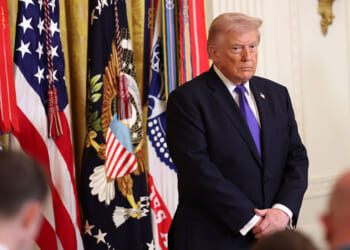
The National Security Strategy (NSS) provides an overarching framework for achieving the objective of America First. The National Defense Strategy (NDS) is the roadmap for how the NSS will be implemented, explaining clearly the intensity with which US equities in the Western Hemisphere and the rest of the world will be defended. The NDS rests fundamentally on the basis of peace through strength and the deterrence that results from it.
The foundational document that lays out the challenges facing America is the NSS, released in early December last year. As Liberty Nation News reported: “President Trump’s cover letter was crystal clear: ‘In everything we do, we are putting America First’ … It’s more than a slogan; it is a rational approach to keeping America safe in a hostile world.”
A Common-Sense Strategy Document
Secretary of War Pete Hegseth made a profound point in his cover letter to the Strategy, observing, “Previous administrations squandered our military advantages and the lives, goodwill, and resources of our people in grandiose nation-building projects and self-congratulatory pledges to uphold cloud-castle abstractions like the rules-based international order.” All too often, the United States has complained that potential adversaries do not live up to the RBIO, and the new NDS recognizes the RBIO as the fiction it is and takes a common-sense approach to America’s defense. Adversaries around the globe have demonstrated no appetite for an RBIO approach to geopolitics, with only infrequent lip service paid to it. President Donald Trump has demonstrated a low tolerance for such symbolic gestures.
The United States will focus on the Western Hemisphere first and foremost, securing America’s “borders and maritime approaches” and creating the Golden Dome for America’s missile defense to secure the nation’s skies. The Strategy specifies the goal to “hunt and neutralize Islamic terrorists who have the ability and intent to strike our Homeland.” That includes sustaining a modern and effective nuclear deterrent while ensuring that American interests throughout the Western Hemisphere are preserved by guaranteeing US “military and commercial access to key terrain, especially the Panama Canal, Gulf of America, and Greenland.”
Defense of the homeland is predicated on the establishment of the Trump Corollary to the Monroe Doctrine:
“After years of neglect, the Department of War will restore American military dominance in the Western Hemisphere. We will use it to protect our Homeland and our access to key terrain throughout the region. We will also deny adversaries’ ability to position forces or other threatening capabilities in our hemisphere. This is the Trump Corollary to the Monroe Doctrine — a commonsense and potent restoration of American power and prerogatives in this hemisphere, consistent with Americans’ interests.”
China as an economic and military threat is by no means minimized and gets special attention in the Strategy. There is an unequivocal assertion to “erect a strong denial defense along the First Island Chain (FIC).” Seldom has the United States taken such a bold step as to declare openly that it will fortify its presence along the line of islands extending from Borneo and the Philippines northeastward through Taiwan and the Ryukyu Islands to the Kurils and Japan, to deny any aggression by China toward Taiwan and in the South China Sea. The FIC serves as a strategic line of defense in the Indo-Pacific and a critical element in containing Chinese adventurism and dominance in the broader Pacific Ocean.
The idea is to establish regional military strength, “from which President Trump can negotiate favorable terms for our nation. We will be strong but not unnecessarily confrontational. This is how we will help to turn President Trump’s vision for peace through strength into reality in the vital Indo-Pacific.” The Strategy emphasizes repeatedly that the United States seeks “respectful relations” with China but only from a position of strength.
Shouldering More Responsibility
With the Western Hemisphere and China the top two concerns, in that order, the NDS calls on “allies and partners to take primary responsibility for their own defense in Europe, the Middle East, and on the Korean Peninsula, with critical but limited support from U.S. forces.” As the BBC reported, “The new strategy calls on American allies to step up, saying partners have been ‘content’ to let Washington subsidize their defense, although it denies the shift signals a US move towards ‘isolationism.’”
NATO allies’ (except for Spain) willingness to raise their defense expenditures from 2% to 5% is a positive sign that members understand their obligations. In the Middle East, the NDS asserts that the Department of War (DoW) “will empower regional allies and partners to take primary responsibility for deterring and defending against Iran and its proxies.” On the Korean Peninsula, the Strategy observes that South Korea has been increasing its defense spending and is becoming more capable of deterring North Korean aggression “with critical but more limited US support.”
Achieving NDS objectives requires a strong and capable defense industrial base (DIB). The Strategy explains, “Our fighting force depends on the DIB to produce, deliver, and sustain critical munitions, systems, and platforms.” Working with Congress and the variety of vendors that service the DoW and other government agencies, the NDS focuses on the task “to reinvigorate and mobilize our great nation’s unrivaled creativity and ingenuity, re-spark our innovative spirit, and restore our industrial capacity.”
America cannot be the world’s street cop, and the NDS establishes a no-nonsense, realistic way forward to achieve President Trump’s National Security Strategy based on America First and peace through strength.
~
The views expressed are those of the author and not of any other affiliate.