The MAGA movement sees itself as spearheading a revolt against elites. Many observers have taken note of the irony in this approach. In rising up against the establishment, the rebels have installed a coterie of politicians notable for their wealth and privilege.
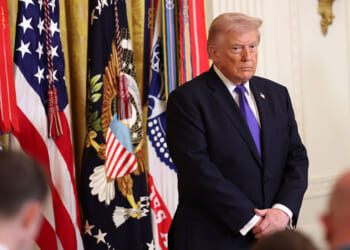
The head of the movement, President Donald J. Trump, is a billionaire, and a proud graduate of the University of Pennsylvania’s Wharton Business School. Before achieving notoriety as a media celebrity, he gained access to a lucrative career in real estate on the back of a large donation from his father. The upper echelons of his administration have been staffed by the well-to-do; key members of his cabinet are in receipt of Ivy League degrees. Trump’s own family has benefited from Presidential power, with close intimates occupying influential roles. In addition, prominent cheerleaders of the MAGA chief include leading tech tycoons like Jeff Bezos, Elon Musk, and Mark Zuckerberg.
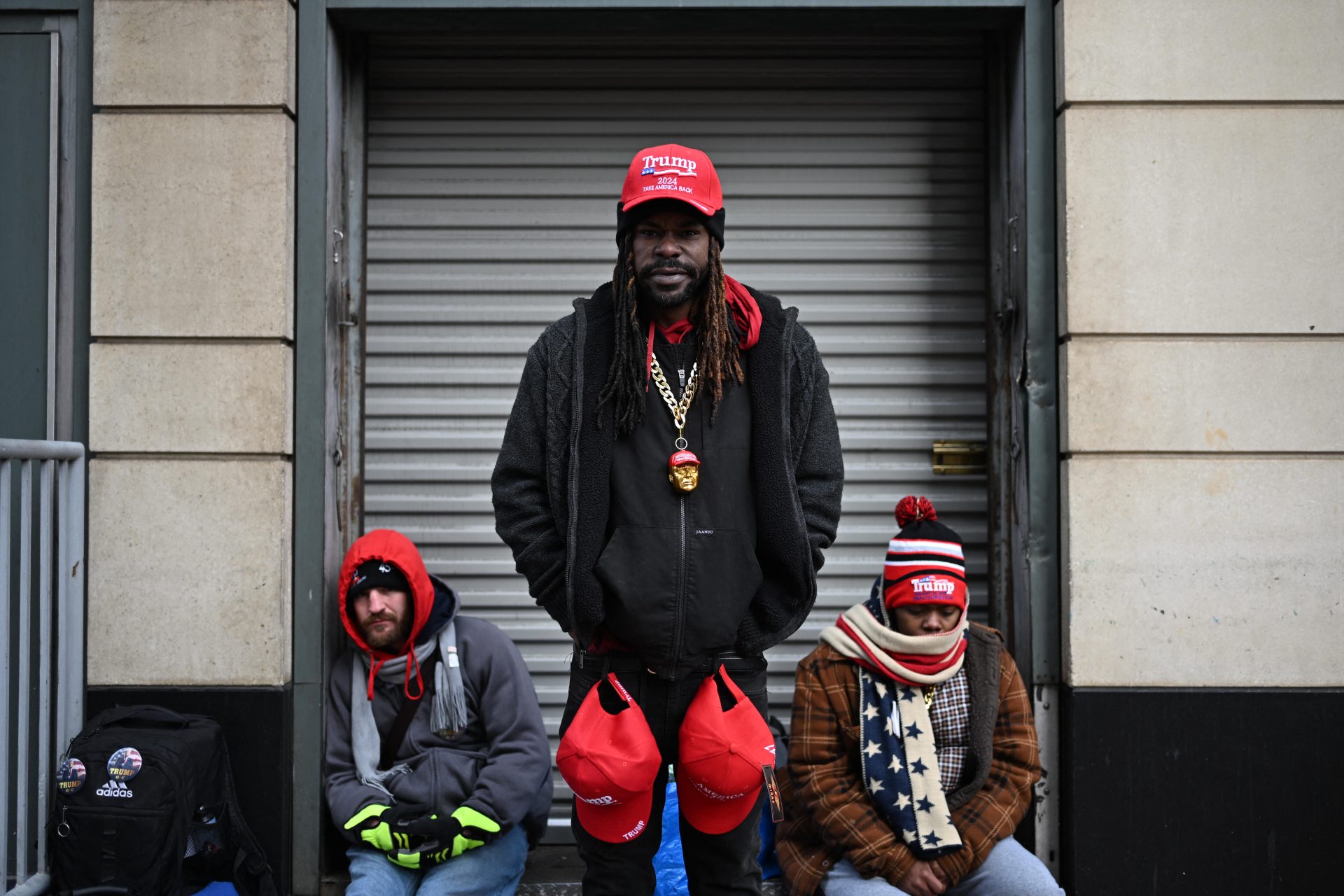
Partisans of MAGA argue that all this misses the point. The movement may be led by affluence and entitlement, but the program (they say) embodies the values of “middle-class America” — a cohort which includes what Europeans call “the working class”. Hillary Clinton once revealingly derided MAGA enthusiasts as little more than a “basket of deplorables”. But the movement’s demographic makeup is altogether more complex than this offhand smear implies. In 2024, around half of the US electorate, both urban and rural, swung behind Trump, with his support among female, Latino, and African-American voters going up.
While MAGA has inspired loyalty among “ordinary Americans”, it has also garnered acceptance among commercial and financial elites. To hold these disparate elements together, Trump has assembled a broad ideological platform: staples of a “neoliberal” economic program, like deregulation and a low-tax agenda, have been married to restrictions on international trade and opposition to foreign migration into the labor market.
Among the most distinctive components of the MAGA program is its hostility to so-called progressive values, many of these identified as pillars of “woke” politics. A target here is the liberal approach to dealing with discrimination, a persistent theme in US politics since the early Sixties, which now centers on the demand for “equity”. Perhaps ironically, equity is similarly intended to dismantle the prestige enjoyed by presumptive elites. As a tool of reparation, it is supposed to deliver fairness by rectifying historic wrongs. Yet, according to its critics, this mission is blind to the real divisions afflicting contemporary society, not least the experience of economic decline across the American rust belt.
This disagreement points to conflict over the meaning of elitism. Rival constituencies face one another in a state of mutual incomprehension. Their opposition has shaken standard perceptions of “Left” and “Right”, with MAGA occupying ground once held by sections of the old Left. This includes antagonism towards global capitalism, backing for some kind of industrial strategy, and a raft of protectionist policies. On the other side, self-appointed radicals among anti-MAGA activists organize around the remnants of new left aspirations — backing “diversity” and “inclusion” as antidotes to social hierarchy.
In this way, two factions have emerged in US politics exhibiting contempt for one another while sharing the goal of dismantling select structures of inequality. To advance their cause, both blocs place their trust in a political class, expecting to advance their sectional interests while punishing the undeserving few. In other words, both sides engage the services of political elites to bear down on the supposedly corrupt beneficiaries of the “system”. These elites employ favored rhetoric to fire their respective bases. Democrats opt for sermonizing appeals to hope and cosmopolitan justice while Trump promises to assuage resentments in blunt demotic tones.
With adversaries ranged across the aisles in this manner, it is generally recognized that the level of acrimony in US politics has steadily risen since the 2008 financial crisis, ratcheted up under the impact of social media. But wariness of elites in America has roots going back to the presidency of Andrew Jackson in the third decade of the 19th century. In Jacksonian parlance the “common man” was championed over northeastern “aristocrats”. The crusade against unmerited privilege took a new turn after the Second World War when governing minorities were branded the “elite”. This characterization was popularized by C. Wright Mills’ The Power Elite, which appeared in 1956.
“Wariness of elites in America has roots going back to the presidency of Andrew Jackson”
Mills’ thesis appealed to the popular imagination agitated by concentrations of power in areas that mattered most: in the military, the federal government, and large corporations. This depiction gave an impression of US society as directed by a concerted combination of bosses. Thereafter, “elites” were associated with excessive clout exercised by a narrow oligarchy. But from the start the book was seen as radically simplifying reality. With its stark portrayal of an all-powerful few, Mills rode roughshod over the layered complexity of social life by focusing on the barons at the top. Modern conditions can’t be crudely split into haves and have-nots. In capitalist societies, inequality is not binary but gradually stratified, organized around a continuous division of labor and an elaborately differentiated distribution of property. Between the super-privileged and the disenfranchised, the bulk of society is divided into a vast array of separate tasks, remunerated along an incrementally ascending scale.
Although Mills altered the terms of debate among the American public at large, his argument harks back to older diatribes against elites. As Hugo Drochon shows in his essential new book, Elites and Democracy, such harangues gained momentum at the turn of the 20th century when European thinkers examined the composition of society and its representation by elected elites.
The starting point for Drochon’s story is a troika of thinkers later dubbed “elite theorists of democracy”. Between 1890 and 1911, two Italians — Gaetano Mosca and Vilfredo Pareto — as well as the German-born Italian sociologist Robert Michels, set out to analyze relations between rulers and ruled under conditions of mass democracy. Responding to the extension of the franchise in European states — in France, Italy, Germany, and Britain — these figures sought to take the measure of modern politics. Even so, neither Mosca, Pareto, nor Michels shared ideological common ground. Originally, Mosca was an exponent of gentrified liberalism, Pareto a qualified defender of market freedoms, and Michels a supporter of the German Social Democratic Party, at one point attracted to its anarcho-syndicalist wing.
From these different angles of vision, all three figures worried about the monopolization of decision-making. It seemed that the rise of popular rule was matched by opportunities for charismatic authority. In launching their objections to the prospect of Caesarism, they rightly presupposed the need for a political division of labor. There must, they accepted, be some species of governing structure, staffed by rulers of a given character, and either rigidly persisting or being dynamically replaced.
Drochon recounts how this tradition of commentary impacted 20th-century political science. The American scene in particular split into partisans of elite practice and critics who favored popular participation. Like so many standoffs in academic culture, this tussle soon evolved into a dialogue of the deaf — with “elite theorists” fearing the irrationality of the crowd and “radical democrats” seeking to bypass the state in search of the voice of the people.
As Drochon observes, there is a doggedness about these divergent renditions which belies the changeability of the social arrangements they hope to represent. Instead of “control by elites”, modern capitalist democracy is defined by competition for office and fluctuating classes locked in dynamic struggle. This is not a recipe for egalitarian rule, but neither can it be dismissed as a static oligarchy. Society is divided into a multitude of interests periodically converging to advance a common cause, only to fragment again as the conditions for alignment recede. This leaves us living with the constant rise and fall of elites, partly driven by the shifting divisions churning within their electoral base. The constant remaking of electoral attitudes over the past two decades across the UK and Europe illustrates this fluidity. So too do the erratic fortunes of parties throughout the same period.
The contemporary cast of US politics vividly captures this process. Over a year into the second Trump administration, and cracks are already starting to appear among his loyal adherents. Held together by the forces of an aggrieved nationalism, MAGA shows signs of gradually splintering into camps, with potential clashes in the offing over the Epstein files, the future of AI, and foreign entanglements. Confused messaging around the war in Iran — from J.D. Vance, Marco Rubio, Pete Hegseth, and Donald Trump — reflects dissensions over strategies and goals. An inward-looking “America First” posture finds itself hitched to a military machine focused on the wider world with supporters of both tendencies pulled in two directions. In due course, the leading enemy of liberal elites may be remembered as an oligarch-in-chief, with new victims and new culprits serving to mobilize fresh political collisions.