Foreign intervention’s hidden costs.
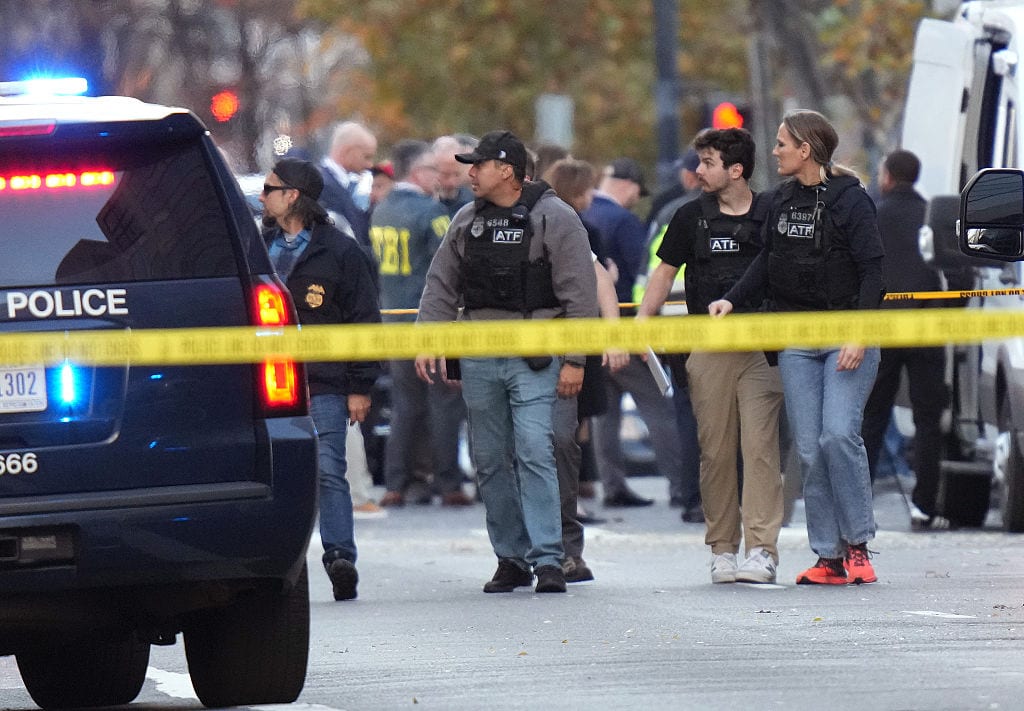
Foreign policy and international relations are not disconnected from domestic politics—they are intimately intertwined. As I previously argued at The American Mind, the downsides of imperial foreign policy involve not only the possibility of being routed abroad, but also corroding social relations between citizens and their representatives at home. Perhaps the clearest recent example of this is the tragic shootings of two National Guardsmen in our nation’s capital by an Afghan national who was resettled in the U.S. after the war in Afghanistan.
Jeremy Carl is surely right that many of our Afghan allies are far from benevolent allies like the British or Canadians, as evidenced by reports from our own soldiers of serial pederasty amongst the Afghan National Police. But we should also analyze the extent to which the shootings can be described as “blowback.” It is reasonable to ask to what extent U.S. policymakers laid the groundwork for these sorts of attacks by our intimate involvement in nation-building in Afghanistan.
“Blowback” is not a term created by your favorite Ron Paul libertarian or Pat Buchanan-thumping conservative neighbor. The Central Intelligence Agency coined the term in the early 1950s to describe unintended consequences arising from its actions abroad. One may also use the term more broadly to highlight results that are the opposite of the original intentions of policymakers, even if mission creep does not occur.
The most obvious example of blowback is the creation of both the Taliban and the training of Osama bin Laden in the late 1970s as a part of Operation Cyclone. Beginning in 1979, the CIA began funding local Afghan and Arab fighters, including bin Laden, to conduct guerrilla warfare against the Soviets. Bin Laden would later use both the weapons and the training he received against the United States. The Taliban ended up capturing much of Afghanistan in the mid-1990s using weapons from the operation.
Bin Laden used his fame and rhetoric to attract the early members of al Qaeda and carry out bombings on the USS Cole, the World Trade Center, and the U.S. embassy in 1998. Eventually, he and his minions carried out the 9/11 attacks.
Another example of blowback is the creation of ISIS. The child of U.S. support for the Free Syrian Army, fighters under Operation Timber Sycamore would funnel weapons and training to their most extreme elements. Amongst those was Jabhat al-Nusra, an Islamic organization allied with al Qaeda. Members would split off from this group, U.S. weapons in hand, to help form ISIS. Hardly the intended goal, U.S. intervention in Syria indirectly helped to create further Islamic terrorism in the Middle East—which would soon reach home.
Analysis of blowback requires journalists and political scientists to look beyond mere assertion of motives and draw a causal line from intervention abroad to the consequences that followed from said intervention. If we see the tragedy that occurred over Thanksgiving as an example of blowback, we must understand what was intended with U.S.-Afghan policy as it related to the perpetrator.
The New York Times reports that the perpetrator, Rahmanullah Lakanwal, was a former member of a CIA-backed paramilitary group called “Zero Units.” Reports indicate that the CIA used them to help kill high-level Taliban and ISIS fighters, as well as civilians, in night raids.
These units would often do the dirty work of U.S. forces, being described as “death squads.” They appear to have been the worst of the worst in terms of tactics and behavior, and in exchange were given extensive covert support. It should be no surprise that radicalized youth and brutal killers would occupy such positions.
Over 10,000 Zero Units fighters were brought to the United States after the fall of Afghanistan.
Though the American people rightfully do not want to feel that they have abandoned allies to be killed, Zero Units members very likely do not have the cultural background conducive to living in America. But if we cannot bring them here, they become part of the mass of refugees moving toward Europe, which helps instill a mistrust of the United States among potential future allies.
Why aid the United States in fighting terrorists if the perception is that the government will abandon you? This drives potential allies into the arms of insurgents and terrorist groups. The CIA has equipped and trained these fighters—now they may turn those weapons against the American people, who will certainly bear the costs of terrorism, unlike the policymakers who armed these groups.
Clearly, providing permanent refugee status to Zero Units members is not the answer, as many come away as disturbed as Lakanwal did. Those not already “head choppers and door kickers” when they entered the units either became one or they left scarred. Reports indicate that Lakanwal became increasingly isolated and erratic during his time in the U.S.
An unknown number of asylum seekers from Afghanistan are either dangerous already or a ticking bomb. This is why we should not create the conditions where we are stuck with two unfavorable options. A lack of potential allies or dangerous former allies within our borders puts the U.S. at risk.
This is not to suggest that we should never work alongside potential allies in other countries, because they may potentially use the resources we equip them with against us. We should enter these potentialities into the calculus of our decision-making. And neither is this some kind of moral equivalency, wherein the United States occupies the same moral plane as individuals who commit terrible acts of violence.
But it does raise this question: Should we allow policymakers to engage in covert support of dangerous groups to thwart another foe?
The answer in Afghanistan was an obvious no. Our mission went from capturing Osama bin Laden to overthrowing the Taliban to installing a democracy in Kabul to eventually protecting women’s rights. It was obvious by 2002 that bin Laden had escaped into the mountains of Pakistan, and U.S. troops remaining in Afghanistan were not serving the original purposes of U.S. action. Why was it the United States’s mission to overthrow the Taliban, which posed no broader geopolitical or security threat to our interests?
Afghanistan had proved before that supporting insurgents could lead to terrorism. The CIA should not have been surprised that their squads would attract those naïve enough to believe they could handle the work or potential terrorists. Seen in this light, Lakanwal’s horrific actions before Thanksgiving are a predictable outcome of endless wars and shifting goalposts.
When U.S. officials are deciding whether to engage in military action, they must consider the possibility that those they ally with may lash out in the only means available to them as they face a superior military: insurgency and terrorism. They shouldn’t equip those whom they have reason to believe will attack the U.S. later. And they also shouldn’t put the country in a situation where we may have to care for potentially dangerous former allies.
Blowback is a real cost of foreign policy, and one that policymakers must account for. If they do not, their failures will ultimately be borne by the average American and our men and women in uniform.
The American Mind presents a range of perspectives. Views are writers’ own and do not necessarily represent those of The Claremont Institute.
The American Mind is a publication of the Claremont Institute, a non-profit 501(c)(3) organization, dedicated to restoring the principles of the American Founding to their rightful, preeminent authority in our national life. Interested in supporting our work? Gifts to the Claremont Institute are tax-deductible.