Meanwhile in Gaza, Phase 2 of President Trump’s plan for pacifying and rebuilding the enclave has gone into effect.
“Phase Two establishes a transitional technocratic Palestinian administration in Gaza, the National Committee for the Administration of Gaza (NCAG), and begins the full demilitarization and reconstruction of Gaza, primarily the disarmament of all unauthorized personnel,” announced special envoy Steve Witkoff. “The US expects Hamas to comply fully with its obligations, including the immediate return of the final deceased hostage. Failure to do so will bring serious consequences.”
Let’s unpack this. First, the “transitional technocratic” administration. The great paradox of projects like this is that the overall goals are extremely ambitious, but the people charged with guiding the project must be entirely without ambition themselves. Here’s a good rule of thumb: Members of the public who have no professional or academic interest in the conflict should hear the names of such “technocrats” and say: Who?
Fame and political ambition are the poison pills of technocratic governance. For example, the man chosen to lead the entire transition project under Trump’s watchful gaze was named one week ago today. How many people could name him without googling? Exactly: so Nickolay Mladenov is off to a good start.
Mladenov is a Bulgarian diplomat whose primary Mideast experience consists of five years as the UN’s Mideast peace coordinator. Despite what that title might normally suggest, Mladenov was generally well-liked by both sides.
The full Board of Peace, however, remains a mystery.
Mladenov has chosen Ali Shaath to head the group of Palestinian technocrats tasked with building the capabilities of a local government: “We are not talking about ‘reconstruction’ but construction anew,” he told a Palestinian radio host, adding: “We will set plans for water, well rehabilitation, water purification, and treated water — water is the secret to health, education, hospitals, all of which were destroyed.”
According to the Times of Israel, Shaath is a civil engineer who had once been a Palestinian Authority minister of planning. He’s already tossing around some creative ideas. What to do with all that rubble in Gaza? Well, Shaath says, how about bulldozing it to the waterline to extend Gaza’s shore?
And therein lies the problem. Who controls Gaza’s coast? Not Ali Shaath. Not Nickolay Mladenov. Not the IDF.
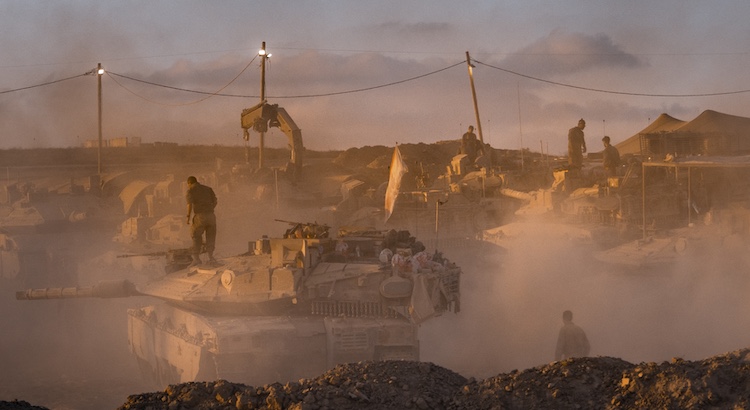
The Yellow Line separating the IDF from the rest of Gaza puts the enclave’s north, south, and east under Israeli control. It is within those areas that Shaath’s team will set to work clearing rubble and building housing and, as the man said, pumping clean water.
The decision to move to the second phase without a clear Hamas disarmament plan in place was not a mistake. As I argued last month, any extensive delay helps Hamas, which is gearing up for another round of fighting at some point. Also, the cease-fire deal pretty much locks any progress in place, since the IDF is in charge of security for any territory under reconstruction. Hamas can dig in, but it won’t advance.
The challenge that Hamas still presents, however, is significant. The scenario that Trump’s team expects to play out is the following: Life for Gazans improves exponentially in the half of the enclave stewarded by the Israelis and a supplemental international force, and pressure on Hamas increases while the humanitarian crisis abates.
But here’s another scenario: The moment shovels get put in the ground on the Israeli-controlled side, Hamas begins firing rockets and challenging the troops along the Yellow Line with skirmishes and attempted incursions. In this environment, the stabilization force never materializes and the technocrats wait for the skies to clear. With rebuilding frozen, Israel has no choice but to go into Hamas-controlled Gaza and disarm the terror group by force. But the renewed fighting takes a toll on the civilians left in Hamas’s half of the enclave, and scenes from the two years of war start replaying themselves.
Trump will obviously support the forced disarmament of Hamas even (or especially) if Israel is the one to do it. But will the Europeans fold? Will the stabilization force dissolve before it’s even on the ground?
There are only two reliable actors in this saga: the U.S. and Israel. Hamas is going to attempt to make it so that the U.S. and Israel are the only actors in the saga at all. As long as the U.S. and Israel are committed to victory, they’ll succeed. Because the enemy always gets a vote, and Hamas always votes for war.