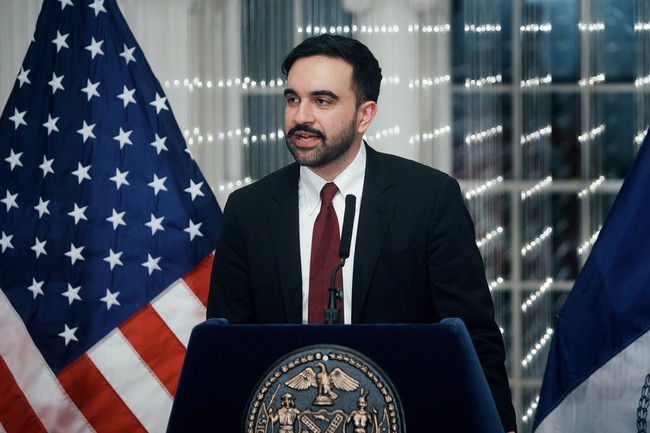
New York City Mayor Zohran Mamdani walked into the “Downtown Seder” at City Winery in Manhattan ready to set a tone. He spoke first, leaned into unity, and tried to present himself as a mayor who moves easily across lines that divide the city.
Unfortunately for the mayor, the room didn’t follow his lead.
Zohran Mamdani is clearly aiming to convince the world that he isn’t anti-Semitic in the most lefty-coded theater-kid way possible. It didn’t quite go as he planned.
The New York mayor attended what The New York Times called a “hip” Passover Seder on Monday.
The event was also attended by former CNN host Don Lemon, who is in a bit of legal trouble at the moment, and a whole host of other characters, including a drag-queen rabbi who phoned in from Jerusalem and George Floyd’s brother, who spoke about “racism,” according to the Times.
Michael Dorf, founder of City Winery and longtime host of the event, has run the gathering for over 30 years. Mamdani took a seat alongside Don Lemon and Amichai Lau-Lavie.
Rabbi Amichai Lau-Lavie will appear at the Seder by video from Israel. The rabbi and human rights activist is best known as the subject of the documentary film Sabbath Queen (2024), which followed Lau-Lavie’s “epic journey” as a “drag-queen rebel” who “challenge[s] patriarchy and supremacy.” It is not known if the rabbi will appear as himself or as his drag alter ego, Hadassah Gross. Other guests will include Terrence Floyd, brother of George Floyd, and Matthew Broussard, the actor and comedian who played “Comic 2 at Stage Deli” in The Marvelous Mrs. Maisel.
Mamdani addressed antisemitism and told the audience he stands with Jewish New Yorkers, framing himself as a bridge builder, even while promoting a political agenda rooted in democratic socialism and expanded government authority.
That contrast didn’t sit well.
Israeli musician David Broza attended the event, along with other artists and community figures. Syrian Jewish comedian Olga Namer cut through the tone with a line that landed because it carried weight, joking that Mamdani likes half of her, and the room understood exactly what she meant.
Then things didn’t go as well as Mamdani hoped: the mood shifted.
Hecklers interrupted Mamdani mid-speech and made their frustrations clear.
The Seder event was briefly interrupted by a heckler who yelled out, “every Jewish organization is a target,” after Mamdani went into a spiel about how a “rising tide of antisemitism has caused enormous pain for so many Jewish New Yorkers.”
Those interruptions weren’t random; they reflected a deeper skepticism that had already taken hold before he ever stepped before the microphone.
Observant Jewish comedian Modi Rosenfield chose not to attend at all after learning Mamdani would be part of the program.
Jewish comedian Modi pulls out of Passover event in Manhattan due to @ZohranKMamdani participation.
Modi’s team announced on his Instagram page that “We were never told Mamdani was participating in this event until today.”
It concluded, “Modi will no longer be attending.” https://t.co/u6gv3aESxS pic.twitter.com/tjDCEg5Yso
— Yossi Farro (@FarroYossi) March 31, 2026
Rosenfield primarily performs for Orthodox audiences and didn’t want to appear alongside a socialist mayor.
The evening raised funds for Seeds of Peace, a group that works with young people from regions shaped by conflict. The mission carried meaning, the setting carried tradition, and the guest list created a tension that never resolved.
Mamdani’s approach relies on presence: he shows up, delivers a message about unity, and expects that to carry weight.
His problem?
Audiences don’t separate the speech from the record that followed it, and current news cycles are highlighting Mamdani’s current record.
The disconnect remained visible throughout the night. A mayor who supports policies that expand government control spoke about shared values rooted in freedom, but a political figure tied to activists critical of Israel positioned himself as a defender of Jewish communities. His effort to reconcile those positions didn’t convince the audience.
America’s last remaining independent journalist (/sarc) delivered the Four Questions with a personal twist tied to his church protest arrest.
Dorf defended the event’s mix of politics, performance, and tradition and encouraged open dialogue, something we as freedom-loving Americans should respect, but that framework depends on a level of credibility that can’t be built in a single appearance.
The annual Downtown Seder is not a traditional Seder but rather a “supplement,” according to the event’s longtime host, City Winery proprietor Michael Dorf. One Jewish magazine described it as “half postmodern religious ritual and half cabaret,” while the New York Times said the 1997 ceremony was “a cross between summer camp in the Catskills and a progressive jazz concert.” Net proceeds from the Seder will be donated to Seeds of Peace, a nonprofit that “empowers young leaders from regions of conflict … to dismantle legacies of animosity.”
It wasn’t there; the interruptions made that clear. Mamdani didn’t lose the room because of a single comment; he never had it because the audience already weighed what he represents against what he was trying to say. That gap proved too wide to close in one night.
New Yorkers notice patterns, they listen, they compare words with actions, and they watch whom leaders align with and what policies they push. When those pieces don’t match the message being delivered, the reaction comes quickly.
Unfortunately for the city, they still elected a democratic socialist.
Moments like this don’t happen in isolation. They build over time as audiences test what leaders say against what they do. If you want coverage that keeps tracking those moments and calls them out directly, PJ Media VIP gives you that access. Use promo code FIGHT to get 60% off today.