The fight for liberty never ceases – even on Christmas.
Nearly 250 years ago, five months after the Founding Fathers adopted the Declaration of Independence, America approached its first Christmas as a sovereign nation. After formally severing ties with Great Britain and declaring itself a new nation, America was locked in a desperate fight for freedom.
What happened on the first American Christmas in 1776 would determine whether the cause of liberty survived.
Leading Up to Christmas
Shortly after the Declaration was signed, General George Washington, leader of the Continental Army, suffered a brutal defeat. Anticipating a British attack on New York, Washington moved his troops to the important city. Throughout August, General William Howe, a British officer, gathered 32,000 British and Hessian troops on Staten Island. Washington, on the other hand, had assembled 20,000 largely untrained soldiers and militia.
The Continental Army focused on building defensive systems near and on Manhattan Island, and roughly half of Washington’s army in New York was sent to Brooklyn Heights and the western side of Long Island.
From August 22-25, General Howe moved around 20,000 regulars to Long Island, where he executed a sweeping flanking maneuver around the American troops, commanded by Maj. Gen. John Sullivan. On August 26, after Sullivan’s forces fought hard against the British, the American front collapsed, forcing Continental troops to retreat back to Brooklyn Heights and eventually Manhattan.
The American defeat was costly: An estimated 300-400 Continentals were killed or wounded, and another 700-1,200 were taken prisoner. The British only reported losing 367.
By December, things had only gotten worse. A bitter cold swept through the young nation during a time when supplies and morale were already low. Many of the soldiers who served in the Battle of Long Island were gone as men deserted the Continental Army, fearing the war had already been lost.
Even General George Washington, just 44 years old at the time, expressed doubt in a letter to his cousin, writing, “I think the game is pretty nearly up.”
A Revolutionary Christmas
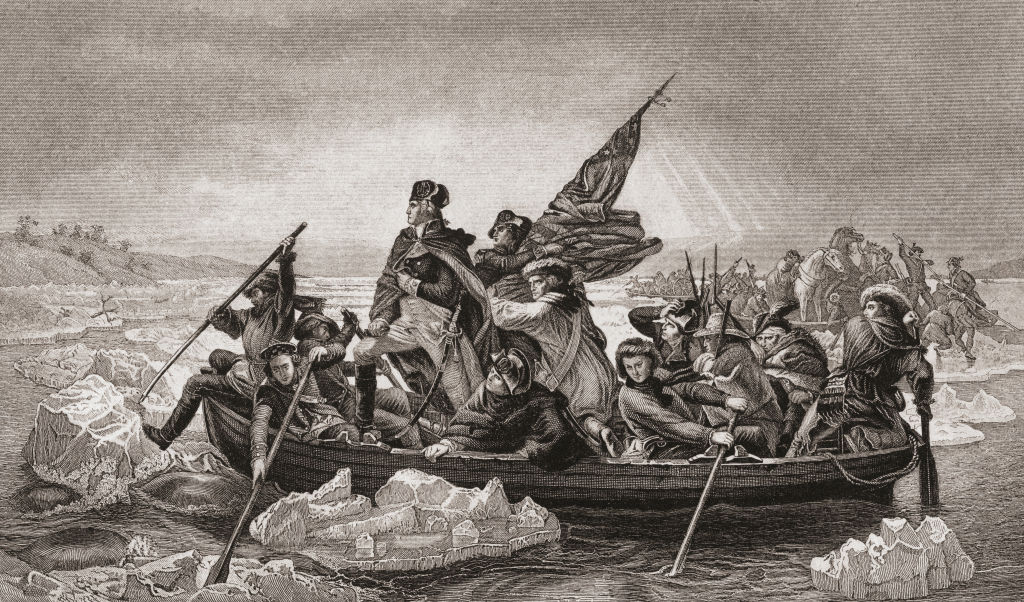
Despite the dire circumstances, Washington and several thousand American troops weren’t ready to give up on the cause of liberty just yet. So the general devised a plan: Cross the icy Delaware River on Christmas night to execute a surprise attack on about 1,400 Hessian soldiers in Trenton, New Jersey.
Washington’s strategy included three crossings. First, Col. John Cadwalader would lead 1,200 militia and 600 Continental soldiers across the frozen waters near Burlington, New Jersey. His task was to block additional British troops from assisting the Hessian garrison in Trenton.
Then, Gen. James Ewing would take 800 militia across the river to Trenton to set up defensive positions and prevent a Hessian retreat.
Finally, Washington and 2,400 men would cross the freezing, ice-choked waters roughly ten miles north of Trenton before marching down to attack the Hessian soldiers at dawn.
Washington’s scheme didn’t go as planned: Neither Cadwalader nor Ewing was able to cross the ice-choked river. Only George Washington and his men made it across the Delaware on Christmas night.
Around 8 a.m. the following morning, Washington and his small force achieved the surprise. After less than two hours of fighting, the Hessians surrendered. The assault was a huge success: About 30 Hessians were killed in the attack, and over 900 were captured. Only four Americans died in the battle, and an equal number were wounded.
Washington’s victory at Trenton proved to be a turning point in the Revolutionary War, restoring hope to a battered army and kicking off a string of successful battles against the British. America’s first Christmas as an independent nation was uniquely its own, marked by sacrifice and faith in a cause greater than oneself.
Liberty Nation does not endorse candidates, campaigns, or legislation, and this presentation is no endorsement.