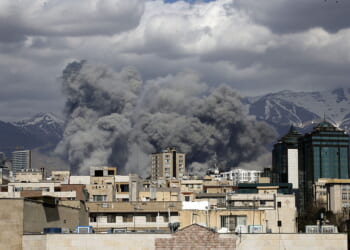
After Israel and the US attacked Iran on 28 February, a post on social media declared: “Purim came early this year.” That Jewish holiday, which fell on 2-3 March this year, celebrates the salvation of the Jews of ancient Persia — present-day Iran — from a plot to exterminate them, as recounted in the biblical Book of Esther. But it was the post itself that came early. It’s premature to proclaim victory on behalf of the Iranian Jews, whose precarious circumstances resonate with diaspora communities around the world. The whole of world Jewry is watching the war with a mixture of hope and trepidation.
Jews have lived on the Iranian plateau for more than 2,600 years, constituting one of the oldest continuously existing religious communities in the world. The Babylonian monarch Nebuchadnezzar II brought them there by force after he destroyed Jerusalem and the Temple of Solomon in 586 BC. This exile, known as the Babylonian Captivity, lasted until 536, when Cyrus, the founder of the Persian empire, conquered Babylon and allowed the Jews to return to Jerusalem. (See the Book of Ezra.) Some chose to remain in the regions of modern-day Iraq and Iran. And these Mesopotamian Jewish communities of late antiquity were not idle. Their rabbinic academies produced the nearly two-million-word Babylonian Talmud, the crowning intellectual achievement of Jewish thought to this day.
The Book of Esther is set during the reign of the Persian despot Ahasuerus (better known as Xerxes), who in 480 BC led his massive invading army to epic defeat at the hands of the Athenian-led Greek cities. Read aloud on Purim, and celebrated in a carnivalesque atmosphere of mime and mimicry, the story of Esther expresses diaspora Judaism’s great wish: to triumph over neighbors who would annihilate them, but in such a way as to make them friends. This is the accomplishment of young Esther and her uncle Mordechai, who lived under Ahasuerus’ reign. On Mordechai’s advice, Esther conceals her Jewish identity, becomes Ahasuerus’s queen and cleverly maneuvers him into executing Haman, a Persian Heinrich Himmler. Mordechai then takes Haman’s place as prime minister. Something like this has in fact been the general strategy for Jewish survival in the diaspora: benefit the ruler (as Joseph did Pharaoh), enter the ranks of the elite, and use economic and political power to protect the Jewish community. But as the fate of European and Middle Eastern Jewry showed in the mid-20th century, this strategy, called shtadlanut (“intercession”) in Yiddish, entails considerable risks, and seems to have outlived its usefulness.
The reality of Jewish life in Persia has been neither as perilous nor as glorious as in the Book of Esther. Until the arrival of Islam in the seventh century made them second-class citizens distinguished from Muslims by special clothes and yellow patches, Jews “participated freely”, as the historian Houman Sarshar notes, “in every sphere of society, from the army to the courts”. Subjected to further economic, social, and physical restrictions after the ascendancy of Shi’ite Islam in the 16th century, they regained their ancient freedoms in 1906, when Iran adopted a new constitution. Iranian Jewry enjoyed a golden age under Mohammad Reza Pahlavi, a Westernizing ruler who became Shah in 1941 and later extended de facto recognition to the new state of Israel. When political turmoil forced Pahlavi into exile in 1953, an Iranian Jewish merchant issued him a blank check drawn on a Swiss bank account. Jews subsequently assumed leadership roles in key Iranian industries.
But history is full of ironies, and one long in the making finally caught up with the people of Iran. The Greek victory over Xerxes in the Second Persian War saved Athenian democracy, and thereby the West, from perishing in its infancy, but the equally despotic Ayatollah Khomeini used Greek philosophy to defeat Western values when he established the Islamic Republic of Iran in the 1979 revolution. The medieval Shi’ite thinker Alfarabi argued for an Islamic version of Callipolis, the city ruled by philosopher-kings in Plato’s Republic, that would be ruled by a Muslim prophet and lawgiver who was also a philosopher. A millennium later, Khomeini looked to the Republic in founding his totalitarian theocracy, in which power is concentrated in a Supreme Leader and a Council of Guardians composed of clerics.
“History is full of ironies, and one long in the making finally caught up with the people of Iran.”
The Shah had grown increasingly authoritarian and repressive in the Seventies, and Iranian Jews supported the revolution in the hope of a more progressive government. Instead, the Ayatollah exacted a heavy price for their policy of shtadlanut. The new regime almost immediately charged Habib Elghanian, a wealthy businessman and president of the Tehran Jewish Society, with corruption, Zionism, and contacts with Israel. He was executed and his family’s property was confiscated by the state. Most Jews subsequently fled Iran, and the community, which numbered 100,000 under the Shah, now has perhaps 9,000 members.
It’s hard to know what the Jews of Iran are thinking right now, because the regime monitors their communications with the outside world, strictly prohibits direct contact with Israel, and treats Zionism as a serious crime that can be punishable by death. Little wonder that they “dodge questions”, “talk in code”, and use fake names on social media; that they participate in Al-Quds Day rallies expressing solidarity with Palestinians; and that, when Israel and the United States bombed Iran last year, the Jewish communities of Tehran and Isfahan issued public statements condemning the “Zionist regime’s” brutal aggression. There’s no doubt that Iranian Jews feel great pressure to make such declarations. But after the Hamas pogrom of October 7, 2023 unleashed a worldwide wave of anti-Israel sentiment and Jew-hatred, diaspora Jews in general, who are increasingly suspected and accused of having more loyalty to Israel than to their home countries, have felt a similar (if less intense) social pressure to denounce Zionism. This is a cruel predicament, for that very pressure underscores why the existence of Israel — the ultimate guarantor of Jewish safety in the post-Holocaust, post-Soviet world — is so necessary.
Why haven’t the remaining Jews of Iran left for greener pastures? For one thing, Iran has historically restricted Jewish families from emigrating together. It’s also unclear whether her Jewish communities know enough about the situation of Jews in other countries to make a realistic assessment of their alternatives. Then, too, it’s very difficult to give up one’s home, business, and way of life in order to become a stranger in a strange land, compelled to learn another language. Finally, Iranian Jews, including those who left after 1979, feel a strong and genuine attachment to the land where their ancestors have lived for millennia. Some even believe that, if the Americans succeed in toppling the regime, they might be safer in Iran than anywhere else, even Israel.
The Jews of Iran are surely anxious about the current war, and they’re by no means alone. Between 40,000 and 50,000 Persian or Tehrani Jews live in Los Angeles, and they are currently experiencing a “mix of jubilation and dread” as events unfold in the Middle East. One member of the community expressed a fear that many American Jews are feeling: “If this war doesn’t have a positive end result, it will only further increase the resentment that Americans have of Israel. And that is not good for Israel. It is not good for American Jews.” Nor would it be good for any of the world’s other Jewish communities, to say nothing of the beleaguered Iranian people, who have repeatedly shown great courage in opposing a malignant ideological tyranny. This year, it’s not just the Jews whose hopes of safety are reflected in the story of Purim.