OAN Staff Katherine Mosack and Brooke Mallory
12:20 PM – Wednesday, April 1, 2026
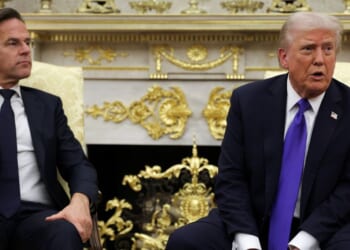
President Donald Trump became the first sitting U.S. president in history to attend oral arguments at the Supreme Court of the United States (SCOTUS). He was present for the proceedings in Trump v. Barbara, the landmark case concerning the Constitutionality of ending birthright citizenship for children of illegal aliens.
Trump arrived at the Supreme Court on Wednesday, as the justices weighed whether his 2025 executive order (EO), which ends birthright citizenship for children born to illegal immigrants, is Constitutional.
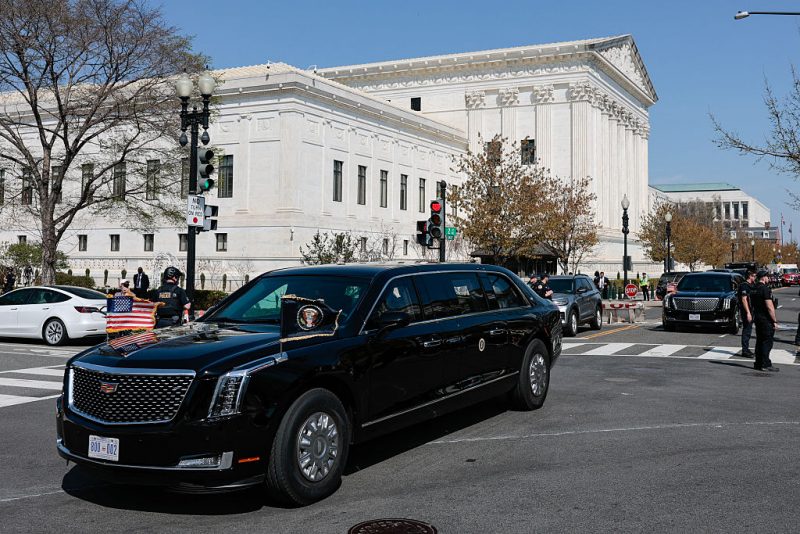
The president arrived at the courthouse at approximately 9:40 a.m. local time, traveling in a full motorcade. After spending roughly an hour and thirty minutes inside the court, observing the arguments presented by Solicitor General D. John Sauer, he departed and returned to the White House in his armored presidential limousine, famously known as “The Beast.”
However, according to reports, Trump did not have time to attend the subsequent arguments made by the American Civil Liberties Union (ACLU), which represented the plaintiffs.
“I’m going,” he told reporters on Tuesday when asked about the upcoming ruling. “I think so. I do believe. Because I have listened to this argument for so long.”
Trump has long expressed that the Citizenship Clause of the 14th Amendment has been severely abused and taken far beyond its original intent.
He argues that the clause was specifically designed to guarantee citizenship to the descendants of enslaved people in the aftermath of the Civil War, and that it is now being wrongly applied in ways never envisioned by its authors.
“This is not about Chinese billionaires or billionaires from other countries who all of a sudden have 75 children or 59 children in one case or 10 children becoming American citizens,” he argued. “This was about slaves.
“We’re talking about slaves from the Civil War,” he continued, “and if you take a look at when it was filed, all of this legislation … everything having to do with birthright citizenship, it6 was at the end of the Civil War. … It had to do with the babies of slaves. It didn’t have to do with the protection of multi-millionaires and billionaires wanting to have their children get an American citizenship.”
The 14th Amendment states, “All persons born or naturalized in the United States, and subject to the jurisdiction thereof, are citizens.” For more than 150 years, this has been interpreted to mean that anyone born in the U.S. is guaranteed citizenship regardless of their parentage.
“The Fourteenth Amendment has never been interpreted to extend citizenship universally to everyone born within the United States,” Trump’s EO, “Protecting the Meaning and Value of American Citizenship,” asserts, arguing that those born in the U.S. but not “subject to the jurisdiction thereof” are excluded from birthright citizenship.
The EO prohibits all U.S. departments and agencies from issuing documents recognizing United States citizenship to an individual whose mother was unlawfully present in the U.S. and whose father was not a citizen or lawful permanent resident at the time of their birth.
During the Wednesday SCOTUS session, several justices reportedly expressed skepticism regarding the administration’s interpretation. Chief Justice John Roberts and Justices Amy Coney Barrett and Neil Gorsuch raised questions about the legal definition of “domicile” and the practical implications of the proposed restrictions.
The Court’s eventual ruling, which is expected by July 2026, will determine whether the long-standing precedent established in the 1898 case United States v. Wong Kim Ark remains the standard for birthright citizenship in the United States.
Stay informed! Receive breaking news alerts directly to your inbox for free. Subscribe here. https://www.oann.com/alerts
What do YOU think? Click here to jump to the comments!
Sponsored Content Below