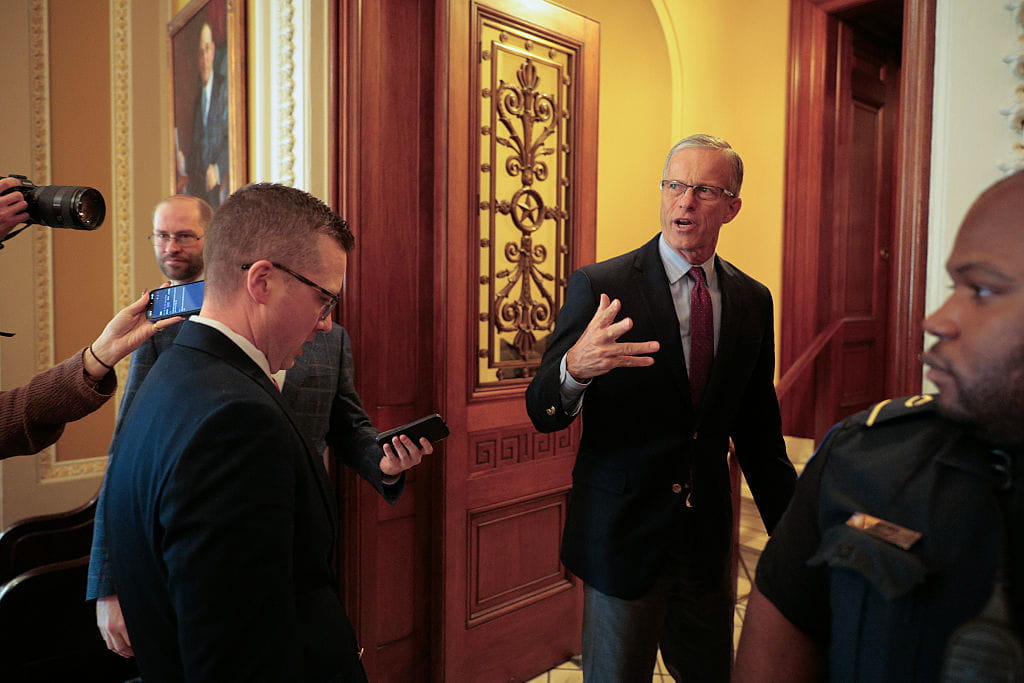
The result: Just before 6:30 p.m. that evening, the Senate went on to pass the new package in a decisively bipartisan 71-29. Just 23 Democrats and independent Sen. Bernie Sanders of Vermont (who caucuses with Democrats) opposed on the left. They were joined by five Republicans – Florida’s Rick Scott, Kentucky’s Rand Paul, Utah’s Mike Lee, Ted Cruz of Texas, and Ron Johnson of Wisconsin.
A Headache Headed for the House
Since the six-bill package was initially passed altogether through the House and the Senate changed that by replacing one of the bills with a CR, the whole deal has to return to the House – which won’t happen until the lower chamber reconvenes on Monday, February 2. So, yes, there will be a brief lapse of funding over the weekend. But, assuming all goes smoothly on Monday, it won’t last long enough to really be felt.
But there’s no guarantee things will go smoothly.
The deal was struck between President Trump and the leaders of both parties in the Senate – not the House – but lower chamber leaders have promised to get it done. Still, there are holdouts. That the package will eventually pass seems almost a foregone conclusion, though how quickly remains the question. Speaker of the House Mike Johnson (R-LA) said the earliest a vote could happen was Monday, but that they would “get the job done.” On Friday, he said he would try to use a fast-track process called suspension of the rules to allow the body to vote on Monday. To allow that accelerated timeline, however, he’ll have to get full compliance from his own party and the support of more than 70 Democrats to achieve the required two-thirds majority. The bill itself only needs a simple majority – half plus one – but getting to that final vote quickly will have to be a bipartisan effort.
House Minority Leader Hakeem Jeffries (D-NY) said on Friday that he was fine with passing the five-bill package as it is, and said Democrats would evaluate whether there is “a real path toward making dramatic changes to the Department of Homeland Security necessary to stop the use of taxpayer dollars from brutalizing everyday Americans.” He may be on board – and he may lead at least some in his party to go along.
But some progressives – who voted against the package the first time – remain adamantly against passing any funding for DHS, even in the form of a two-week stopgap bill with renegotiation on the table.
Rep. Greg Casar (D-TX), the chair of the Congressional Progressive Caucus, flat-out said in an X post on Friday: “My Progressive Caucus colleagues and I have been clear: not another cent to ICE until we stop the chaos and lawlessness.”
“If this comes to the House, I’m voting no,” he said in response to the news that Trump and Senate Democrats had struck the deal.
To make matters even more difficult, a new Democrat will be sworn in today after a Texas special election runoff, reducing the GOP majority by one.
But it isn’t just Democrats who might try to kill the deal. Some of the more conservative representatives have expressed skepticism over the Senate deal and are pushing for additions of their own. Reps. Anna Paulina Luna (R-FL) and Ralph Norman (R-SC) both pushed back on Speaker Johnson’s plan on Friday. Luna demanded a vote on the new package come with a vote on either the SAVE Act or the SAVE America Act, either of which would require photo ID as proof of citizenship for people to register to vote in federal elections.
Rep. Norman, on the other hand, doesn’t want a two-week CR for DHS funding at all. “And why would we give them two weeks to negotiate? I mean, what is there to negotiate?” he asked earlier in the day. “I’m fed up with the senate not having the backbone to stand up and say, ‘Look, we’re not going to play ping pong, this back and forth.’”
So the new package probably will pass through the House, just as it did the Senate, but not without plenty of drama and maybe even a little bit of delay. And, of course, President Trump will sign it, ending this year’s funding fight for all save DHS. It is, as the song says, all over but the crying.
Still, there may indeed be some crying two weeks later when Republicans want a final answer on DHS funding but have nothing to hold over Democrats to leverage their support.