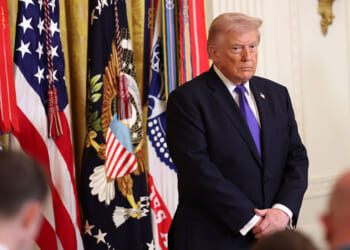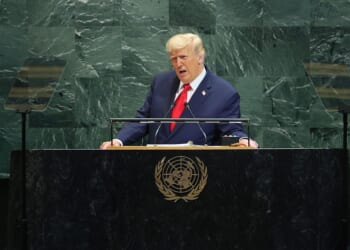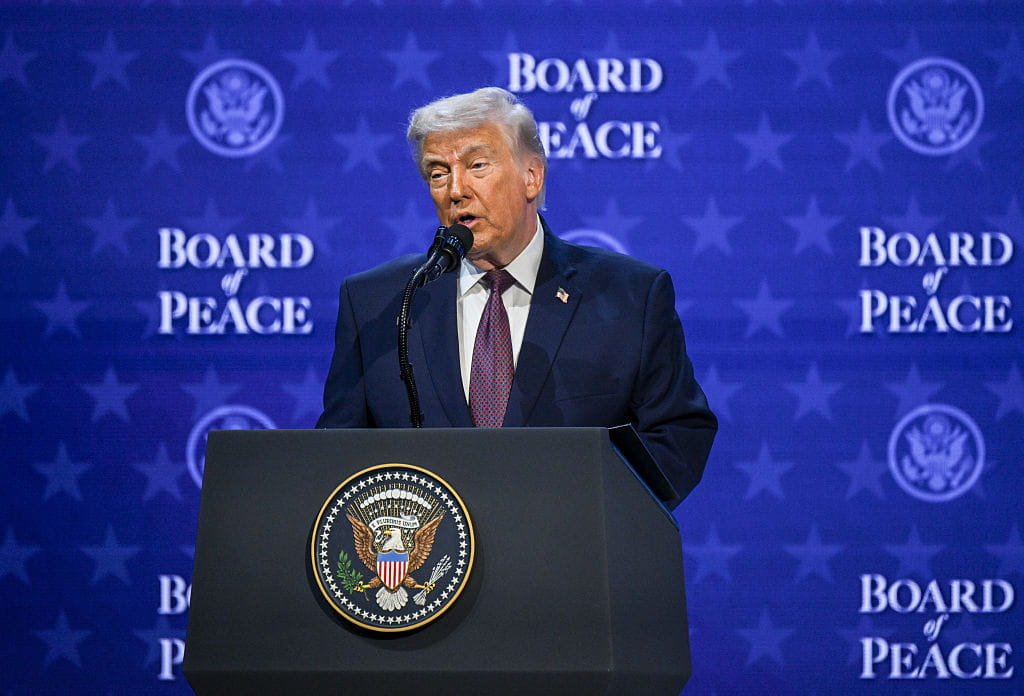
While in Davos, Switzerland, following his speech at the World Economic Forum, President Donald Trump signed the Charter of the Board of Peace. It is a key element in the White House’s 20-point plan, agreed to in October 2025, to end the bloody Gaza conflict.
The plan has three parts. The first was the ceasefire and withdrawal of Israeli forces from parts of Gaza, the return of Hamas-held Israeli hostages, and the beginning of significant deliveries of humanitarian aid. The second phase included the establishment of the Board of Peace and an International Stabilization Force, both of which create effective governance and stability for the Gazans. Long-term reconstruction, deradicalization of the population, and political normalization will constitute phase three.
The Board of Peace Implements the Gaza Peace Plan
On Oct. 13, 2025, the Gaza peace summit, held in the Egyptian resort town of Sharm El-Sheikh, was co-chaired by Egyptian President Abdel Fattah el-Sisi and President Trump. The meeting was attended by more than 20 world leaders, including Palestinian Authority President Mahmoud Abbas. As Liberty Nation News reported, “All confirmed their support for Trump’s peace plan for the Gaza Strip. The signing ceremony formalized the ceasefire between Israel and Hamas, which included the hostages’ release, the Palestinian prisoner exchange, and an opening of corridors for a surge in aid to Gazans.”
The ratification of the charter for the Board of Peace was critical to lasting peace in Gaza, since the document established oversight and international coordination to ensure the peace plan’s execution. This created a sense of hope, in the wake of other efforts that have not been successful. A White House press release described the Davos gathering:
“President Trump, who is serving as the Board’s Chairman, was joined by Founding Members representing countries around the world who have committed to building a secure and prosperous future for Gaza that delivers lasting peace, stability, and opportunity for its people. It’s another pivotal step forward in realizing President Trump’s vision of transforming Gaza from a region plagued by conflict and despair into one defined by opportunity, hope, and vitality.”
As of this writing, the Times of Israel has tallied the number of countries confirming their intention to join the Board of Peace at 26, which includes the United States. Others are Argentina, Albania, Armenia, Azerbaijan, Bahrain, Belarus, Bulgaria, Cambodia, Egypt, Hungary, Indonesia, Israel, Jordan, Kazakhstan, Kosovo, Morocco, Mongolia, Pakistan, Paraguay, Qatar, Saudi Arabia, Turkey, United Arab Emirates, Uzbekistan, and Vietnam. The nations that have rejected joining include “France, Germany, Greece, Italy, Norway, Slovenia, Sweden, United Kingdom and Ukraine,” the Times of Israel reported. Some prominent nations have refused, including China, Russia, and India.
Some Nations Concerned
Some nations were hesitant to formally join out of concern that the organization would broaden its reach to include regions beyond Gaza, thereby supplanting the United Nations remit. Such reluctance should have been assuaged with UN resolution S/RES/2803, which clearly states, “This resolution endorsed the ‘Comprehensive Plan to End the Gaza Conflict,’ welcoming the establishment of a Board of Peace and authorizing the Board of Peace to establish a temporary International Stabilization Force in Gaza.”
The Board of Peace has an executive board, which includes US Secretary of State Marco Rubio, Special Envoy Steve Witkoff, former UK Prime Minister Tony Blair, Trump’s son-in-law and participating architect of the 20-point peace plan Jared Kushner, businessman Mark Rowan, World Bank President Ajay Banga, Deputy National Security Advisor Robert Gabriel, White House Chief of Staff Susan Wiles, and special adviser to the government of the United Arab Emirates Martin Edelman.
It’s not surprising that the organization overseeing the implementation of the Gaza peace plan should resemble a corporate board of directors. Trump is a businessman and knows that to get things done, an agile organization empowered to move quickly and efficiently is needed. The goal is to rapidly establish a secure Gaza by implementing effective governance to ensure it is safe and capable of achieving a future of peace and prosperity.
~
The views expressed are those of the author and not of any other affiliate.