Mexican cartels have begun avoiding direct attacks on Americans in Mexico because President Donald Trump has made clear that violent drug trafficking organizations now face the possibility of U.S. military action. Trump’s harder regional strategy raises the stakes for cartel violence against American citizens and businesses operating south of the border.
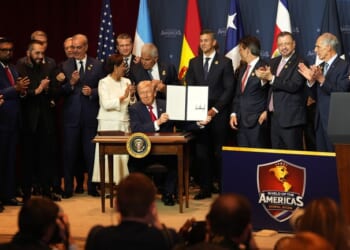
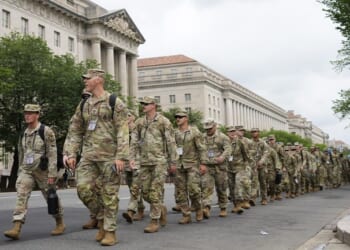
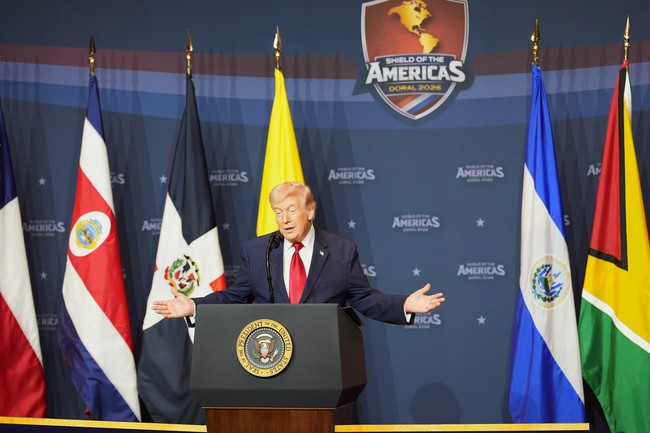
Trump’s intentions were driven home during his remarks at the Shield of the Americas summit in Doral, Fla., where he told regional leaders the United States won’t hesitate to use lethal military force against cartel operations if necessary, specifically stating that missiles and other military tools remain on the table if cartels continue threatening American lives and U.S. national security.
Trump encouraged regional leaders gathered at his Miami-area golf club to take military action against drug trafficking cartels and transnational gangs that he says pose an “unacceptable threat” to the hemisphere’s national security.
“The only way to defeat these enemies is by unleashing the power of our militaries,” Trump said. “We have to use our military. You have to use your military.” Citing the U.S.-led coalition that confronted the Islamic State group in the Middle East, the Republican president said that “we must now do the same thing to eradicate the cartels at home.”
Trump’s approach already appears to be changing cartel behavior. Analysts studying organized crime in Mexico have noted that several cartel groups now warn members to avoid incidents involving American citizens that could provoke a direct U.S. response. Robbery, fraud, and extortion still occur in some areas, but cartel leadership understands that harming Americans carries new consequences under Trump’s strategy.
We’ve come a long way from a mashed potato president warning Russia about invading Ukraine using one word: “Don’t.”
The cartel shifts follow a major decision made by the Trump administration a year ago, in February, when the U.S. government designated six major Mexican drug cartels as Foreign Terrorist Organizations, a designation that allows the United States to use stronger counterterrorism laws to target cartel finances, international operations, and logistical networks that support drug trafficking across the hemisphere.
The designation dramatically increased legal exposure for companies and financial institutions that unknowingly work with organizations linked to cartels. Businesses operating in Mexico now face expanded compliance requirements designed to prevent any financial connection to groups identified under U.S. terrorism law.
With the summit, Trump aimed to turn attention to the Western Hemisphere, at least for a moment. He has pledged to reassert U.S. dominance in the region and push back on what he sees as years of Chinese economic encroachment in America’s backyard.
Trump also said the U.S. will turn its attention to Cuba after the war with Iran and suggested his administration would cut a deal with Havana, underscoring Washington’s increasingly aggressive stance against the island’s communist leadership. “Great change will soon be coming to Cuba,” he said, adding that “they’re very much at the end of the line.”
Cuban officials have said on several occasions that they were open to dialogue with the U.S. as long as it was based on respect for Cuban sovereignty, but they have never confirmed that such talks were taking place.
Multinational companies have strengthened internal training programs to reduce the risk of transactions tied to cartel money laundering or trafficking networks.
Mexico’s government has cautiously responded to the administration’s rhetoric. Mexican President Claudia Sheinbaum said that Mexico will cooperate with the United States in fighting organized crime, but rejected the idea of unilateral U.S. military operations on Mexican soil.
Sheinbaum emphasized that cooperation between the two countries must respect Mexico’s sovereignty and existing bilateral security agreements.
Trump’s national security team continues pressing for stronger regional action. Secretary of War Pete Hegseth has urged Latin American governments to move aggressively against cartel infrastructure, including laboratories, trafficking corridors, and leadership networks. Hegseth warned that the United States may act independently if regional partners fail to dismantle criminal organizations responsible for narcotics trafficking and violence.
White House Deputy Chief of Staff Stephen Miller has also delivered blunt warnings about cartel activity, describing the organizations as security threats comparable to extremist groups operating in other parts of the world.
@cbsnews Deputy White House Chief of Staff Stephen Miller told U.S. Southern Command military leaders that the cartels “can only be defeated with military power,” comparing them to terrorist groups like Al-Qaeda and ISIS. “The cartels that operate in this hemisphere are the ISIS and the Al-Qaeda of the Western Hemisphere, and should be treated just as brutally and just as ruthlessly as we treat those organizations,” Miller said. “We have learned after decades of effort, is that there is not a criminal justice solution to the cartel problem.” #cartel #us #military #miller #war ♬ original sound – cbsnews
Miller argued that cartel violence destabilizes entire regions and drives illegal migration, making the problem far larger than traditional criminal activity.
The administration has already begun shifting military resources to support the strategy. Trump authorized expanded naval deployments to target maritime trafficking routes that move drugs through the Caribbean and eastern Pacific. U.S. Navy and Coast Guard assets now operate with broader authority to intercept vessels suspected of carrying narcotics destined for the United States.
Of course, the left and their PR firms, the MSM, are warning that military strikes inside Mexico could trigger diplomatic tensions and create friction between Washington and Latin American governments wary of foreign intervention. What they’re ignoring is the broad support Trump’s initiatives have received, while supporters counter that decades of law enforcement cooperation have failed to dismantle cartel networks that generate billions of dollars through narcotics trafficking and human smuggling.
Cartel leadership appears to recognize that the strategic environment has changed. Organizations that once operated with little fear of American retaliation now face the possibility of military pressure if their violence crosses certain lines.
That caution suggests Trump’s warnings are landing exactly where they’re intended.
Want more reporting that cuts through political spin and digs into the forces shaping national security and immigration policy? Join PJ Media VIP today. Use promo code FIGHT and receive 60% off a membership that supports independent journalism and unlocks exclusive analysis.