Given how rare it’s been for pro-Gaza activists to face consequences for their lawbreaking, it makes headlines when it actually happens.
So I was relieved to see that a British woman who repeatedly stole parts of a memorial to an Israeli hostage was convicted, with the judge explaining to her that theft isn’t “free speech.” At the same time, I worry that we are lowering our expectations for society by taking satisfaction in the occasional slap on the wrist for a violent organized hate movement that has made a mockery of both the U.S. and British legal systems.
As Heidi Bachram, an organizer of the memorial, told the press following the verdict: “This crime was one out of 50 times the memorial was vandalized and it took two years to get justice. But it is possible to get a win.”
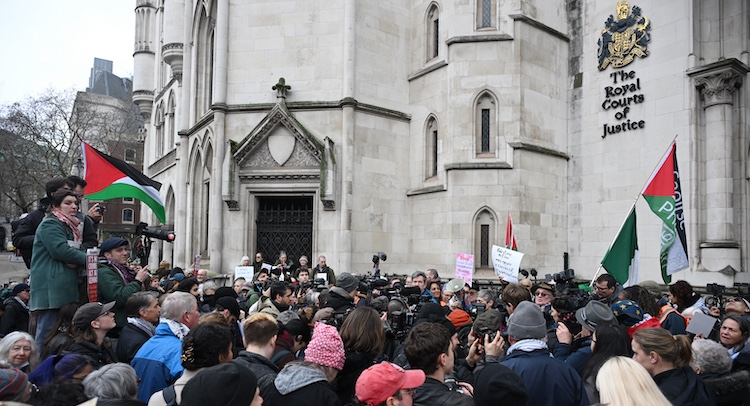
Meanwhile, the Crown Prosecution Service will take another shot at getting a conviction against six Palestine Action activists who were found not guilty despite telling the jury that they broke into an Israeli-owned factory and damaged equipment, and one of them was caught on video smashing the spine of a police officer with a sledgehammer when her back was turned. The jury, as I wrote at the time, appeared to be convinced that they can acquit if they approve of what motivated the crime.
Although the defendants were acquitted of some of the charges, the jury failed to reach a verdict on the others. It is on those charges that the six members of Palestine Action, which was proscribed as a terrorist organization last year (a designation that has just been overruled by a judge, though it remains in force for now), will be tried.
A lot is riding on the case. Were the prosecution to fail again, it would only reinforce the idea that one may commit acts of violence so long as one claims to be doing it “for Palestine.” Which is to say, Jew-hatred becomes a legitimate legal defense. Britain would be transformed into an illiberal democracy almost overnight.
The significance of the Palestine Action case, in fact, threatens to obscure the importance of the fight over the hostage posters. But the hostage posters arguably represent the problem at the root of all this activism.
The Palestine Action non-convictions were made possible by a campaign for what activists called “jury equity.” The defendants’ own lawyer argued that they should be treated like suffragettes, not criminals. But how does a society—in a democratic country, with a free press—come to embrace that idea widely enough to nullify the law? And to apply it only when the motivating factor is Jew-hatred?
To answer that, we only have to listen to the people who tear down hostage posters. In the case cited above, here’s how the defendant, Fiona Monro, explained her destructive actions:
“The board was clearly there to justify the genocide that was happening. A large laminated board with a photograph of a hostage was highly inflammatory to many people in that community clearly found it very upsetting to have that constantly thrust in our face daily.”
This is genuinely insane. The central claim of hers is that “a photograph of a hostage was highly inflammatory” and that people understandably “found it very upsetting.”
It is a picture of a Jewish person who was kidnapped during a pogrom and then murdered by his kidnappers.
You cannot get to the Palestine Action acquittals until your society produces enough people like Fiona Monro and those she claims to represent.
The people who tear down hostage posters represent a genuine threat to the functioning of a free society. They are an indication that the virus of anti-Semitism has metastasized to the point at which self-government becomes imperiled. As Britain is the first to belatedly realize.