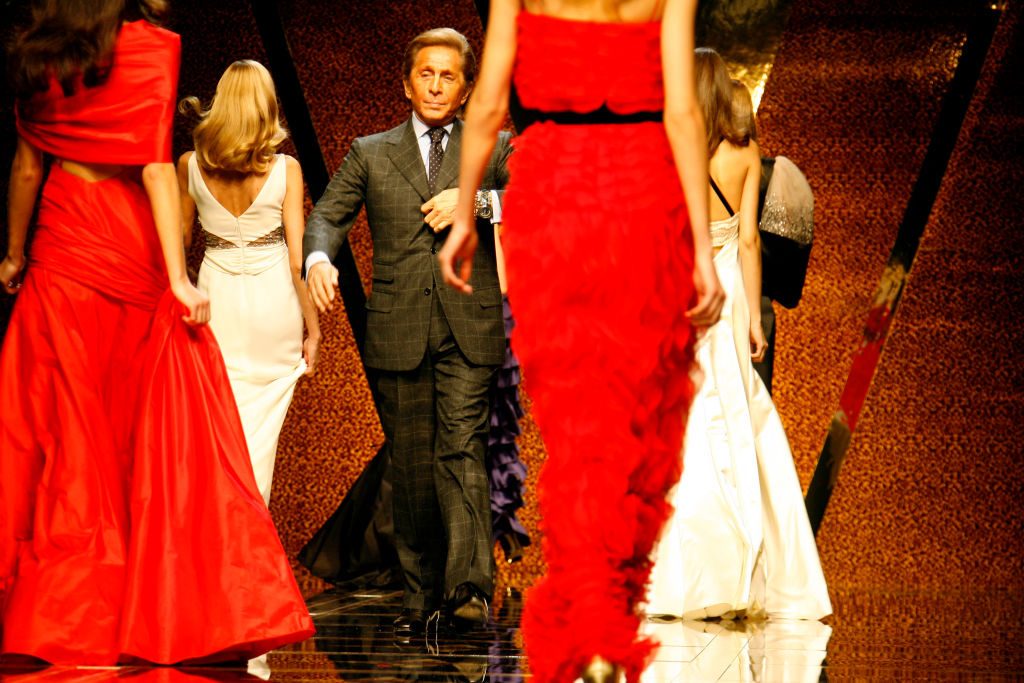
The death of designer Valentino Garavani this week at age 93 should inspire us to rethink our relationship to beauty, to rebel against the current aesthetic regime and its rulers — the moralisers and uglifiers — who killed Valentino long before he was dead.
The loss of any profound sensibility — whether in fashion, philosophy, physics, film, literature, politics, music, or engineering — is cause to think about its absence and its impact. Valentino’s passing shows us that high fashion has become a feckless and heartless enterprise, afraid of the poetry of universal forms, and, in particular, of the masculine appraisal of the female form and of the synergistic relationship between the male eye and the feminine as a civilisation-enhancing ideal.
What Valentino stood for — what his work manifested — was the apprehension of beauty, rather than the presentation of an ideology. His reign from the Sixties through the late Eighties, and his decline through the Nineties and aughts, almost perfectly tracks the radical aesthetic break after 1989, when a confident, gendered view of both men’s and women’s fashion gave way to the shiftless, formless, deconstructed grunge aesthetic that has, in one form or another, predominated for the last 30 years.
At the street level, the apotheosis of this drab, ideologised style are the hideously baggy women’s sweatpants and jeans that have come to prevail in the post-#MeToo era: low-rise or otherwise garishly revealing — but, crucially, without celebrating the female form.
Valentino’s gift — visible in dresses for stars from Elizabeth Taylor to Julia Roberts, and most radiantly evident in the dresses he made for Jacqueline Kennedy Onassis — was for framing his subjects in a way that enhanced their elegance without reduction to plainness or over-simplicity. The essence of a Valentino dress might be summarised as decorated elegance, the suggestion that there could be more, that there is more, that the designer could have done. Valentino’s dresses hover at the edge of restraint, just over the line of good taste.
To borrow from the philosopher Peter Sloterdijk, Valentino’s dresses were some of the last miracles of a European tradition that risked, aspired to, and was drawn toward transcendence (or what Sloterdijk calls “verticality”). Valentino never fell from grace or respect in the fashion world; rather, the civilisation that he designed for ceased to exist.
The fall of the Soviet Union, especially, freed the West from the reliance on tradition that it formerly used to draw a clear contrast between itself and a revolutionary utopian enemy. During the jaded ’90s, fashion was flattened and became “horizontal.” The red carpet, which represents what a culture wants to see about itself, lost interest in the female form as a miracle and final flower of civilisation, and Valentino’s very Catholic vision of beauty, which was not open to deconstruction and moral nagging, fell out of fashion.
To borrow another key idea from Sloterdijk, fashion over the last 30 years, and especially in the last decade, seems to have become more and more armoured, as if clothes were an immune response to a chaotic and dangerous world. Celebrity fashion’s strategic shift toward the ugly, oversized, and ironic might be described as so many inoculations against judgment — protection against any accusation that the wearer might be secretly allied to the old, pre-social justice cult of sumptuousness epitomised by house Valentino in its heyday.
Valentino’s death this week coincides strangely with the eruption of public drama between Brooklyn Beckham and his family — in particular his mother, Victoria, the pop singer-turned-fashion designer whose minimalist, wearable brand, which is clean, neutral, and risk-free, embodies the very horizontality that Valentino must have abhorred. The strange thing about the intra-Beckham spat, however, is that it seemingly began with the choice of Brooklyn’s betrothed Nicola to wear Valentino, rather than Victoria Beckham, at the couple’s 2022 wedding. The younger Beckhams didn’t just reject their aesthetic matrilineage; they embraced something like an aesthetic nostalgia, a desire for a fashion absolute.
“Valentino’s gift … was for framing his subjects in a way that enhanced their elegance without reduction to plainness or over-simplicity.”
And yet the Beckham family beef, which has played out on Instagram, also demonstrates that nostalgia for the vertical, Catholic sense of beauty has no chance of reaching escape velocity. It will be dogged and enchained by the puerility and ugliness of social media culture and, by extension, a celebrity culture that has lost all connection with iconography and ritual.
If the women that Valentino dressed in the Sixties, Seventies, and Eighties stood for aspiration toward a distant and beautiful absolute, then the celebrities who will undoubtedly line up to wear vintage Valentino in the coming weeks and months will stand for nothing other than the lust for clicks and attention. Jackie Kennedy, dressed in Valentino in the Sixties, could only be glimpsed by the public in snapshots that still contained a sense of scarcity, yearning, and symbolism. Images of celebrities on red carpets today are subject to endless recirculation, meme-ing, commentary, and now AI recreation and modification. If you don’t like how a celebrity is dressed on the red carpet, you can use AI to realistically redress or undress them, destroying any vestigial sense of the sacred, and degrading yourself in the bargain.
The coincidence of Valentino’s death with Brooklyn Beckham’s break from House Beckham, in the context of our menacingly tasteless algorithmic era, suggests that a rebirth of Valentino’s aesthetic spirit will not, ironically, have much to do with celebrities or celebrity culture. Valentino’s greatest designs came about during an era of analogue media, before imagery overload became too profound. My guess is that the designer working in Valentino’s mode — with an eye toward the splendour of the human form, the splendour of clothes, and the union of the two — must serve private audiences away from cameras and screens. He must seek after the limited eternity of private memory, not terabytes. Fashion in the future, ironically, might resemble the anonymous design of the pre-celebrity, premodern era: it will be for aristocrats and salons removed from public consumption and opinion.
“I love beauty. It’s not my fault,” Valentino said in 2008. It was not a fault, but a virtue, and his legacy will long endure for it.