Americans must look to the principles of nature and eternal reason.
What is it, according to Francis Fukuyama, “for which we should be willing to struggle and die today,” and how does history—Western civilization—inform our answer to this permanent question?
Fukuyama thinks history has bequeathed us liberal “values” sufficient for the purpose. Spencer Klavan thinks history has quite a bit more to offer. Fukuyama has made a career out of the “end of history.” Klavan points the way to careers for young Americans in the continuation and making of history. He thinks the 250th anniversary of American independence is a good time for Americans to reflect on how Western civilization has always informed our answer to this question and continues to do so.
Nothing could be more edifying for Americans than a true and sufficient answer to the unsettling question of what they should be willing to fight and die for. Klavan thinks that if Americans are to be properly edified, they will “need to recover a sense of their country as an era-defining project, forward-looking but steeped in ancient traditions of faith and law—not just a Western nation, but the Western nation par excellence.” Here, to quote Walter Berns, I will hope to do “nothing but edify.” Berns gave that phrase currency among small circles back in the early 1980s, accusing Harry Jaffa of misunderstanding Leo Strauss when Jaffa claimed Strauss thought philosophy, or even political philosophy, might have some place in saving Western civilization—and America.
Klavan cites John Quincy Adams as an instructive example of how to think about America and its relation to history. In his remarkable 60-year career in American politics, foreign and domestic, Adams took his bearings from the principles of the Declaration of Independence. These principles, he held, express “the only legitimate foundation of civil government.” And—here Adams might sound like Francis Fukuyama—he thought governments based on these principles were “destined to cover the surface of the globe.” Adams, however, was not thinking of Hegel’s historical dialectic. He was thinking of God’s providence. If America stays true to its principles, then fulfilling its providential role, America “must for ever stand, alone, a beacon on the summit of the mountain, to which all the inhabitants of the earth may turn their eyes for a genial and saving light till time shall be lost in eternity.”
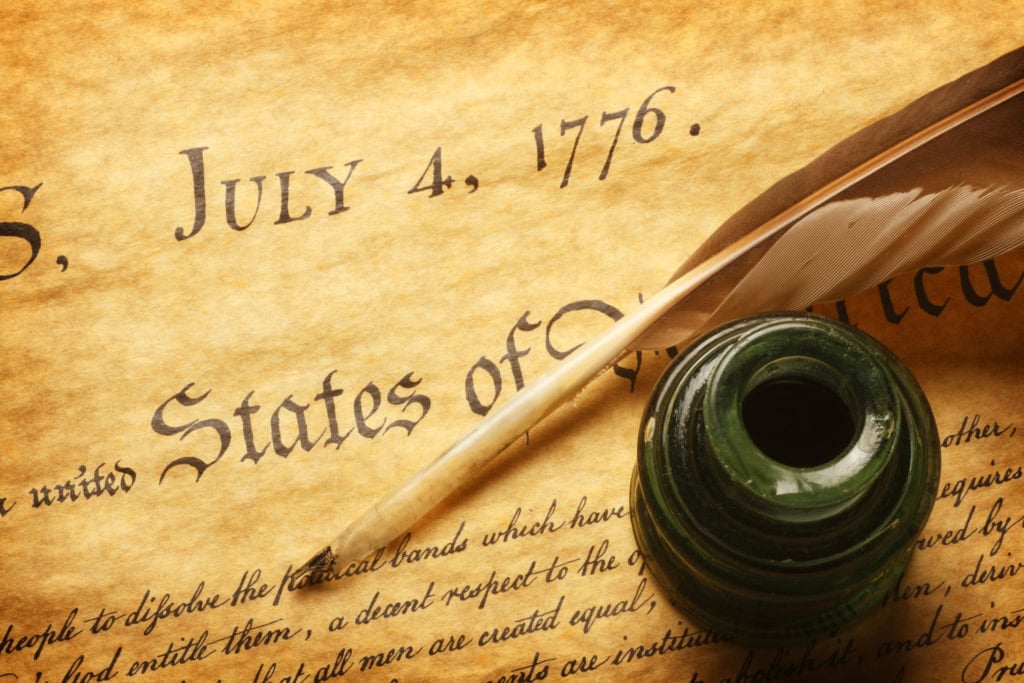
What are the principles of the Declaration of Independence that define America’s providential role in history? They are still familiar to all Americans: that all men are created equal; that they are endowed with certain unalienable rights, including life, liberty, and the pursuit of happiness; that government is instituted to secure these rights; that the just powers of government are derived from the consent of the governed; that when a government violates these rights, it is the right and duty of the people, guided by prudence, to alter and abolish the government and create a new one that better serves the purpose.
A nation governed by and faithful to these principles would present, as the American revolutionaries said, a “new order of the ages.” Klavan shows how the ancient Roman poet Virgil can still teach us how to understand that memorable American (Virgilian) phrase. In the same spirit, the American revolutionaries spoke of the ancient wisdom given new life in the New World.
Sources of The American Mind
Thomas Jefferson died on the Fourth of July, 1826, 50 years to the day after the proclamation of American independence. John Adams died on the same day. John Quincy Adams always thought that remarkable historical coincidence was a sign of divine favor. A little more than a year before he died, Jefferson wrote a letter that would become famous as an expression of the ancient leaven in the American new order of the ages. Jefferson wrote that the Declaration was meant “not to find out new principles, or new arguments, never before thought of,” but to be an expression of “the American mind” as formed by “the elementary books of public right, as Aristotle, Cicero, Locke, Sidney,” among other things.
John Adams, who was with Jefferson on the committee that drafted the Declaration of Independence, called the principles of the Declaration “revolution principles.” Adams characteristically offered a more inclusive list than Jefferson as to the sources of these revolution principles: “They are the principles of Aristotle and Plato, of Livy and Cicero, of Sydney, Harrington and Lock.—The principles of nature and eternal reason.”
Jefferson and Adams did not speak of liberal “values” pinched by the historical dialectic out of the great minds and deeds of antiquity and modernity to provide us answers to our most consequential questions. They spoke of principles of nature and eternal reason, accessible to the ancients no less—or even more—than to the moderns, and available to us in their fullness if we will consult them. In trying to replace the principles of natural right and reason as they informed the American Revolution with the “values” of history, Fukuyama contributes not to the fulfillment of Western civilization but to its crisis.
Twin Peaks
Benjamin Franklin, more than any other founder, became a model for future Americans. When devising a personal plan for moral perfection, he concluded that for humility, he should imitate Socrates and Jesus. His example invites all generations of Americans, to the best of their ability, to be guided by Athens and Jerusalem—the fonts of Western civilization—in their fullness.
A half century after Tocqueville’s famous visit to America, a less well-known German traveler, visiting isolated cabins in America’s “far west,” confirmed Tocqueville’s observations. From what he found on the primitive bookshelves of these cabins, he concluded, “There is, assuredly, no country on the face of this earth in which Shakespeare and the Bible are held in such high esteem as in America.” Of course, visiting an English department—or a school of theology!—in any prestigious American university these days, no one would draw such a conclusion. But I join Spencer Klavan in believing that this need not be so. History has not ordained it.
How should our hearts, minds, and souls be disposed toward the principles of America’s revolution as we approach its 250th anniversary? Again, John Quincy Adams offers a good example. On April 30, 1839, the 50th anniversary of George Washington’s inauguration as president of the United States, Adams spoke to the New York Historical Society about the significance of the occasion.
As with all his great speeches, Adams spoke to his immediate audience and to posterity. He wanted to take the opportunity to present “in bold relief” this great “epocha” in American history, which marked the providential fulfillment of the Declaration of Independence in the Constitution. The speech—“The Jubilee of the Constitution”—concludes with a description of the place of the Declaration in American and providential history.
Adams tells the biblical story of the children of Israel’s entry into the Promised Land, and says, “Fellow citizens, the Ark of your covenant is the Declaration of Independence.” All of our blessings, he tells us, will come from adhering to the principles of the Declaration; all of our curses will come from departing from these principles.
Lay up these principles, then, in your hearts, and in your souls—bind them for signs upon your hands, that they may be as frontlets between your eyes—teach them to your children, speaking of them when sitting in your houses, when walking by the way, when lying down and when rising up—write them upon the doorplates of your houses, and upon your gates—cling to them as to the issues of life—adhere to them as to the cords of your eternal salvation. So may your children’s children at the next return of this day of jubilee…celebrate it again in the full enjoyment of all the blessings recognised by you in the commemoration of this day, and of all the blessings promised to the children of Israel upon Mount Gerizim, as the reward of obedience to the law of God.
On his fateful way to assume the presidency of the United States, Abraham Lincoln stopped in Philadelphia and made a short, emotional speech in Independence Hall, where the Declaration of Independence had been signed. It happened to be George Washington’s birthday, February 22, 1861. Lincoln said that
all the political sentiments I entertain have been drawn, so far as I have been able to draw them, from the sentiments which originated and were given to the world from this hall. I have never had a feeling politically that did not spring from the sentiments embodied in the Declaration of Independence.
He spoke especially of
that sentiment in the Declaration of Independence which gave liberty, not alone to the people of this country, but, I hope, to the world, for all future time. It was that which gave promise that in due time the weight would be lifted from the shoulders of all men. This is the sentiment embodied in that Declaration of Independence….. [I]f this country cannot be saved without giving up that principle—I was about to say I would rather be assassinated on this spot than to surrender it.”
Francis Fukuyama will not be of much help to Americans asking serious questions. But Jefferson, Adams, Franklin, John Quincy Adams, Abraham Lincoln, and Spencer Klavan are good guides on how Americans can begin to take the opportunity of the 250th anniversary of American independence to give a new birth of freedom to America and to Western civilization.
Coincidentally, or providentially, Klavan has reviewed The Golden Thread: A History of the Western Tradition, by James Hankins and Allen Guelzo and published by Encounter Books, for the latest issue of the Claremont Review of Books. As Kathleen O’Toole says, “[I]t is the definitive textbook for high school Western Civ and world history.” The writing of the book, its publication, and what Hillsdale College is doing with it are splendid and inspiring examples of what Spencer Klavan is calling for.