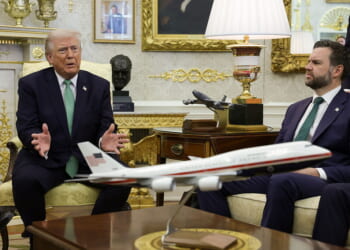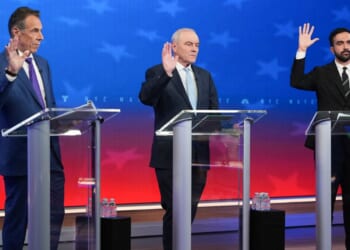
As terrible as Donald Trump’s war is, you wouldn’t know it from America. Outside the political obsessives on Twitter or BlueSky, people here simply aren’t preoccupied about the blackouts and bombings — certainly not compared to previous foreign adventures. Forget the Gulf War or even Vietnam. When George Bush launched his so-called “shock and awe” campaign against Iraq less than a quarter of a century ago, it was gripping, must-watch TV. That’s just not the case now, with many Americans seemingly more exercised by The Bachelorette. Yet this passive, numbing acceptance of an illegal and dangerous foreign war is about more than the triumph of celebrity nonsense.
A week before the Iraq War began, in the middle of the night, I got on a filthy, retired Greyhound bus commandeered by unreformed communists. Together we went to an anti-war protest on the Washington Mall. Roughly 50,000 people showed up. In the days before smartphones, it was easy for mainstream media outlets to downplay resistance to the war, or indeed pretend it didn’t exist. Many supported the Iraq War, but just as many did not. Either way, back in those lost pre-smartphone days, the country argued, protested, debated heavily and often. Many politicians and journalists embarrassed themselves repeating Bush propaganda. For good and for ill, talk about the war was everywhere, and that’s just not the case now.
Now, though, American politics now operates in a post-kayfabe era. In the sweaty, steroid-filled world of professional wrestling, “kayfabe” refers to the meticulously maintained illusion that everything in the ring is real: the melodramatic rivalries, the improbable alliances, the blood feuds. Up until the late Nineties, wrestling promoters protected this illusion because they believed the entire spectacle would crumble if the audience understood that the whole thing was choreographed. But as the new millennium dawned, rising public cynicism meant wrestling bosses stopped trying to hide the truth: and instead asked the audience to just embrace the ludicrous nature of the spectacle.
Something similar has happened in American politics under Trump — yet unlike what liberal politicians and commentators seem to believe, the fall of American kayfabe was inevitable. Trump was merely the conduit for obscene forces already at work within American institutions. The Iraq War, in many ways, was the last great performance of American political kayfabe. For anyone paying attention, the pretexts for the war in Iraq were comical — but at least people were paying attention. More than that, the government still felt obligated to construct a coherent narrative for war, the media still treated political messaging as something that needed to be defended, and the public still believed that exposing lies might actually change policy. The performance had not yet collapsed; the audience was still expected to believe the show was real.
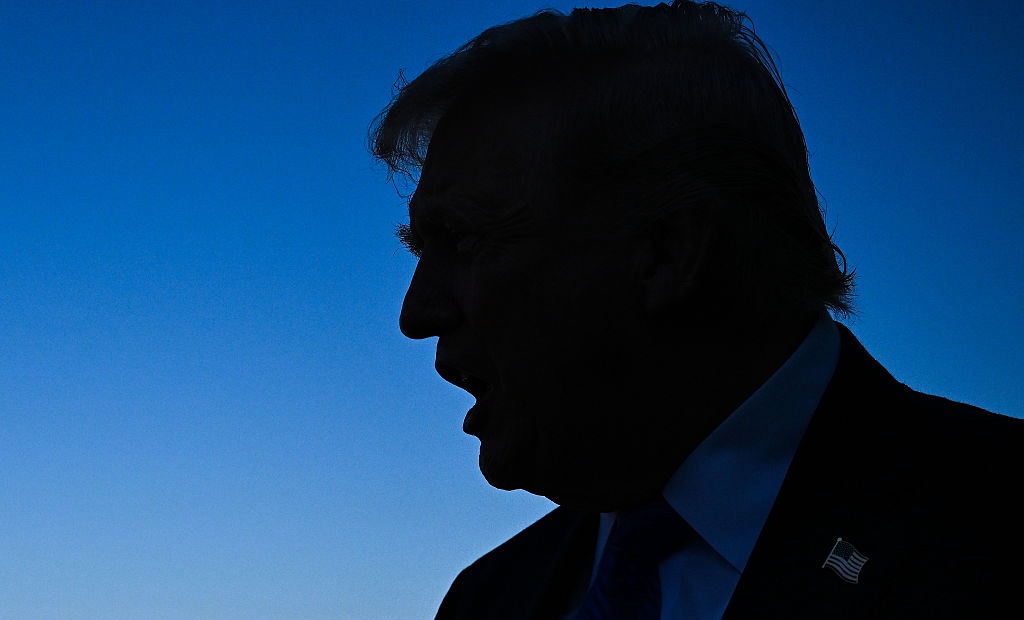
In the post-liberal, post-kayfabe era of American politics, not only is the public too preoccupied with the latest happenings in their social media algorithms, nearly everyone has given up on the idea that American politics is anything other than the theater of the absurd. No one embodies that oeuvre better than Donald Trump himself. From his Dadaesque speeches to his frat-boy mannerisms, nearly everything about Trump is larger than life, beyond belief, and too much to bear. The President is the very definition of “over the top” — the living, breathing singularity of absurdity. The gravity of Trump’s supreme ridiculousness pulls nearly everything and everyone into its orbit, then down into a dark psychic funnel of confusion where we must constantly ask ourselves, “Wait, did he really say that?” “Is he doing what I think he’s doing?” “This man is our President — is it all a joke?”
It’s tempting, of course, to compare all this with previous debacles. Wasn’t Dubya a joke too? Well, it’s true that the Iran War, Iraq, and even Vietnam feel similar in their dubious justifications and blood-stained pointlessness. Nonetheless, the trajectory of this latest war continues to evolve along its own absurd imperial logic. Unlike with Lyndon Johnson, after all, no longer does the American president seem to care if the public deeply opposes the war, nor even if the Wilsonian pretense of “making the world safe for democracy” is even halfway believable. Trump simply proceeds as if his own population’s reservations didn’t exist, unabashedly pursuing not national self-interest but something closer to an nth-generation copy of “national self-interest” distorted through a childhood game of telephone.
Don’t believe me? Just compare Condoleezza Rice’s justification of the Iraq War:
The Iraqis are building weapons of mass destruction, we don’t want the smoking gun to be a mushroom cloud — pass it on.
To Trump’s meanderings on Iran:
We are in the “final moments” to prevent Iran from getting a nukes… Not good… Not good.
So while it’s tempting to laugh, everything about the Trump era has been characterized not by comedy, but what late-stage Soviet anthropologist Alex Yurchak called “hypernormalisation”, a concept made famous by Adam Curtis in his 2016 film of the same name. Little could have been more prescient than Curtis seizing on this idea right before Trump took office.
“Hypernormalisation” describes the idea that during the later stages of a dying empire, politics becomes defined by bureaucratic ritualism, ideological decay, and surreal, performative politics. All the elites inside the Soviet Union knew that the leadership was lying. Eventually, by the early to mid-Eighties, Soviet citizens did too. The fraud of the whole system was obvious and undeniable. But nearly everyone went along with the charade anyway, because there was simply nothing else to be done. My fellow Americans: we are here. We know the language is fake, the justifications are recycled, and the outcomes are predictable, yet the machinery continues anyway.
Who, besides the most MAGA diehards, believe that the war in Iran is necessary, much less worth its absurd economic consequences? Whether it’s the price of gas at the pump, the inflation of everyday goods, or the possibility of food shortages due to the absence of necessary fertilizers, all of these downstream effects of the war in Iran are likely to be more economically consequential than anything that ever occurred because of Vietnam or Iraq. Yet Americans still can barely look up from their hand-held gambling apps and TikTok feeds to muster concern. Even as its consequences become intimate, the war feels distant and immovable.
A majority of Americans disapprove of the war in Iran. An even greater majority want the war to end quickly. Only 25% approved of the initial air strikes that launched the war in the first place. Practically speaking, no one other than true-believer followers of Trump and Netanyahu wants what’s currently happening. Unfortunately Trump’s constant breaking of every norm of political etiquette over the last decade has so turned up the dial that Americans — and everyone on Earth — have been lulled into accepting it as normal.
Certainly, we all seem completely uninterested in trying to mobilize any kind of serious opposition. In the early days of Trump’s ascendancy, the Democrats and their legions of legacy-media allies jumped the gun so many times trying to portray Trump as a “fascist” and a “threat to democracy” — long before anything substantial actually took place — that we’ve all become numb to the grotesquely out-of-control actions now actually happening inside Trump’s White House. On Monday, according to the Financial Times, over $580 million in financial bets were made on the oil futures just 15 minutes before the President’s announcement of supposedly “productive conversations” with Iran.
Whether it was someone in the Trump family or their friends or confidantes, whoever made these futures trades likely made out with more than $1 billion in profit. All this insider-trading corruption surrounding the White House has followed a distinct pattern throughout Trump’s second administration, including polymarket bets made prior to the conflict in Venezuela. While nearly every American I know is financially struggling, our political insiders extract generational wealth by gambling on events they control from start to finish.
In “normal” times — when the country wasn’t at war, facing mass job losses, or runaway inflation — these corruption scandals, which are worse than anything that happened under Nixon, would dominate the discourse. But Democrats and their media allies conducted perhaps the greatest “Boy Who Cried Wolf” campaign in modern Western politics. Long before Trump took office, they declared him an existential threat in the most alarmist terms possible. After a while, everyone stopped listening, which only contributed to our current hypernormalisation. Everything is always the “end of democracy” — and so nothing ever is.
Six months ago, when Pete Hegseth pushed for the Department of Defense to change its name back to the Department of War, it seemed little more than a perverse stunt. But, in fact, it couldn’t fit better with our new post-liberal, post-kayfabe reality. Just seven months later, Trump and Hegseth launched the most aggressive and unpopular war in the nation’s history and yet few Americans believe there’s anything to be done about it. That’s hypernormalization working its magic. The spectacle becomes so overwhelming, so frenzied, so totalizing, that you stop seeing it as a performance and start forgetting there was ever anything else.
The dystopia of the Iran war, then, is not that it began on illegal grounds, or that the justification for it barely makes any sense, or even that most Americans oppose it. Its dystopia lies in that none of this seems to matter. The machinery of the American empire now runs independent of public opinion, political norms, or even coherent rhetoric. Maybe Trump will “TACO” and wrap up the conflict in the next few weeks. Or maybe, to cover up his failure to anticipate the difficulties of the war, Trump will be the first head of state to drop a nuclear weapon post-Nagasaki. Who knows.
In 21st-century America, our wars begin, they spur corporate profiteering, and then presidential cronies suck billions out of our economic system placing bets on events only they can accurately anticipate. Everyone knows all this is happening, but the response is not outrage or protest — it’s total resignation. This is what hypernormalization looks like in practice. A society that knows what is happening, knows it is absurd, knows it cannot last, and yet continues behaving as if everything is perfectly normal. But, hey, maybe there’s something good on Paramount plus. I hear they’re merging with HBO Max, that might be alright… or unimaginably terrible. Who knows.
a.appcomments {
background: #FFF;
border: 1px solid #446c76 !important;
font-family: benton-sans,sans-serif;
font-weight: 600;
font-style: normal;
font-size: 12px;
color: #446c76 !important;
padding: 12px 50px;
text-transform: uppercase;
letter-spacing: 1.5px;
text-decoration: none;
width: 100%;
display: block;
text-align: center !important;
}