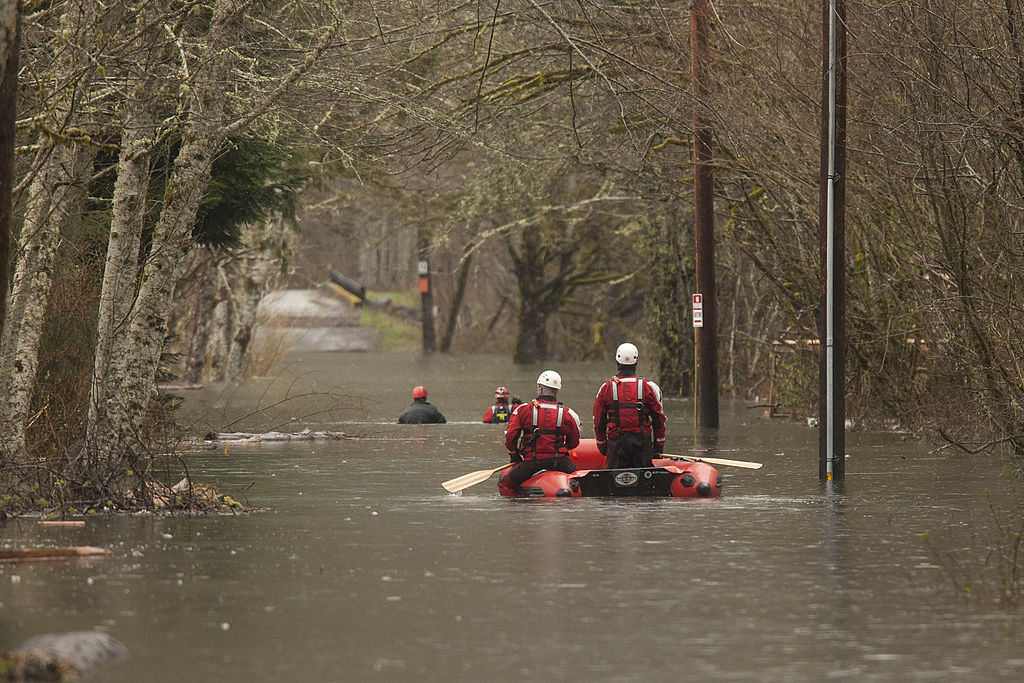
In December, the state of Washington has been literally up to its ankles – and in many places its rooftops and bridges – in water. Atmospheric rivers have battered the region for weeks, dumping historic amounts of rain, pushing rivers over their banks, swallowing highways, and turning neighborhoods into ad-hoc lakes that no one asked for. This should be the kind of story that dominates national headlines for days at a time, complete with on-the-ground reporting, dramatic water rescues on cable news, and satellite images showing swollen river basins. Instead, the national media’s attention has drifted elsewhere, leaving residents with the sinking feeling that half the country doesn’t even realize Washington is flooding at all. And while state leaders talk plenty about climate resilience, the way they have actually spent billions in climate money tells a very different story.
Flooding in the Evergreen State
The flooding itself has been severe enough that even long-time Washingtonians, who are used to getting soaked nine months out of the year, are stunned by the scale of the damage. A report from The Weather Channel described how “days of heavy rain from a strong atmospheric river triggered major flooding in western Washington state that topped all-time record crests in some areas.”
As the storms kept coming, rivers swelled far beyond their banks. More than 600 rescues were conducted across ten counties after nearly two feet of rain fell in parts of the Cascade Mountains, with at least one flood-related death and widespread power outages. Levees failed, neighborhoods and mobile home parks were swallowed up, businesses were flooded, thousands of people were evacuated, and still the rain continues to fall.
For all the destruction, the coverage by national outlets has been surprisingly thin. Most stories that do appear frame the events as generic “winter storms” rather than a statewide crisis that has destroyed homes, blocked major highways like State Route 2, and left entire towns temporarily unreachable. People searching for detailed reporting on national networks often find nothing but brief weather blurbs. It’s as if the wider media landscape has collectively decided that Washington is simply too rainy to take seriously, even when the region is fighting its worst flooding in recent memory.
The Washington Policy Center has noticed this disconnect as well, publishing an analysis highlighting how little attention the floods have received despite their severity. The report points out that when The Seattle Times did mention flooding within a climate-change context, the discussion was superficial and lacked the depth one might expect when thousands of residents were being forced from their homes.
By December 17, Governor Bob Ferguson finally addressed the scope of the disaster. He explained that “the damage is profound” and warned that a full assessment would take months due to ongoing mudslide risks, damaged roads, and inaccessible communities.
Climate Change – Where’s the Money?
Part of the broader conversation around these floods is the role of climate change and, crucially, how Washington has chosen to use its climate dollars. The Climate Commitment Act (CCA), which created a carbon-credit auction program beginning in 2023, has generated more than $4 billion. On paper, that sounds like a lot of climate muscle. But when analysts dug into how much of that mountain of cash was actually used for flood mitigation, the number was closer to a rounding error.
“When the Climate Commitment Act passed – in the very first paragraph, they were talking about why we need to have this CO2 tax – and it specifically mentions flooding,” Todd Myers, vice president for research at the free-market Washington Policy Center think tank, told The Center Square. “Flooding is one of the things you hear all the time, and flooding is going to get worse because of climate change. There is some merit to that as warmer air holds more water, so there’s going to be more moisture, more rain, and so obviously the potential for more floods.” He went on, asking: “Since we’re blaming these floods on climate change, did we use the money to fight climate change, to prevent flooding?”
“Out of that $1.5 billion, just over $7 million was spent – which is about one half of 1% [on flood mitigation]. I looked at some other things that we spent more on during the first two years, and we actually spent more than double that, $15 million for bicycle education programs for elementary and middle school students,” Myers explained.
In other words, while leaders regularly point to flooding as a prime example of why Washington needs aggressive climate policy, the checkbook tells another story.
Flooding is one of the most predictable and costly natural threats in Washington, and scientists have repeatedly warned that atmospheric rivers will grow more intense as the climate warms. These storms hold more moisture now, meaning they can dump extraordinary amounts of rain in very short bursts. Yet Washington’s climate-spending choices suggest that long-term infrastructure upgrades, levee modernization, and watershed-level mitigation have not been treated as urgent priorities.
The result is a perfect storm, figuratively and literally. Washington’s flooding this month is not just a weather event; it is a stress test of the state’s priorities. Billions of dollars are flowing into climate programs, yet very little goes into the projects that might have prevented at least some of the devastation. When the conversation about climate focuses more on aspirational goals than on specific, concrete protections, communities end up learning the hard way that talk does not stop rivers from rising.
And with the national media barely paying attention, Washingtonians are left shouting into the void while bailing out their living rooms. It’s difficult not to notice the irony. The state is drowning, yet the headlines seem more interested in atmospheric rivers when they are hypothetical future threats rather than real disasters unfolding right now. Perhaps if the floods came with catchy names or celebrity sponsors, they would finally get cable-news attention.
For now, the water keeps rising, the rescues continue, and thousands of residents are asking the same question: If billions in climate money won’t help protect people during one of the worst floods in state history, then what exactly is all that money for?