The Franco-American alliance after Davos and Munich.
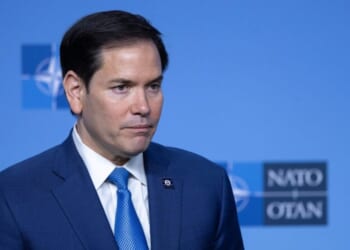
Marco Rubio’s speech at the Munich Security Conference may have been enough for Munich 2026 to displace Munich 1938 in the annals of geopolitics. Far more than an effective rehearsal of European and American commonalities, it touched on the very soul of politics.
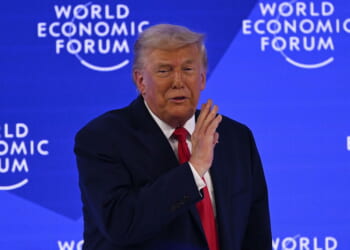
Running through Rubio’s speech was a metaphor of filiation: “For us Americans, our home may be in the Western Hemisphere, but we will always be a child of Europe.” But sons and fathers do sometimes part ways, and skeptics in Europe have seen Rubio’s words as window dressing on hostility. Just a month ago, President Trump’s push to compel Denmark to cede Greenland climaxed in another, harsher speech from a glamorous podium. The American postures at Davos and at Munich, however, must be seen as reflecting an underlying commitment to forging a frank friendship with Europe.
Evidently, America’s bond with Britain and France is different in kind from her arrangements with Saudi Arabia or Mongolia. Sharing common enemies is not the same as participation in common goods, which the Trump Administration is working to articulate.
The State Department’s Samuel Samson has described America’s European friends as “civilizational allies,” appealing to the shared “rich Western tradition of natural law, virtue ethics, and national sovereignty” and the classical and Christian recognition of “natural rights that no government can arbitrate or deny.” The 2025 National Security Strategy takes up this language, pledging itself to “restoring Europe’s civilizational self-confidence and Western identity” and “promoting European greatness” in the face of the threat of “civilizational erasure.”
Europe, understood as a family of nations sharing a Hebraic, Greco-Roman, and Christian soul, is not reducible to the formal apparatus of the European Union. The myriad threats facing that family include the E.U.’s deracinated bureaucracy and digital censorship, the establishment of Islamist parallel societies stemming from unassimilated mass migration, and aggressive foreign powers (Russia and China, of course, but, closer at hand, Algeria constricts critical French supply lines, and Turkey presses Greece in the Aegean). This is why Trump said at Davos, “I love Europe…but it’s not heading in the right direction.”
In all this, the French National Rally, typically assumed in the American press to be “far-right” and therefore aligned with Mr. Trump, has charted its own path. Jordan Bardella, heir presumptive to party leader Marine Le Pen and presidential frontrunner for 2027, proclaimed his autonomy from the U.S.’s rhetoric regarding Greenland: “The U.S. presents us with a choice: accept dependency disguised as partnership or act as sovereign powers capable of defending our interests…. The choice is simple: submission or sovereignty. Europe must choose freedom, responsibility and control of its own destiny.” This followed closely on Bardella’s cool on-the-one-hand, on-the-other-hand reaction to the American capture of Venezuela’s Nicolás Maduro just after the new year.
The RN’s rhetorical posture will likely catch on if Europe takes a more sovereigntist turn. For America, this will mean facing disagreement in good faith, because truly independent allies can and will advocate for their interests—even where they conflict with our own.
Foreign would-be partners have often suffered from the Trump Administration’s attempts to toughen up American allies. Although the ascent of a muscular executive in Washington, D.C., promising to turn back mass migration and renew national solidarity, might have been thought to inspire parallel movements throughout the West, anti-Trump nationalism has swept the old centrist parties in Canada and Germany to power. Nigel Farage’s Reform Party in Britain seemed weak during the Greenland affair. In Italy, the one major NATO power with a friendly government, Giorgia Meloni was left looking behind in the game. (Latin American relations have similar dynamics.)
Left-of-center observers tend to see such disputes as revealing the absurdity of an international coalition of nationalists, assuming that nationalism in any form must devolve into petty chauvinism. But since the National Rally was founded in 1972 (as the National Front), when Trump was just getting started in real estate, Bardella has more credibility as an independent actor than Europe’s more upstart populist leaders.
In France, resistance to the universal acid of consumer markets takes the form of skepticism toward American culture across the political spectrum. Charles de Gaulle and François Mitterrand looked down on Anglo-Saxon hustle just as much as Jean-Marie Le Pen.
Yet the change America is trying to effect in her European allies is not grasping but magnanimous, despite some clumsiness in the execution. In the 80 years since World War II, Europe has lost the habit of and skills for self-governance, partly as an unforeseen consequence of American protection and partly due to the negligence of Europe’s rulers.
For European powers to rebuild their military capacity as the Americans have been demanding for the past decade would require far more than the ongoing adjustment of spending priorities and the attempt to revive arms industries since Russia’s invasion of Ukraine. To prioritize honor over comfort and to license the love of one’s own would represent a sea change in mores. As Chief of the French Defense Staff Fabien Mandon has warned, “France is not ready to accept the loss of her children.”
It would also require the fiscal pain of facing public finances that favor retirees over young native families seeking children; President Macron has had to back down from the mildest pension reforms. France has a particularly Boomer-slanted welfare state, fueling the sardonic internet jingle “C’est Nicolas qui paie” (“Nicholas will take the bill”), in which a 30-something professional white man toils to support his elders as well as student activists and criminal migrants. Over all of this looms the demographic cliff, which exacerbates every other painful issue and will, in the best-case scenario, take generations to avert.
Hegemons who begin benevolently are typically only too happy to reduce their allies to dependents. Athens, after helming a coalition of Greek cities to defeat Persia at Salamis, went from first among equals in the Delian League to a bloated imperial mistress by the time of Pericles.
Rome likewise began her expansions by coming to the aid of allies. She pushed Carthage out of Sicily alongside Syracuse and humbled Macedon with the help of the Aetolian League. But the legions that came as liberators never left. Just before his death at the orders of Mark Antony, Cicero warned his son, “While we have preferred to be the object of fear rather than of love and affection…all these misfortunes [of civil war] have fallen upon us.”
America has committed itself rhetorically and intellectually to escaping Rome’s hubristic descent. Rubio’s “we do not want our allies to be weak, because that makes us weaker” reflects Cicero’s counsel that “the power of good-will is so great and that of fear is so weak.” It is mightier to be loved than feared—or to be loved by the good and feared by the wicked.
In restoring self-government in Europe, France ought to be America’s preeminent partner. The French have the only world-class military on the continent, proficient on land, at sea, in the air, and even in space. Even in the domains where French assets are limited, solid cores of experience and skill mean they can be scaled up quickly. Founded on abundant nuclear energy and an independent nuclear deterrent, the Gaullist idea of grandeur through a force de frappe (strike force) is not a chimera.
France also has the healthiest national sentiment on the European continent—neither grounded solely in blood-and-soil loyalty nor in abstract universalism but in a long tradition and a great vocation. The country retains a distinct intellectual tradition that extends to diplomatic, strategic, and geopolitical thought, inoculating it somewhat against le wokisme emanating from the English-speaking world.
Realizing this ambition will demand much from both sides. For Bardella, earning the clout to criticize Washington will require showing he can really govern, including making clear how his presidency would handle censorship, immigration, the debt, and rearmament if he wins the presidency. France may be able to blaze a trail for reform in areas that concern both republics, such as rolling back judicial usurpation of legislative authority and restricting birthright citizenship for the children of illegal arrivals.
For the Trump Administration, putting America first must entail recognizing that other countries have their pride, too. Eisenhower modeled this when he placed Leclerc’s division at the head of the column for the Liberation of Paris, an honor out of proportion to the contributions of French troops. Under Secretary of War Elbridge Colby has recently acknowledged that it is in the long-term interest of the United States that France produce Rafale fighters, even if it immediately hurts our sales of F-35s.
Friends, unlike flatterers, can tell each other hard truths. In 2003, Americans would have done well to heed the stinging rebuke that Jacques Chirac’s government gave to George W. Bush’s over the invasion of Iraq. Instead, we renamed French fries and slandered French military history. Today, the painful rebukes come in the other direction, in both the blunt Appalachianisms of JD Vance last year at Munich and Rubio’s warm Miami tones this year. Concern for Europe’s civilizational continuity is going to shape America’s outlook for years to come. May France repay that concern.