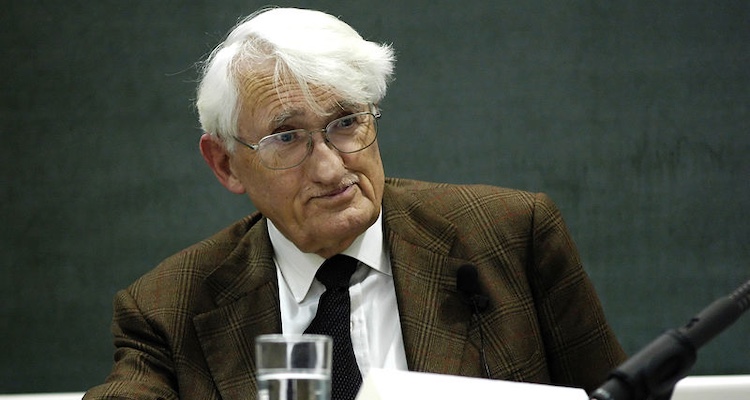
For the past 96 years, cynicism had few greater enemies than the super-famous philosopher Jurgen Habermas, the former leader of the Frankfurt School of critical theory, who died on Saturday. Among the numerous ways Habermas stood out from his peers in modern social theory was that this former Hitler Youth went to his grave defending Israel’s right of self-defense.
This meant breaking with the post-October 7 manufactured consensus in academia that the Jewish state was guilty of the same category of crimes committed against the Jewish people by Nazi Germany. Yet Habermas’s philosophy made his objection to this calumny inevitable: He believed in the power of engagement—his most famous idea arguably remains his belief that societal problems can and should be solved in the public square—and by the time of his death, that made him an outsider among intellectuals.
Indeed, his peers’ turn against Israel was inseparable from their turn against Enlightenment ideals. Official and unofficial speech codes in academia cast the Jewish state out of the public square: BDS became not just a boycott-focused tactic against Israel but a way of life. You simply did not talk to those who held insufficiently hostile opinions about the Jews.
Habermas understood precisely where that attitude can lead. But his critics on the left misunderstand the way his Germanness informed his fairmindedness on Israel. The last great intellectual controversy of his life is instructive.
In November 2023, Habermas and three co-authors published the following:
“The Hamas massacre with the declared intention of eliminating Jewish life in general has prompted Israel to strike back. How this retaliation, which is justified in principle, is carried out is the subject of controversial debate; principles of proportionality, the prevention of civilian casualties and the waging of a war with the prospect of future peace must be the guiding principles. Despite all the concern for the fate of the Palestinian population, however, the standards of judgement slip completely when genocidal intentions are attributed to Israel’s actions.”
In retrospect, of course, Habermas was well-served by his reluctance to join the mob. As we now know, the “genocide” accusation against Israel has no basis and has been revealed as a bad-faith libel constructed by supporters of a “global intifada.” That Habermas wasn’t fooled by it remains unforgivable to his progressive critics.
In that same open letter, Habermas wrote: “It is intolerable that Jews in Germany are once again exposed to threats to life and limb and have to fear physical violence on the streets. The democratic ethos of the Federal Republic of Germany, which is orientated towards the obligation to respect human dignity, is linked to a political culture for which Jewish life and Israel’s right to exist are central elements worthy of special protection in light of the mass crimes of the Nazi era. The commitment to this is fundamental to our political life.”
This led his critics to dismiss him as a guilt-ridden sentimentalist on the subject of the Jews. But that is a misreading—intentional or not—of Habermas’s public writings.
In response, Adam Tooze, Samuel Moyn, and others offered up their own open letter in a demonstration of spectacular intellectual vacuity. Habermas’s “concern for human dignity is not adequately extended to Palestinian civilians in Gaza who are facing death and destruction,” they complained. “Nor is it applied or extended to Muslims in Germany experiencing rising Islamophobia.”
Did they not even read the letter to which they responded? It is entirely possible they did not. In any event, false equivalence was precisely what Habermas was criticizing.
Was Habermas trying to cleanse his own conscience by over-privileging Jewish suffering? Hardly. Instead, he believed that free and honest debate could produce the truth. He didn’t want to live in a world of postmodern relativism; he wanted to be a free thinker. “He was a rationalist when it was unfashionable to be one,” his biographer told the New York Times.
Habermas pursued the truth on a difficult topic; his detractors pursued manufactured consensus. His pursuit of the truth led him to it: Israel was not committing genocide in Gaza, and the uniqueness of the Holocaust was demonstrable. The Jews simply weren’t doing to others what had been done to them. It was a plain fact. His critics didn’t care if what they said was true, they cared how what they said could be instrumentalized toward their own preferred political ends. Habermas surely recognized such proto-fascist groupthink and wanted nothing to do with it.
This was a perfect example of what the larger debate around Israel had become. Habermas believed in the existence of facts and that they could be ascertained through diligent, honest debate. His fellow leftist intellectuals hated the truth that Habermas discovered, because it debunked a modern blood libel. And that truth will live on, whether social theorists like it or not.