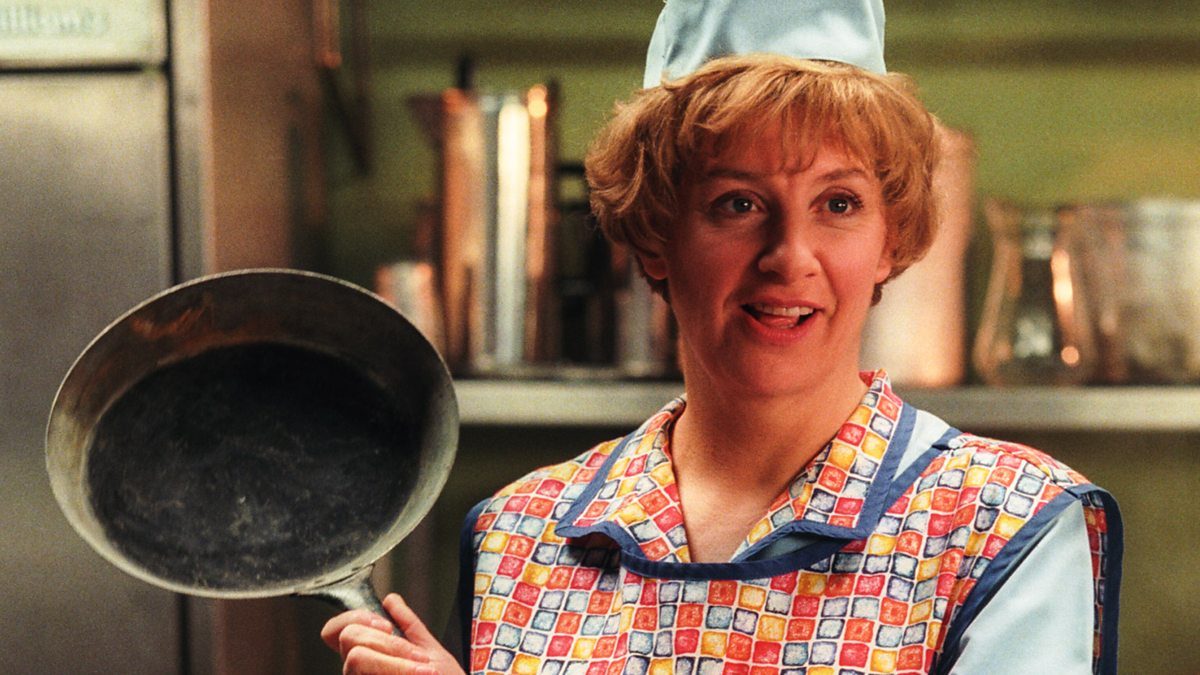
I’m in a primary school in Buckinghamshire. Mrs Phipps is stirring a simmering pot, her face warped in the reflection of a saucepan hanging behind the hob. “Do you enjoy being a dinner lady?” I ask. She abruptly steps back from the roiling contents of the hob and brandishes her wooden spoon at me: “I think you’ll find it’s lunchtime supervisor now.” A blob of red flicks from the spoon to the floor. Probably bolognese, possibly not.
For 80 years, the sentinel figure of what I knew as the “dinner lady” has patrolled school halls, dolloped mash, circumcised Frubes, and stood watch over dining rituals. This totemic British presence has long been a shorthand for pastoral care, hygiene, behaviour management and nutrition. Yet today, school dinners are often outsourced and ultra-processed, and diminishing teams of lunchtime supervisors now have more on their plates than ever. Indeed, their current plight maps onto a deeper story of social neglect, institutional atrophy and cultural inequality within Britain’s education system.
Mrs Phipps tells me she was cared for by that first generation of dinner ladies back in the Fifties, and she’s been one herself for over 40 years. When she first tied her apron, in the Eighties, the number of households with children in poverty had rapidly increased and school dinners were crucial to filling bellies and nutritional gaps. “When I started, the food was much better,” Mrs Phipps attests. “We cooked fresh roasts, sausage and mash, stews, pies and fish and chips. Proper food, properly cooked.”
While this might sound like a menu from Weston-super-Mare pier, she assures me it was far more nutritious than the food provided today. “I wouldn’t give that to the dog,” Mrs Phipps says, showing me a conglomerate of pasta which would be easier to carve than ladle. It is small wonder, then, that in her school a vanishing number of children are opting for provided lunches.
And as Labour announces a “down payment” on its child poverty strategy — free school meals for every child in a family receiving Universal Credit — it still hasn’t realised that children don’t want to eat what it’s serving up. That’s partly thanks to the Government’s own regulations. With concerns about obesity rising, the strict emphasis on restricting salt, sugar and fat has severely limited school menu options. Mrs Phipps looks me in the eye: “Healthy eating is over the top in schools, and it’s having the opposite effect on kiddies’ relationships with their food.” Her school only allows ketchup once a week, and the jacket potatoes are served without butter, salt or pepper. Understandably, children often refuse to eat lunch, “then go home [after school] to fill up on treats”.
But Mrs Phipps doesn’t blame the government: she blames a celebrity chef. In 2004, obesity rates in children aged between two and 15 had ballooned from 12% in 1995 to 19%. Combined with — or perhaps caused by — the availability and affordability of highly processed foods and the higher costs associated with preparing fresh fruit and vegetables, the diet of British children was in dire need of reform. Enter Jamie Oliver who, despite admitting in 2014 that his kids “go to posh private schools”, decided he was the man for the job.
Oliver’s school dinners campaign was a landmark political and cultural moment, dominating headlines and attracting both compliments and condemnation from both sides of the school fence. He was transformed from an inoffensive “lovely-jubbly” Mockney chef to a divisive pseudo-Robin Hood. But instead of stealing from the rich to give to the poor, he sought taxpayer funding and lectured the working classes about quinoa.
Infrastructural overhaul is a hard nut to crack and Jamie’s campaign might have fared better had he not been so out of touch with the working classes. For him, after all, sourcing free food means a bucolic woodland stroll for wild garlic; for many of those he presumes to educate, it’s plucking a tin of beans from a church food bank. His clumsy attempts to reform working-class food habits were painfully misguided: individualising blame, and framing poor diets as a failure of personal responsibility rather than policy and resources.
Feeding schoolchildren has not always been such a Sisyphean task. As far back as 1879, Manchester introduced free school meals to the poorest children following the introduction of mandatory education. The logic was simple and undeniable: hungry children cannot learn. In the aftermath of the Second World War, meanwhile, school dinners became compulsory. This formed part of a larger nation-building project by Clement Attlee’s Labour government, which was committed to narrowing the class divide via the expansion of the welfare state. Better access to healthcare, housing and social security aimed to directly address increasing poverty and inequality. Ensuring children were well-fed was an integral part of Attlee’s strategy to rebuild Britain.
A cohort of women were recruited to oversee the new programme. The colloquial “school dinners” were cooked on site, with pies crimped, vegetables locally-sourced and miles of jam roly-poly coiled by hand. Parents who opted their children in paid a shilling per day (equivalent to just over £1 today) with free meals available to the poorest. Today, though, Attlee’s vision of healthy, filling nutrition for growing bodies and brains has been all but scraped into the bin.
Mrs Phipps and her colleagues are not to blame for disgorging meals blander than anything that could have been scraped together with a ration book. Beyond that flurry of anti-food regulation, only 20% of UK schools have in-house catering. And despite Mrs Phipps’s having a full kitchen designed to serve hundreds, her school outsources 100% of its food which comes in pre-cooked and heated up on site. She suggests that the ready meals don’t live up to the initial promises from slick salespeople: “When we changed to private suppliers to save money, they brought examples and they were beautiful, but aren’t what we’re now given.”
There are many for-profit national caterers for both state and private schools, one of which is Chartwell’s. It is owned by Compass Group, which in September 2025 recorded £2.5 billion in operating profit, and has six peers in the House of Lords as shareholders. According to analysts Tussell, since 2012, Compass Group has been awarded public sector catering contracts amounting to over £856 million.
Chartwell’s boasts of connecting “thousands of pupils and students to nutritious, ethically sourced food through exceptional school catering services”. Its glossy marketing photographs show ethnically diverse children tucking into restaurant-quality meals — but the proof of the pudding is in the eating. In March 2024, headteacher of Redbridge Community Secondary School, Jason Ashley, went viral for publicising the lacklustre food Chartwell’s provided. In a letter to parents, the headteacher lamented: “We have concluded with our photo evidence that Chartwell’s do seem to be unable to ‘bake a potato’ correctly.”
If the role of lunchtime supervisors is now unrecognisable even from my own schooldays, the behaviour of kids is too. Increasing numbers of children come to school without knowing how to use a knife and fork, hold a pen, or wash their hands. A survey by the early-years charity Kindred Squared of 1,000 primary school staff reveals that 37% of children can’t dress themselves, 29% can’t eat or drink without assistance, and one in four arrive at school not yet toilet trained. Mrs Phipps can’t blame Jamie Oliver for that, but she is quick to name another culprit: modern parenting. In her day, “if you were going to get a job, you were a full-time mum and a part-time worker, not the other way around.”
The real recipe for this growing disaster is perhaps more complicated. Studies show that the root causes of low “school readiness” are rising poverty, parental learning difficulties, illness and a lack of access to childcare. But the overall result is that school staff are left to (often literally) mop up the consequences of this shortfall. Parents do have to shoulder some blame. The Kindred Squared study shows that nearly half of parents believe that preparing a child to be “school ready” before reception is not their responsibility. Extrinsic factors aside, this epidemic of parental neglect forces all school staff to be drafted in to teach skills once considered rudimentary and default.
Poverty is not novel, of course, so why have these new gaps in child development emerged?
Such gaps were once successfully plugged with schemes like Sure Start, a 1998 initiative to support the health, childcare, and early learning — particularly in deprived areas — of families with children under five. But in the past two decades, over 1,000 Sure Start centres have been closed, and short-sighted governments have claimed that it’s not cost-effective to support children and families facing circumstantial hardship.
When Mrs Phipps first tied on her apron, lunchtime supervisors were mostly local mums who enjoyed cooking. Yet she and her colleagues now have to attend training courses on everything from positive behaviour management, spotting signs of self-harm and GDPR. The expansion of lunchtime supervisors’ roles has led camaraderie among her colleagues to thin — everyone is stretched too far. And Mrs Phipps predicts that the greatest change is still to come: “There will soon be a time without dinner ladies.”
“There will soon be a time without dinner ladies.”
At one primary school in Northamptonshire, that moment has arrived. Outside, the playground is a frenzied blur of squawking children monitored by two teaching assistants. Inside, a ravenous jamboree is descending on the school hall where two cooks are plating up. The caretaker beckons me into a cupboard lined with shelves sagging under catering-sized containers. A coven of teachers are already there. He reaches behind a sealed vat of cereal and retrieves a nondescript tub. He glances back at the door, then pours a white powder into each of our palms. “You can have that,” he murmurs. “Don’t show the kids.” I dip my finger in it and put it in my mouth. It’s the good stuff: salt. The contraband is to season our otherwise bland food. I consider bagging some up to distribute to the kids.
In this school, the teachers have been handed the role of lunchtime supervisor alongside their adults-only seasoning. They are encouraged to eat alongside the children, earning a free meal while building community, monitoring behaviour and modelling how to engage with the ritual of dining. Mrs Phipps’ minimum wage job has effectively been outsourced in exchange for a £2.60 plate of Friday’s fish fingers.
Observing from my long table, this system feels more like a Benidorm all-inclusive than a village primary. Each morning, children are issued coloured wristbands denoting their pre-selected lunch — hot meal, salad bar, or the popular DIY sandwich option. The food is of a standard most state schools fail to reach. The 10- and 11-year-olds are then enlisted to help the younger ones assemble their meals, coaxed into service with the irresistible bribe of extra food which they actually enjoy eating. As lunch quietens down, and the salad bar begins to resemble a Pollock, I watch children line up to scrape their leftovers into the compost bins. They are unnervingly calm and I wonder what exactly was in the coleslaw. The tranquillity shatters the moment I ask the hive mind what they’d change about their lunch: “Pudding!”, they chorus.
Although it might appear like a well olive-oiled machine, the reality is far more complicated. The school employs a business manager who oversees the administrative and operational functions of the school, once the domain of the head teacher. Half of all primary schools now have someone in this role, which hypothetically frees up other staff to focus on learning or, in this school at least, to supervise lunchtime.
The business manager explains that the quality and diversity of choice to adequately feed the children places the school on a financial knife-edge. Government funding provides universal infant school meals for all children up to Year 2 (ages six to seven) and meals for children whose parents receive Universal Credit — more than 40 pupils in this school. Everyone else has to pay. However, the allocation is just £2.53 per meal — 7p less than they’re sold for. “Once you factor in staffing, food, utilities, and water,” the business manager adds, “our budget simply doesn’t stretch far enough.”
This is in stark contrast to private schools, where students can eat their cake and have it. In these institutions, children are treated to carefully prepared meals, served by a dutiful division of lunchtime supervisors. One such school, Coopersale Hall School in Essex, which costs over £5,000 a term, boasts on their website that they “provide an extremely high [food] budget per pupil — around four times as much per day as in most state schools”. They describe how this includes sourcing food from local farmers, greengrocers and butchers.
Private school kitchens that outsource to third parties like Chartwell’s are afforded a wholly different experience: reiterating the importance of funding to food. At St Faith’s School in Cambridge, where the fees can be as much as £25,000 a year, Chartwell’s reportedly installed an in-house smoker. Meanwhile, state school pupils are left wondering if the carrot sticks on their £2.53 plate count as local if they come from the nearest Costco.
The schools that educate the country’s elite know just how vital nutrition is, not just to physical health but to brain development and focus. A good, healthy meal is a conduit to developing social, behavioural and educational standards that have ramifications for children’s entire lives. The 2006 Wider Benefits of Learning Research Report found that nutritional deficiency in children had an impact on brain performance and that maintaining adequate glucose levels throughout the day (by not consuming ultra-processed or sugar-heavy foods) optimises cognition. This can have knock-on behavioural consequences, which in turn impacts school performance and interaction with peers — not to mention how poor nutrition results in greater susceptibility to disease.
It’s hard, here, not to return to the question of money. Back in 1968, Labour eliminated free school milk for secondary school children on grounds of cost, before objecting strongly when Margaret Thatcher sponsored the proposal to remove free milk for seven-to-11 year olds in 1971. Thatcher, for her part, scrapped the minimum nutritional standards for school meals that had been in place for decades, along with the legal requirement for Local Education Authorities to provide a school meal service. The results were devastating. By 1999, according to a Cambridge study, children’s diets were worse than the Fifties. The Iron Lady had replaced iron, calcium and vitamin-rich foods with fizzy drinks and baked beans. As schools were no longer obligated to fill the nutritional gap, standards hit rock bottom.
It’s unfortunate, meanwhile, that a more radical opportunity for change than what Labour has suggested has been squandered. Henry Dimbleby, co-founder of the Leon restaurant chain, was appointed non-executive director of the Department for Environment, Food and Rural Affairs in 2018. He oversaw the 2021 National Food Strategy, a comprehensive government review proposing major changes for healthier, sustainable food. Its recommendations include a sugar and salt reformulation tax (using some of the revenue to help get fresh fruit to low-income families) — an idea based on the success of the Soft Drinks Industry Levy, which led to reductions in sugar consumption and raised hundreds of millions of pounds for schools. The proposal additionally called for the extension of the eligibility criteria for free school meals — something Dimbleby had repeatedly called for since he and John Vincent wrote the School Food Plan in 2013. The proposal aimed to disrupt what Dimbleby dubs the “junk food cycle” — the snowballing of large companies making increasingly processed and cheaper foods. The Government failed to act and Dimbleby resigned in 2023.
The dinner lady may be next down the drain. Since 1944, she has been more than a hair-netted ladler of gravy. She’s an emblem, a keeper of the peace and a guiding presence in the time breaking up the day. Yet austerity, unaddressed shifts in gender roles, and overstretched budgets are quietly melting this long standing institution — just when children, teachers, and parents may need them most. Thanks to austerity, changing demographics, and overstretched budgets, lunchtime supervisors are now too busy, too few, and are lumbered with too many responsibilities that exceed their original purpose. “I’m coming up on 80,” Mrs Phipps tells me. “I’ll do it as long as I can. When I’ve had enough, I’ll leave. And they won’t replace me — it’ll just be another one down.”
I say goodbye to Mrs Phipps as the school bell tolls. She wipes the tables, slowly lowers the kitchen shutter, and hangs her tabard on the back of a door. She represents the routines and nutritional standards that once unified children across class and culture. Whoever serves it, it’s clear that in 2025 Britain is starving for a renewed moral economy of care.