The US-India rapport has been tricky lately.
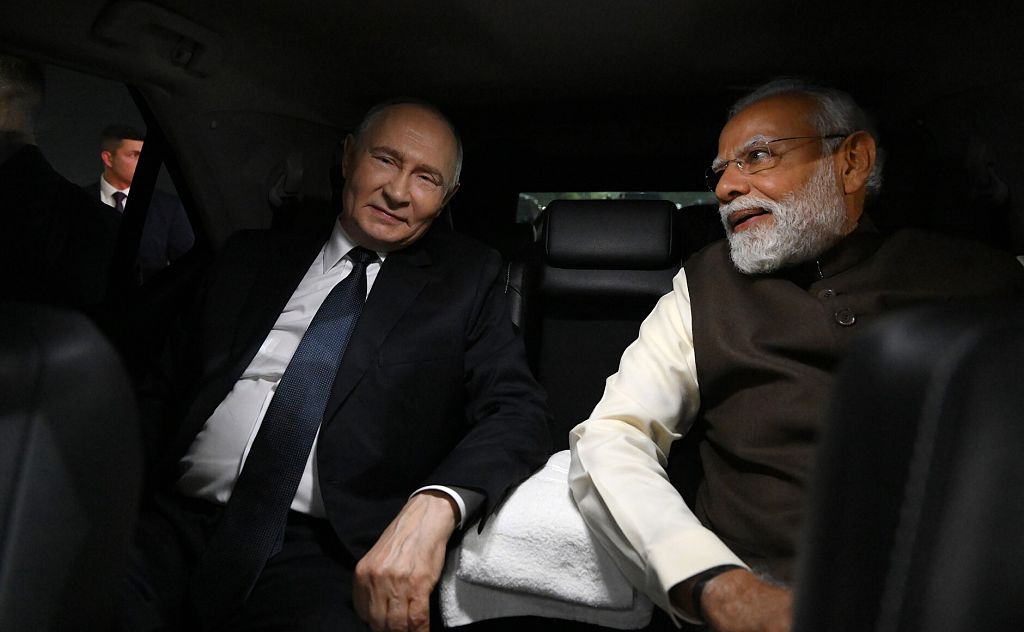
Since the end of the Cold War, the United States has developed a fragile relationship with India as a counterweight to China and Russia. So the White House watched closely when Russian President Vladimir Putin joined Indian Prime Minister Narendra Modi earlier this month for the 23rd India-Russia Annual Summit to assess what strategic agreements the two leaders had forged.
The US-India rapport has been tricky lately, with President Donald Trump’s use of tariffs to advance foreign policy with the world’s most populous country, home to an estimated 1.5 billion people. According to The New York Times, “Mr. Trump has accused India of financing Russia’s war on Ukraine by buying its oil, and last month, India’s biggest oil companies stopped buying Russian crude almost entirely after US sanctions on Russian oil giants threatened the companies that do business with them.”
India and the Big Issue of Oil
The reliable availability of oil and other petroleum products is no small issue for India, which, after the United States and China, is the third-largest consumer of crude. Nonetheless, in December, India’s imports of Russian oil is projected to “drop 600,000-650,000 bpd [barrels per day], a three-year low in Russian oil shipments to India,” explained the Free Network, an Eastern European economic news source. The drop has forced India to seek more pricey sources, such as the United States, the Middle East, and Australia.
During the talks, “Russian President Vladimir Putin offered India uninterrupted fuel supplies … eliciting a cautious response even as he and Indian Prime Minister Narendra Modi agreed to expand trade and defense ties between countries with decades-old ties,” Reuters reported. However, it’s doubtful the offer for “uninterrupted fuel supplies” will be an inducement enough to challenge US tariff power.
Russia and India Bond
The bond between Russia and India is strong when it comes to weapons purchases. India is the top customer for Russian arms, and its arsenal is estimated to be 60% Russian-produced. Discussions between the strategic partners included negotiations for India to secure modern S-400 anti-aircraft missile systems and to continue the joint venture to produce BrahMos, the fastest extended-range supersonic cruise missile in the world, fielded for precision attacks on land and sea targets.
“With Indian firms already reducing oil purchases from Russia to avoid sanctions from Washington, the two countries will look at other areas to boost trade,” the BBC observed. “Defense is the easiest pick. India’s defense imports from Russia reduced to 36% between 2020 and 2024, from the peaks of 72% in 2010-2015 and 55% between 2015 and 2019, according to Stockholm International Peace Research Institute.”
But the strengthening ties between Russia and India present another problem. Washington very much needs India as part of the Quadrilateral Security Dialogue (Quad), comprising the United States, Japan, Australia, and India. This group of four Indo-Pacific nations is the cornerstone of the regional strategy to counter China. As the 2025 National Security Strategy (NSS) explains, “We must continue to improve commercial (and other) relations with India to encourage New Delhi to contribute to Indo-Pacific security, including through continued quadrilateral cooperation with Australia, Japan, and the United States (‘the Quad’).”
A Non-Aligned India
The Trump foreign policy and defense teams must achieve a practical balance in dealing with India. So far, the use of tariffs has worked to a limited degree in persuading India to reduce its purchases of crude oil from Russia, but the New Delhi government is irritated at being forced to purchase it at higher prices elsewhere. Working in the White House’s favor is the decades-old Indian desire to remain staunchly non-aligned in the large-nation geopolitical tug-of-war. The 2025 NSS establishes a more transactional relationship, as The Diplomat observed, “the document primarily highlights the desire to expand economic engagement with New Delhi and encourages India to shoulder greater responsibility for Indo-Pacific security.”
No groundbreaking agreements emerged from the Putin-Modi meeting, but it did reaffirm the strong, strategic relationship between the two countries. Nevertheless, US-India trade deals and the potential to ease tariffs on India’s energy purchases portend a practical, transactional association that will continue. Ultimately, establishing India as an equal partner in Indo-Pacific will go a long way toward sharing the defense burden in the region.
The views expressed are those of the author and not of any other affiliate.
Liberty Nation does not endorse candidates, campaigns, or legislation, and this presentation is no endorsement.