One of the sillier habits of Western Middle East correspondents is that they assume the title of ‘journalist’ carries the same significance in Beirut or in Gaza as it does in London. Alex Crawford’s recent Sky News report on the Israel-Hezbollah conflict was a prime example.
Last week, three people were killed by an Israeli airstrike in southern Lebanon. Lebanon and Hezbollah claim that Ali Shoeib, Mohamed Ftouni and Fatima Ftouni were journalists who were killed for simply doing their job. Or, in the words of the Iranian foreign minister, victims of a ‘targeted assassination’ and an ‘attempt to silence the voices of truth-tellers’. Israel, however, contends that Shoeib and Mohamed Ftouni were Hezbollah operatives working under the guise of journalists. Shoeib allegedly engaged in surveillance activities, including trying to uncover the positions of Israeli troops on Lebanon’s southern border.
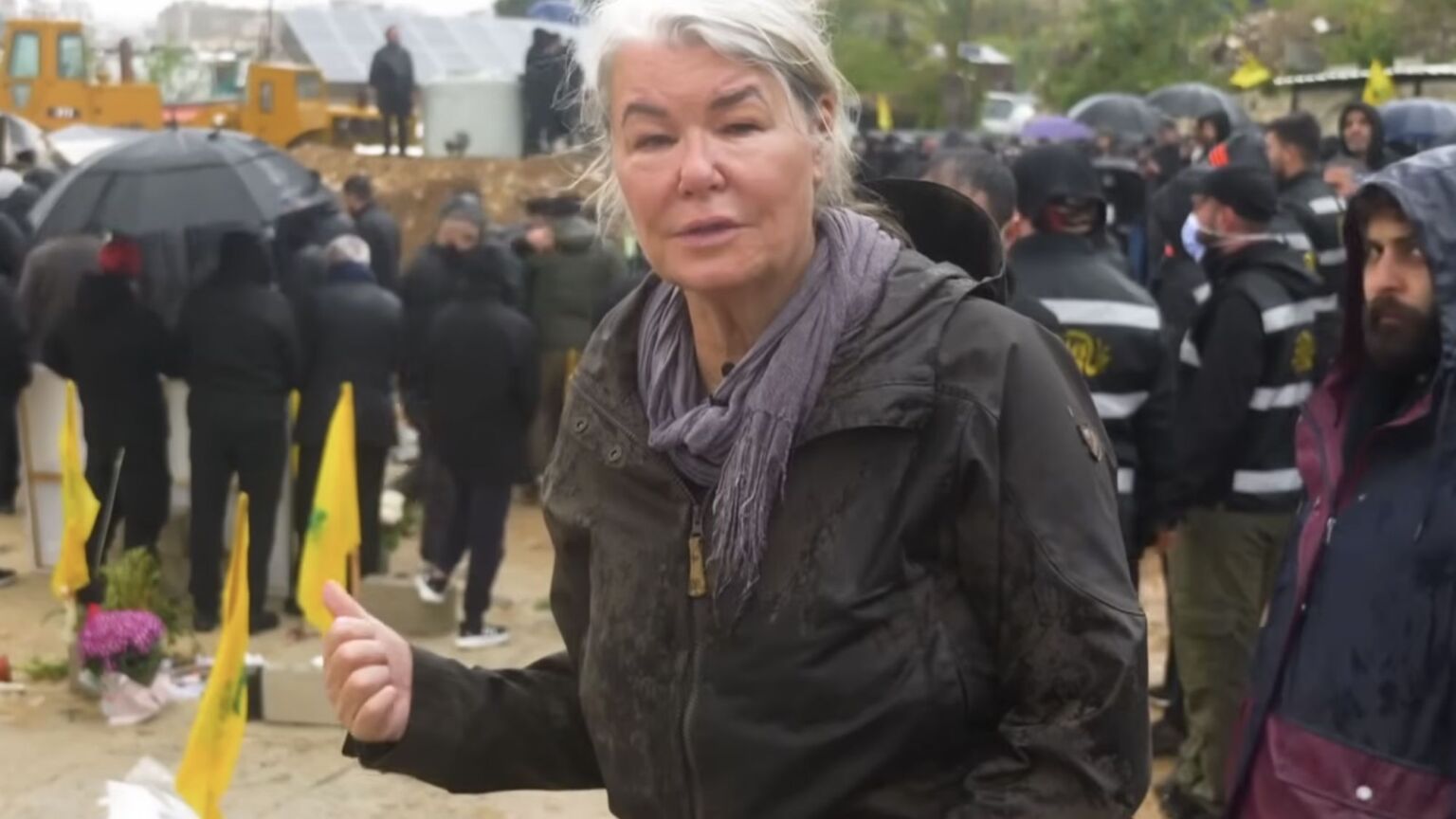
Which takes us to Crawford’s report. Speaking at the scene of the funeral, surrounded by mourners, she told Sky News viewers on Sunday that Israel had ‘provided no evidence’ to support its claim that Shoeib was a member of Hezbollah. But there were clues, if only Crawford had looked around her. In her own report, mourners can be heard chanting, ‘Death to America’ and ‘Death to Israel’. A more inquiring reporter might also have taken note of the sea of Hezbollah flags at the funeral, visible in the background of the shot.
Of course, asking hard questions of Israel and the IDF is the right thing to do. Journalists should always be testing the claims of governments and militaries, particularly when they are at war. But that was not what Crawford was doing. Every reporter in the Middle East should know by now – particularly one as experienced as Crawford – that it is highly plausible Shoeib and Ftouni were not merely ‘journalists’, at least in the way that Westerners would use the term.
To begin with, it is not in dispute that Shoeib worked for the Al-Manar media channel. Al-Manar is not a rough Lebanese equivalent of, say, the BBC. It is owned and controlled by Hezbollah – a fact that led to it being banned from Germany in 2024. The Hezbollah links are not hidden or based on some rumour passed around a Beirut taxi rank – they are part of the outlet’s institutional identity.
Organisations like Hezbollah need men with rifles. They also need men with cameras, studios, edit suites, local access and the correct press credentials. Propaganda, reconnaissance and information warfare are integral parts of the machinery of war. Western outlets are well aware of this, and they tend to make this clear when reporting on other conflicts. Yet, whenever Israel is involved, this well-understood facet of warfare is ignored.
Then there is the adolescent demand that Israel provide journalists with reams of evidence every time it decides to target someone. Intelligence of this kind isn’t gathered to satisfy television correspondents. It exists to provide timely and accurate information for decision-making in the heat of war. Information must remain protected when disclosure would harm national security or the effectiveness of the intelligence. Sources and methods must be safeguarded for their own protection and for the protection of future intelligence-gathering. Armies are not required to publish a user manual on how they identify targets.
None of that makes every Israeli strike lawful or justified. But it does mean the press has a duty to stop feigning ignorance about the institutions it is reporting on. It is a matter of longstanding record that Hezbollah supporters beat video journalist Hussein Bassal while he covered the 2022 elections. Other journalists who criticise or investigate the Party of God have faced threats and intimidation. Then there is the nature of Hezbollah itself: a proscribed terror group and enthusiastic ally of the Iranian regime. The idea that media and militias exist in separate moral spheres in Lebanon is hard to maintain unless one is very determined to do so.
That is what makes so much of the West’s Israel coverage so hopelessly biased. Israeli claims are dismissed out of hand, while Hezbollah-, Hamas- or Iran-linked institutions are given a favourable portrayal the moment a press vest appears on screen. So a correspondent can stand among Hezbollah flags, hear chants of ‘Death to America’, note that the dead man worked for Hezbollah’s own television station, and still strike a baffled pose when Israel suggests he may have been something more sinister than an ordinary journalist. Call this war reporting, if you like. It looks much more like a pantomime.
Andrew Fox is a senior fellow at the Henry Jackson Society, a retired British Army officer, and co-host of The Brink podcast.