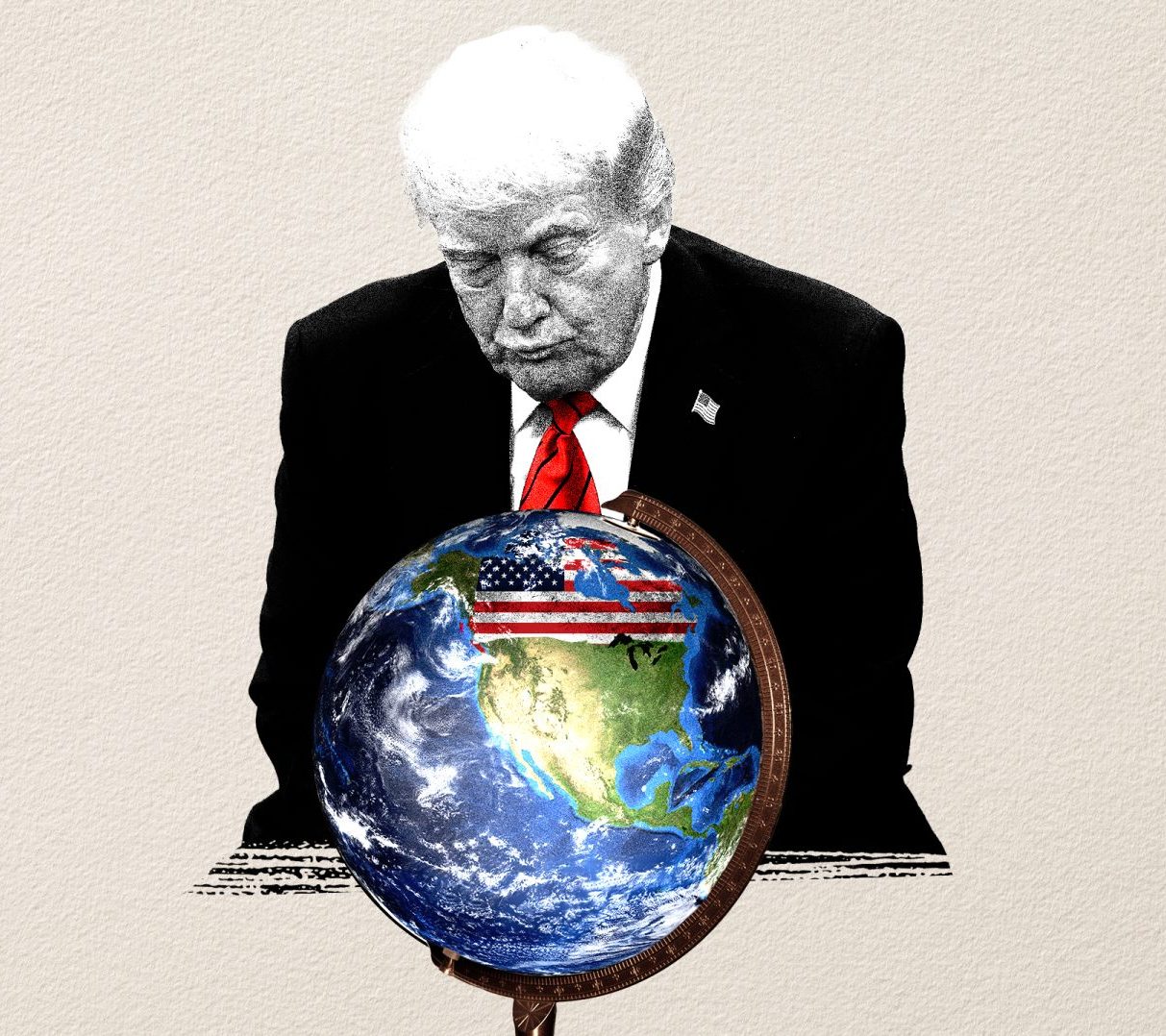
President Trump’s overtures to Greenland might have shocked Denmark, but they certainly haven’t shocked historians of American territorial ambition. Talking about the rendition of President Maduro, Trump called it an example of the “Donroe Doctrine”: a repurposing of the 1823 “Monroe Doctrine” which had declared the Western Hemisphere closed to European interference. It meant that the United States of America, independent for less than a generation, would be the boss of its own backyard. Trump’s interest in Greenland is merely an extension of this.
When Monroe outlined his plans to Congress in 1823, the US already controlled a sizeable portion of North America, but there was still room to grow. Although the country was built-up in the East, it was more sparsely populated in the West. The US bordered Spanish-held land that covered what we now know as California and other states. Both the US and the Spanish territories were themselves incursions onto the lands that were once held, or were still contested by, America’s native inhabitants.
But these settler Americans were not inclined to stop expanding their territory. In 1845, the journalist John L. O’Sullivan coined the term “Manifest destiny”: the belief in a preordained, inevitable and divinely-inspired expansion of the United States across the North American continent to the Pacific Ocean and beyond. Expansionism was not a concept unique to the nascent US, but this was a heady time. Some American men of letters even imagined that their country might one day engulf British North America, now known as Canada. Some of their northern neighbours were equally keen: the repealing of the Corn Laws had severely affected the Canadian economy, and so many Canadians looked south for help. In 1849, a group of Montreal businessmen even demanded political union with the US. William Seward, an American senator, wrote in 1853 that Canada “will ultimately become a member of this confederacy, if we will consent”.
In the years that followed, Manifest Destiny took the US west rather than north. The US engaged in a variety of deals and wars that added hundreds of thousands of square miles to the young nation, but left blood on American hands. Native tribes were brutalised. Even when territory was acquired by purchase, those purchases were often between settlers. The Louisiana Purchase, by which the US had bought a vast tract of land from the French in 1803, is one example; the Alaska Purchase, transferring ownership of Alaska from Russia to the US in 1867, is another. In neither case were the natives consulted.
Such abuses were not acknowledged, of course. Instead, America’s expansion was romanticised in popular culture and with propagandistic art. The painter Emanuel Leutze commemorated the Alaska Purchase with a portrayal of American and Russian officials discussing the deal over an enormous globe. And a painting by John Gast depicted Columbia, a figure representing republican values, marching west, laying a telegraph line as she went. (That painting was posted on X by a newly nationalistic Homeland Security only last year.)
One of the men depicted in the Alaska Purchase painting was William Seward, who had forecast that Canada might eventually join the US. He had now risen to the role of secretary of state, where he was able to put into practice his early enthusiasm for Manifest Destiny. As early as 1848, shortly after the phrase was coined, Seward had written that “our population is destined to roll its resistless wave to the icy barriers of the north and to encounter oriental civilization on the shores of the Pacific”.
Seward, an ardent abolitionist, sought to achieve expansion peacefully, criticising his colleagues who sought to redraw America’s northern and southern borders by means of war. He believed that America had only to be patient, and that Mexico, as well as Canada, would one day join the Union of its own accord.
But his work on the Alaska Purchase helped intensify American territorial ambition. In the summer of 1867, Seward’s ally in the Alaska deal, Robert J. Walker, suggested the purchase of Greenland and Iceland from Denmark. Hoping to persuade his colleagues in government, Walker commissioned a report on the two territories’ assets. In addition to praising the vast and valuable resources of both areas, including fisheries, coal, cryolite, and other minerals — the rare earths of their day — the report specifically noted that the acquisition of Greenland might hasten the absorption of British North America. Such an acquisition, the report argued, would “greatly increase her (British North America’s) inducements, peacefully and cheerfully, to become a part of the American Union”.
The American Civil War had ended only in 1865, but Canada was already back on the agenda. In 1866, Congressman Nathaniel Banks introduced a bill calling for the annexation of British North America. The bill failed, but British officials were alarmed. For decades, they had resisted the idea of the states of British North America becoming a single confederation. A unified Canada might, after all, form a strong bond with its closer, republican neighbour, or fall prey to American expansion without the oversight and protection of the British military.
But things had changed. Now, in the late 1860s, America was making a quick recovery from the Civil War. It was getting its way with Alaska and it was casting hungry glances at Canada. And those glances, as Allen Francis, the US consul in Victoria, British Columbia, noted in April 1867, were reciprocated. Many locals, he wrote, “are now urging with great unanimity annexation to the United States as their only salvation — as the only means of retrieving the Colonies from their present embarrassment and decline.”
“Canada’s existence can be viewed as a defensive play against American expansionism.”
To the British, confederation now seemed the best way of buttressing Canada against American expansionism. On the day before the Alaska treaty was signed, Queen Victoria approved the British North America Act and the Dominion of Canada was formed on 1 July 1867, containing four provinces: Ontario, Quebec, New Brunswick and Nova Scotia. Over the next decade, Canada would grow to include four more provinces. To some extent, then, Canada’s existence can be viewed as a defensive play against American expansionism.
And so far, the play has worked. In 1931, the Statute of Westminster made Canada legally independent from Britain, but there were no rumblings of conquest from the south. The same was true in 1982, when Canada’s constitution became fully separated from British control. (The shared monarch is now the only remnant of the legal bond.) By the second half of the 20th century, America was the global hegemon, and its foreign adventures went far beyond its home continent: not only in Latin America, to which President Roosevelt had extended the Monroe Doctrine, but to Vietnam, Iraq and Afghanistan. Canada was a friendly neighbour that subscribed to America’s liberal values and was an important trading partner.
Yet today those jingoistic rumblings have resumed. Trump represents less a continuation of 20th-century liberalism than the expansionism of old. He invoked “Manifest Destiny” in his second inauguration speech, is pressuring Denmark to cede Greenland, and has sometimes appeared to have similar designs on Canada. Indeed, he has called the Canadian-American border “artificial” and envisioned Canada as the 51st state.
Canadians, of course, have bristled. In early 2025, the then-prime minister, Justin Trudeau, wrote on X that “there isn’t a snowball’s chance in hell” that Canada would become part of the United States. When Mark Carney became prime minister a few months later, Trump seemed to quieten down, perhaps feeling less overshadowed or threatened now that the handsome and charismatic Trudeau was out of the picture. But now, in the wake of the attack on Venezuela and the threats against Greenland, Canadian politicians are once again eyeing the United States with suspicion. Both Bob Rae, Canada’s former ambassador to the United Nations, and Jean Charest, the former premier of Quebec, have warned that Trump’s imperial ambitions may include putting Canada “back in his crosshairs”. Canadian Arctic sovereignty and control of the Northwest Passage, after all, have been challenged by the US and are directly linked to Trump’s claims about national security concerns in that region. Meanwhile, conservative Albertans have mirrored the Montreal businessmen of yore, campaigning for a separatist referendum in the hope of joining the US.
How this all plays out remains to be seen. History cannot predict the future, nor can it offer specific advice for political players. As Adam Gopnik, an American essayist raised in Canada, wrote: “What history generally ‘teaches’ is how hard it is for anyone to control it, including the people who think they’re making it.” And despite the historical legacy of American expansion and the notion of Manifest Destiny, the circumstances today are far different from those of the 19th century. Greenland and Canada are not vast expanses of uncharted land, waiting to be “discovered” and “civilised”. Furthermore, the United States, Denmark and Canada are all Nato members. Threats of American aggression have created an unprecedented crisis within the alliance, destabilising an organisation that is still wrestling with how to respond to Russia’s invasion of Ukraine.
The arrogance with which the imperial countries of the 19th century invaded other lands in search of resources, disregarding the existence and rights of the local inhabitants, should be a thing of the past. Yet Trump, just like Vladimir Putin, seems to wish for a bygone day, when larger nations dominated smaller ones without fear or compunction.
Both men may discover that they have less control over the future than they think. The war in Ukraine has dragged on far longer than anyone thought possible, and Putin has discovered that President Zelensky is a more dogged adversary than he anticipated. Might Canada surprise Trump in a similar way? Though American military superiority is unquestioned, Canada has begun to expand its military reserves and may take the approach of Finland vis-à-vis Russia, the goal being to make conquest too costly and troublesome to be worth the effort. Or will the Democratic Party find its footing and retake the White House in the next presidential election, reversing the tide of American foreign policy? Elections in the fall of 2025 seemed to indicate a shift in that direction, but 2028 is far off and Trump can do a lot of damage before then.