One of the many disadvantages of growing old is that you have seen more but are often too late to do much about it. You see more, not of course because of any innately superior faculty, but for no better reason than that you have lived through many changes and remember how things can be different, for better or worse, in a way which is hard to understand unless you experienced it. In the absence of experience, we rely on theory. For this reason, there are always campus Leninists, but very few survive into old age. Experience is a wise teacher, so long as you listen.
Nearly 100 years ago, Walter Benjamin wrote: “The art of storytelling is coming to an end. It is as if something that seemed inalienable to us, the securest among our possessions, were taken from us: the ability to exchange experiences. One reason for this phenomenon is obvious: experience has fallen in value. And it looks as if it is continuing to fall into bottomlessness.”
The art of storytelling is vital to truth. To a certain cast of mind this sounds like nonsense: after all, in the schoolyard “telling stories” is a synonym for lying. But after the schoolyard comes life, and to understand what is happening in life one needs myths. “Myth”, too, has journeyed from being a word that denoted the deepest kind of truth to the ancient Greeks, to one that suggests falsehood to us. (I hold this to be a natural consequence of the limited way in which our brains now serve us.) Myths embody wisdom that cannot be conveyed in the vapid language of concepts. It is, for example, because we have forgotten the great myths that we are defenseless against artificial intelligence. Leaving aside whether the projected, almost infinite expansion of power offered by artificial intelligence were really possible, could such an expansion ever be wise? For that, we would already have to have achieved wisdom commensurate with the power that is being offered; and, as it turns out, any wisdom we once had seems to have left us at just the moment when it was most needed. But that is only to be expected, since if we had been wise we would not have aimed for Promethean power. We need to remember and understand the great and ancient myths — no amount of meaningless information will ever serve in their stead. The wise rarely aspire to be chained to a rock in perpetuity, while an eagle devours their liver. Other cultures, other times, have seen this only too clearly. Why are we so blind? We have forgotten the eloquent wisdom made real and palpable in the deepest myths.
“Experience is continuing to fall into bottomlessness.” What this means is that we rely on mere theory to guide us. Around the time Benjamin wrote these words we were engaged in the hubristic exercise of turning our backs on the wisdom of experience, and striking out with bold new theories, however half-baked they might be. And theory is an atrociously bad guide to life. But life is in retreat; in its place is theory of every kind.
I often refer to the well-known fact that English has only one word for knowledge, whereas in most other languages there are at least two: in French, for example, savoir and connaître, and in German wissen and kennen. The difference, of course, is between knowing the facts, so to speak, and knowing by experience: I know (savoir) that Paris is the capital of France, but I know (connaître) Paris, because I lived there for a couple of years. These are so different that it is quite astonishing that we should apply the same word to them, and I sometimes wonder if the mess we are in is due to this tendency in the Anglophone world. After all it is the Anglophone world that is responsible for a whole school of philosophy that assumes that a technical, abstract, decontextualizing, dissevering approach to life will disclose its true essence, rather than a phenomenological approach to life as it is experienced. Such an analytic approach reveals not embodied, embedded, situated gestalten — that is to say wholes that cannot be taken apart without profound loss — but mere fragments.
Now these differences, between theory and experience, between the general and the unique, between what is abstract and what is embodied, between what can be made explicit, and what must forever remain implicit if it is not to become a travesty of itself, are at the heart of the difference between the two brain hemispheres. I can’t unpack either the science or the multitude of philosophical implications of this, but for those who want to get the full picture I have done my best in a disgracefully-long book called The Matter with Things: Our Brains, Our Delusions and the Unmaking of the World, but here I must content myself with the merest outline.
It turns out that the foundational difference lies in the nature of the attention each hemisphere pays to the world. This has a clear evolutionary purpose. For all creatures, the ultimate survival conundrum is how to eat while at the same time not being eaten. For the first, what is needed is narrow-beam, highly focused, piecemeal attention to a familiar detail, targeted for its use; for the second, the exact opposite — broad, open, sustained, vigilant attention to everything else that is going on in the world, without preconception as to what it might be. Since this is impossible to achieve in just one neuronal mass, the solution adopted by all creatures with brains is to have two such masses, each capable of disposing its consciousness towards the world in a quite different way.
But that evolutionary account is only the very beginning, since attention is no small thing: indeed, attention changes the world. How you attend determines what it is you will find, and what you find determines the kind of attention you will pay in the future. Thus, it is that two distinct experiential worlds, each internally coherent but at least superficially incompatible, are brought into being for us by our two brain hemispheres.
What are those worlds like? In one, that of the left hemisphere, we know and recognize what is familiar, certain, fixed, a collection of isolated fragments or parts, “things” that are explicit, decontextualized, disembodied and meaningless, abstract, general in nature and lifeless. But useful. What matters here is quantity, not quality: all is both fungible and reproducible. What is experienced is a re-presentation, a two-dimensional version of the world, a schema, a theoretical model, and it is, like a map, vastly simpler than the world that is mapped. That is not a weakness in a map, but a strength. Obviously we must be careful not to mistake the map for the world in which it is given us to live.
In the other world, that of the right hemisphere, nothing is ever completely certain, or wholly predictable, and we are always alert to the possibility that there could be something new here. Where the left hemisphere aims to close down to a certainty, the right hemisphere opens up to possibility. What looks fixed in the left hemisphere is seen to be part of a continuous flow in the right. Everything here is connected and essentially relational. Where there were only parts, there are now wholes, gestalten. Here the implicit matters at least as much as the explicit, and everything is understood in terms of the context in which it is situated. This is a world composed of unique things, not general types. It is animate, and in it things are not just re-presented, but truly “present” to us, in the Heideggerian sense — they are not just passively there, but actually coming into being for us.
Obviously, barring accidents, both our hemispheres are working and need to be working in tandem. So, I expect many people might say that all this is very well, but why should they care where certain types of experience are brought about in the brain? But that is to overlook something I believe to be both exciting and important.
Because the two worldviews mediated by the two hemispheres are, strictly speaking, logically incompatible, when it comes to formulating an understanding of what we humans are, what we are doing here, and what the nature of the cosmos might be — in other words, when we begin to philosophize — we tend, in order to be consistent, to rely on one or other of these hemispheric viewpoints, not both. Only relatively rarely do we succeed in synthesizing them. This leads to what have traditionally been seen as irresolvable debates about the nature of reality; and over 2,500 years of Western history are littered with such disputes between schools. It would seem the choice one ultimately makes must be determined by nothing better than personal inclination. But I suggest to you that this is not where things need to end.
“The two worldviews mediated by the two hemispheres are, strictly speaking, logically incompatible.”
We can now definitively say that the left hemisphere is not, as people used to think, the reliable and dependable one — indeed, the opposite is the case. Not only does the right hemisphere attend better, but it is also superior to the left hemisphere in perception (which is of course not the same thing as attention), and far better at forming reliable judgments on the basis of what it has attended to and perceived. Delusions are so much more common when the reality-orienting influence of the right hemisphere is impaired, that the left hemisphere has been described by several neuroscientists as frankly delusional — a conclusion with which I concur. In The Matter with Things, I look at some 25 of the most extraordinary and bizarre neuropsychiatric delusional syndromes, and in all but one case the lesion responsible is either always, or more commonly, found to be in the right hemisphere, not the left. Additionally the right hemisphere is not only more emotionally and socially intelligent than the left hemisphere, but actually more cognitively intelligent: old-fashioned IQ is more dependent on the right hemisphere than on the left, and in cases where people show a drop in IQ following a brain insult of some kind, that insult is far more commonly in the right hemisphere than the left.
All this may sound unlikely and unbalanced — why should the right hemisphere have such a marked advantage? But, if you think about it, this would naturally follow from the differing evolutionary roles they have developed to fulfill. So important is the ability to grasp things, pin them down and have power over them that, while in the left hemisphere comprehension is poorer, the faculty of apprehension is clearly superior. This explains its control of the right hand, with which the majority of us literally grasp hold of the world so as to manipulate it, and its dominance for those aspects of language with which we say we have grasped something or pinned it down. But the left hemisphere has for millions of years — remember, not just human brains, but all brains, have this structure — ceded comprehension of the whole to its counterpart on the right.
So we know that one hemisphere at least tends to be more reliable, less prone to be deluded — in a word, a better guide to reality than the other. The left hemisphere has a role in making us powerful manipulators, but it cannot make us wise. There is a vast body of neuropsychological literature which I have reviewed in The Matter with Things that confirms this to be the case.
Clearly even that revelation would be of rather little practical use if we could not simultaneously have a very good idea of which hemisphere’s world picture we were encountering in any one situation. But we can. We can see the hallmark or characteristic imprint of either hemisphere on different ways of thinking. This means that we can say with a degree of confidence that one way of looking at the world is, other things being equal, more likely to be on the path to truth than another. This is surely a step forward for both philosophy and science.
Don’t get me wrong; there is no problem with the left hemisphere as long as it remains firmly under the guidance of the right. But since it knows so much less than the right, it is prone to imagine that it knows everything, and tends to become headstrong. Though a helpful servant, it is a very poor master. Interestingly there are myths from round the world that speak of two powers that should not cooperate but come, through the resentment of the inferior party, to be at loggerheads — two rivalrous brothers, an emperor and his general, a master and his emissary. And ultimately, if the quarrel is not resolved, the world falls to ruin. It was this that led me to choose the title The Master and his Emissary for my first book-length exploration of the philosophical significance of hemisphere difference; and in the second part of that book, I consider the main turning points in the history of ideas in the West, from the ancient Greeks all the way through to postmodernism, looking specifically at the way in which that civilizational turn reflected a balance or imbalance between the contributions of the hemispheres. In summary, there is a pattern repeated at least three times — in Greece, in Rome, and in our own civilization since the Renaissance — whereby there is a sudden upwelling, an efflorescence of creative life and beauty, accompanied by great advances in both the arts and sciences, in which the appropriate balance between the hemispheres is achieved; and then overall, though with at times temporary corrections, a decline, as the civilization moves further and further towards the dominance of the left — always the left — and the subtlety and insight that had been achieved is lost, and in one case was lost for nearly a thousand years.
I imagine you will have little difficulty in recognizing the stigmata of left-hemisphere domination in our culture. Amongst the most obvious are neglect of the broader picture; the replacement of understanding by information, and the complete abandonment of wisdom, even as an ideal; the loss of concepts of skill and judgment, which are human, contextual, nuanced, not programmatic, abstract and rulebound; the rise of what Jacques Ellul called technique, the totality of rationalized methods aiming for absolute efficiency in every field, including politics, education, and human behavior; and, with it, bureaucracy — a cancer that has spread everywhere and continues to leach the life blood of the organism it was supposed to serve; the loss of uniqueness — a much neglected virtue of all life as opposed to the machine; the triumph of quantity over quality; the rise of either/or, black-and-white ways of thinking; the loss of reasonableness, which can only come from experience; a failure of common sense; an obsession with control, while being completely unwilling to take responsibility… I could go on, but I won’t. I believe the mushrooming of bureaucracy and the sudden irruption of AI into our lives are the most obvious examples of the externalization of left hemisphere ways of thinking into our environment, and its most audacious bid for domination yet. They recognize only one value, the lowest of all, that of mere utility and power.
Both are driven towards, and issue in, the fettering of human freedom and creativity, and lead to the disengagement of human lives and loves from the traditional centers of our loyalty which are not only overlooked but actively excluded in this vision of things. AI, in particular, promises us freedom, as do all seductive tyrannies; once again we appear to have forgotten a myth, that of the serpent and the apple (whether Steve Jobs recognized it, or whether the archetype spoke to him unconsciously, I don’t know).
The ultimate goal of modern man is to be himself, unfettered from all bonds. Everything that gives meaning to our lives is, under the left hemisphere’s view, seen as a constraint from which technocracy will free us. Yet it is through constraint alone that we can be free, or create anything that is good, beautiful and true. We cast off the bonds — for the very word, too, embodies the paradox to which I wish to draw attention — the bonds that unite us to family, friends and community, the bonds we have with nature that gave birth to us, and the bonds we feel with the sacred, all that fulfills us and set us free to be truly ourselves. We reject the service in which we could have found perfect freedom, and, as though hypnotized, we embrace the fetters of the machine.
Behind all this is a morally bankrupt and intellectually simplistic philosophy, that of reductive materialism. And so, of course, it is good when people adopt what they call a more spiritual approach, and I do not in the least decry it. But I think we will not survive without something more substantial, something more embodied and embedded in the deep structure of life, something, importantly, not just personal but shared — in short, we must return to the spiritual roots of this civilization. We have been living for some time in what might be thought of as the afterglow of Christianity: there were the usual gestures of a respectful kind in its direction, while in practice it was considered by many a dispensable anachronism. It moved out of the realm of lived experience into that of a perfectly acceptable theory for those who liked that sort of thing — peripheral, rather than central to our shared lives. The full extent of what we in truth owe to it is only now being realized as all the customary decencies we took for granted fall away from life. Without some return to religion, there is not enough there to provide the needed structure and support for both the moral life and the life of the spirit. Our house is built on sand, and as the rain descends, and the floods come, and the winds blow, and beat upon that house, it will fall: and great will be the fall thereof.
“Our house is built on sand, and as the rain descends, and the floods come, and the winds blow, and beat upon that house, it will fall: and great will be the fall thereof.”
We urgently need something to lead us out of the shallows back into the depths, out of the two-dimensional world of the abstract and theoretical, into the full-bloodedness of embodied life. Myths are embodied insights into the nature of being. In ancient Greece mythos, from which we get our word myth, was considered the source of the greater truths, and more important than logos, which was appropriate to the pragmatic mode of thought that enabled people to function effectively in the world. In hemisphere terms, mythos was aimed at intuitive and imaginative integration of an understanding, the concern of the right hemisphere, while logos was aimed at utility and power to manipulate the world, the concern of the left hemisphere.
Christianity is I believe the greatest of all myths, a word I use without any implication that it is not true — indeed quite the opposite. And something it expresses better than any other I know is the beauty, dignity and pathos of the soul’s embodiment in this world. Ordinary language cannot reveal to us what is divine, which utterly transcends everyday language. Language was developed for purposes of utility, enabling people to share an understanding of the steps to be taken in a practical task. Language refuses God, and God refuses language, unless it is the language of poetry. Poetry is when language is deftly used to subvert language: and that is why the language of ritual must work at the level of poetry if it is not to lead us astray.
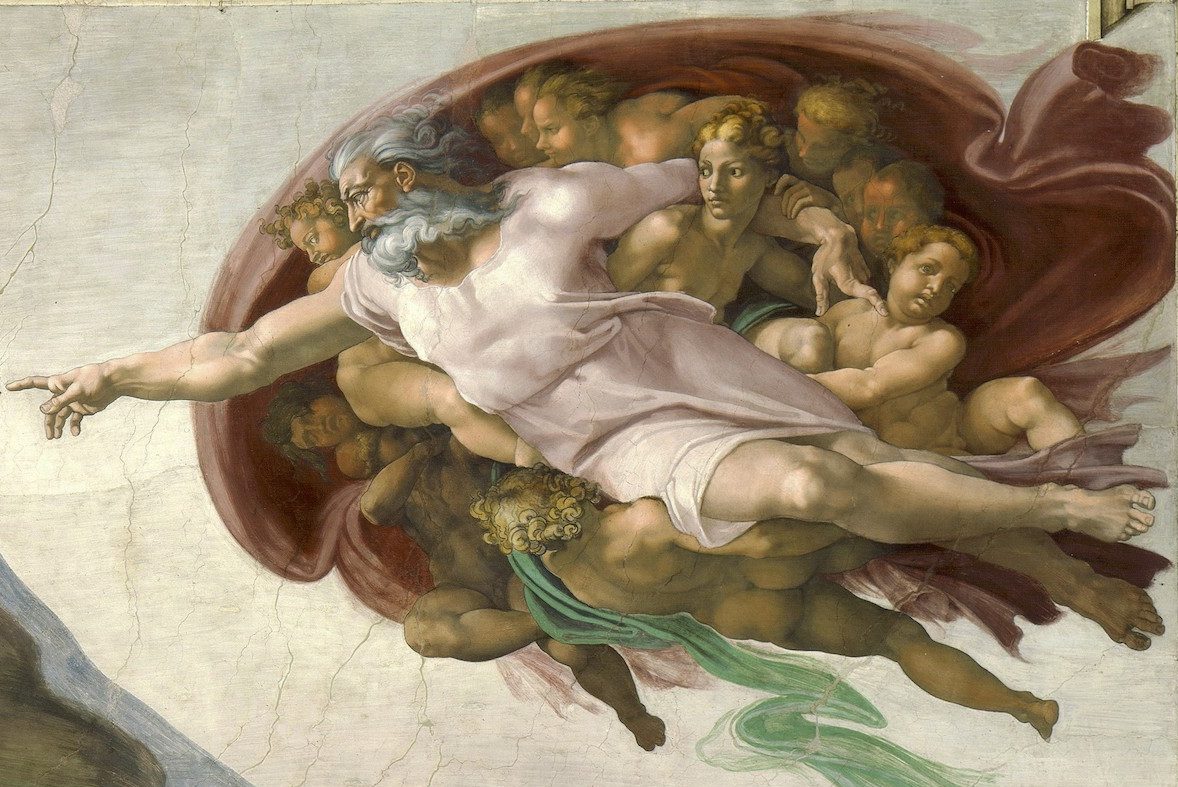
The Christian mythos centers on the embodiment of the divine in a living, and suffering, world. What the church offers us is a treasure-house of embodied meaning that our souls can turn to for sustenance. It incarnates the sacred in a narrative or mythos, stores it for us in ways that can be accessed through ritual, and through the language of poetry and music, as well as through art, and icons, and the beauty of an architecture that provides a tangible instantiation of all of this. It is not that they do not speak to one’s emotions and intellect, but that they transcend any such terms. It is to the soul that they speak. They make the things we otherwise can only talk about palpably real.
The other great embodied treasure-house of the divine, of course, is the lives and deeds of the saints, as they are passed down to us. They speak to us of what at our best human beings can be. And here I would include all those unnamed and unremembered “saints” whose lives spoke of their beliefs, in the performance of selfless and compassionate actions, sometimes at very great cost, cost even of their lives. As Pope Benedict XVI reflected: “The only really effective apologia for Christianity comes down to two arguments, namely the saints the Church has produced, and the art which has grown in her womb.”
All this language, that is importantly so much more than language, is also importantly shared with others across time and space, and down through generations, finding its way into the very fabric of everyday life. While it is a wonderful thing for people to find their own spiritual path, I fear that we need more than good intentions and private spiritual experience if we are to survive. If this civilization is to be saved, and we all know how urgent that need is, there must be more: nothing less than a return to the place of the Christian tradition at the core of life, daily life. I don’t know how likely this is; however the signs are that people, particularly perhaps young people, are realizing the bankruptcy of the materialist position, and are seeking more nourishing sustenance.
Part of this is to do with the absolutely core insight that this is not a world of things, but a world of relations. Over the last hundred years, the reality of this has been emphasized, in modern physics, of all places. This is, as the great physicist John Archibald Wheeler put it, a participatory universe. That means that our consciousness makes a difference to what happens. This is part of a reimagining of the world that I have elaborated in Part III of The Matter with Things, and is one of the three ways in which the title of that book can be read. We believe the world is made up of things, but as I argue, things are secondary to relations — relations come before relata. There is a vast body of psychological research which shows that it is relationships with one another, bonded by shared values and beliefs, our relationship with nature, and our relationship with the divine cosmos that constitute the three great factors that give meaning and fulfillment to life.
If you wanted to destroy a people, you would teach them to be alienated from the past and careless of the future. That self is everything and that all factors that tend to limit total freedom are to be scorned and rejected. That societal traditions and loyalties are nothing more than inconvenient trammels. You would extract them from, and alienate them from, nature in all her forms — nature out of which we are born and to which we return. You would teach them that only simple people adhere to a religious tradition and way of life. The predictable consequences of this would be massive increases in existential anxiety, depression and a pathological self-absorption, in which all the deep causes of human fulfillment would have been cut off.
As Emerson put it already in the 1830s, man has become the dwarf of himself. Self-respect (and I do not mean self-esteem, a much over-rated quality) has been eroded by mass society in all the ways so trenchantly identified by Hannah Arendt, and recently we have been relentlessly dragooned into a belief that we are inefficient machines. Yuval Noah Harari calls us hackable animals and recommends we should get used to the idea and even embrace it. In January this year he spoke at Davos to the World Economic Forum. “Artificial Intelligence is the new master of words,” he said. “It will take over language, law and power. Most of the world of the mind will originate in a machine. AI has coined a new word for humans —‘the watchers’. AI machines can lie better than humans.”
Low self-respect leads to moral degeneracy, deceitfulness, selfishness, lower achievement levels and addiction. This is where I believe we now are, and we need to rediscover what our right hemispheres know at a deeper level, but have been taught to disattend to and disregard.
The right hemisphere alone has the capacity to understand the depths of meaning required by those who would approach the ideals on which Western civilization was founded: Plato’s the good, the true and the beautiful. And I would add, at the pinnacle of all, the sacred. Without this wiser understanding, human life is already over.
But life can be snatched from the jaws of death. We matter and there is hope. That too is the Christian story.
This is an edited version of a speech delivered at the Pusey House Revival Conference.