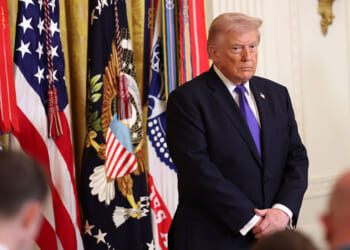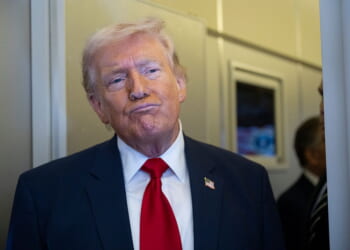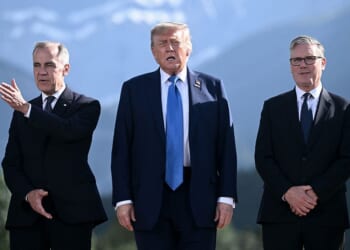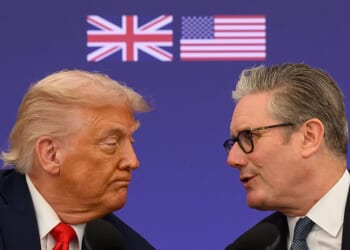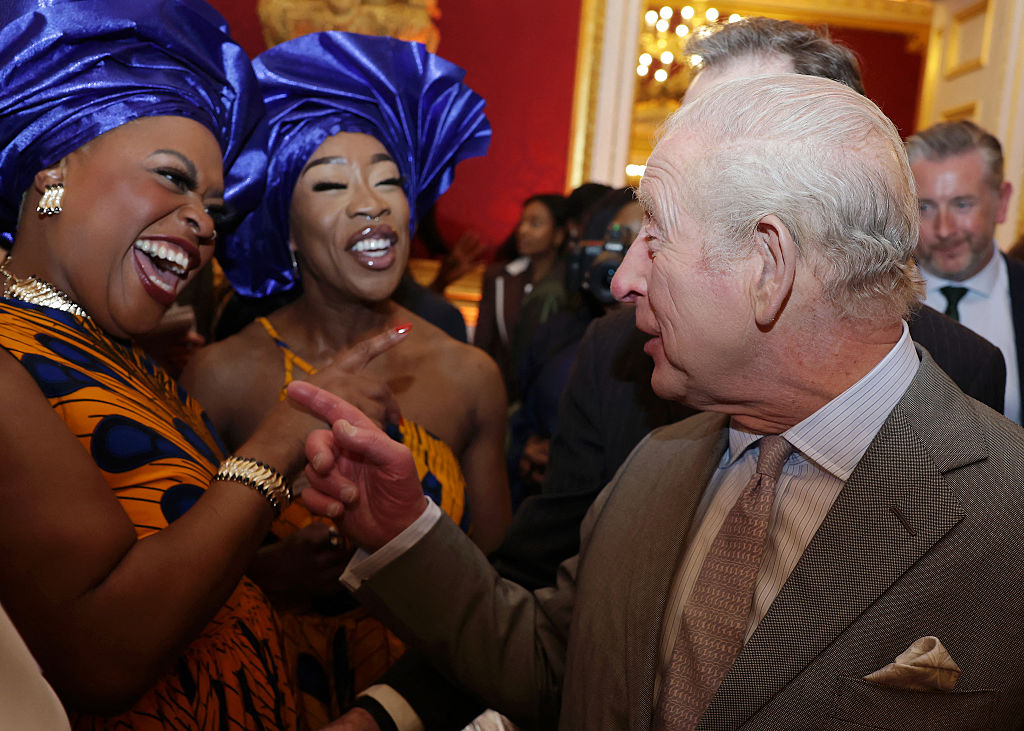
The last time Britain hosted Nigeria for a state visit, the world felt almost impossibly different. Just look at the pictures: Queen Elizabeth, a spry 63; Ibrahim Babangida, an old-school military hardman who took power in a coup and clung on for nearly a decade. Yet more than the principals, it is the context of the last grand meeting between a British monarch and a Nigerian president that now feels so strange.
Back then, after all, the United Kingdom was a fairly prosperous, settled nation, and would soon be on the winning side of the Cold War. As for Nigeria? A dictatorship with some crude oil. Now, of course, everything has changed. As Elizabeth’s son welcomes Bola Tinubu today, it’s Nigeria, not Britain, that holds the best cards. Indeed the UK’s long-term prospects feel rather uncertain — precisely why courting Nigeria, and countries like it, is so important to its future.
For much of the post-Cold War period, Britain and its Western allies could sort the world into two broad zones: stable and unstable. In the stable countries, money was safe, governments were predictable and the future discernible enough for long-term bets. In the unstable places, governance was erratic, investment risky, and violence never far off. This mental mapping had real consequences, shaping where capital, attention and diplomatic respect all flowed.
Nigeria long sat on the wrong side of that divide. With Marxist-Leninism just about still a going concern, the anti-communist Babangida was an important friend to have, likely explaining the 1989 state visit. At the same time, though, Nigeria’s economy was taken far less seriously. Through the Eighties and Nineties, after all, the country lurched through coups, aborted transitions and IMF austerity schemes, while its politicians acquired a reputation for predation and volatility. As late as 2016, David Cameron was filmed describing Nigeria as a “fantastically corrupt” country.
Over recent years, of course, our neat ideas of stability and corruption have started to collapse. A major war has raged on European soil for four years now, with the Baltics and Poland fearing for their very sovereignty. The Gulf, long an oasis of affluent calm, suddenly looks much less secure. America, hitherto the chief guarantor of Western stability, is now a country whose Capitol can be stormed by an angry mob, and whose president can levy tariffs or launch foreign adventures overnight. As for Britain, one-in-three Britons now believe civil war could occur here in the next decade.
This does not mean that Britain or America are “just like” Nigeria. But it does mean that disorder, or at least the serious prospect of it, is no longer something that simply happens over there. That in turn changes the relative position of countries like Nigeria. Their problems hardly vanish, but they no longer look like uniquely disqualifying flaws in an otherwise ordered world. Now, Britain’s Business and Trade Secretary Peter Kyle says that “the UK and Nigeria share a belief in the power of enterprise, innovation and education” — with a new strategic partnership between the two countries promising a flourishing of finance and fintech jobs.
To be clear, Nigeria still remains a difficult, exasperating country, whose promise has long been squandered by its own elites. Tinubu himself is hardly the personification of clean government, with allegations of corruption trailing him throughout his career. In this, Nigeria’s president shares much with the country’s broad political class. For instance, a court in London is currently hearing bribery charges against Diezani Alison-Madueke, Nigeria’s former petroleum minister, who supposedly spent £2 million at Harrods gotten from industry figures keen on government contracts.
Meanwhile, though wealthier now than they were in 1989, most Nigerians remain poor, even as the state struggles to deal with a plethora of jihadist terrorists and criminal gangs. Kidnapping for ransom is so rife that it’s become a multimillion dollar industry of its own. The country’s size and natural resources have often made outsiders assume its eventual success is somehow inevitable. It never was — and isn’t now.
Yet it’s also true that Tinubu’s government, in power since 2023, has done something previous Nigerian administrations long avoided: embarking on reforms that acknowledged the country’s economic model was bust. Oil rents, import dependence, the sheer hustle of its citizens — none of these make an advanced economy. The broad direction of Tinubu’s changes, including lifting fuel subsidies and generally liberalizing the economy, have won praise from the IMF and World Bank. This matters not because their approval is all that matters, but because many Nigerians agree that the old system was unsustainable. The year before they were removed, the fuel subsidies consumed a quarter of Nigeria’s budget.
What many Nigerians rightly complain about is the brutal way in which Tinubu’s reforms were implemented. For instance, the sudden removal of fuel subsidies has drastically raised costs, with some basic staples now costing two or three times what they used to. That’s a big deal in a country where poor households spend up to 70% of their income on food. In other words, then, measures that look rational on an IMF spreadsheet can feel like punishment to regular citizens, especially if they’re already distrustful of their rulers. With 8-in-10 Nigerians expressing little to no trust in Tinubu’s government, he certainly has his work cut out for him.
Yet if Tinubu’s reforms succeed, Nigeria’s strategic position offers reasons to cheer. Aside from the country’s transition to democracy, the country’s GDP has also jumped eightfold since 1989, while its population has tripled to around 230 million, roughly 60% of whom are under 25. This makes Nigeria one of the youngest nations in the world, in sharp contrast to the aging societies of Britain and the wider West. That youthfulness offers both opportunities and risks in a land where some estimates put youth unemployment at around 50%. Fail to create enough jobs and the government is in trouble.
Nonetheless, Nigeria’s youthfulness remains a strategic fact. And besides, it has other strengths Britain can only dream of. Alongside the crude oil reserves it’s long been famous for — especially helpful given events in the Middle East — Nigeria also enjoys significant deposits of lithium, beryllium, zinc and other metals critical to technology supply chains. Britain needs access to critical minerals to power its renewable, high-tech and defense industries, even as it actively seeks to “full-proof” its supply chain over the years ahead.
Britain has more basic reasons to cultivate economic ties with Africa’s most populous nation too. Since 2008, its GDP per capita growth has fallen to a sluggish 0.46% per year, hardly enough to cover the galloping rise in living costs. The country’s long-run economic story is hardly cheering either. In that context, a fast-growing market of over 200 million people looks less like a realpolitik ally — and more like an opportunity. Britain and Nigeria already do about £8 billion of trade a year, and British ministers have spent the last two years pushing new agreements in legal services, finance, education and energy. And why not? This is precisely the kind of fast-growing, English-speaking market Britain cannot afford to dismiss.
The feeling is mutual. For decades, and despite being such a vast oil producer, Nigeria imported much of the refined petroleum it consumed: its own state-run refineries barely functioned. Now, though, Aliko Dangote, Nigeria and Africa’s richest man, has built one of the world’s largest oil refineries in Lagos, spearheading investments in steel as part of a broader industrialization push. These are the most serious recent attempts to drag Nigeria up the value chain, and Britain can prod things along with targeted investment.
All the while, Nigerian immigration to the UK, reckoned to be around 300,000 over the last five years, means that the country’s cultural influence has blossomed too. Afrobeats stars now fill arenas and top music charts the world over, while the Nigerian diaspora is helping shape British society from KSI to Bukayo Saka — to Kemi Badenoch.
Altogether, then, it’s clear that Britain needs meaningful relationships in the rising global south, relationships based on more than postcolonial guilt, paternalism or nostalgia. In our increasingly dangerous geopolitical age, friendship is not ornamental. Rather, it shapes supply chains, diplomatic leverage and investment decisions. Britain can no longer simply announce its importance everywhere. It has to work out where history, language, and diaspora networks give it a real foothold, then build out from there.
“Britain needs meaningful relationships in the rising global south”
Nigeria is one of those places. And while some on the fringes of British politics — both the radical Right and Left — are uncomfortable with that fact, Nigerians themselves seem far more relaxed. As a 2020 Ipsos survey of young Nigerians found, Britain’s people, government and institutions are the most trusted among foreign nations. Tinubu’s office has described Nigeria and Britain as sharing a “special bond”, while many wealthy Nigerians send their children to British universities, maintain homes here, and consider London a serious place to do business. Nigerians who live or spend most of their time in Nigeria itself have little time for the performative anti-colonial waxing some British-Nigerians indulge in here.
That, in turn, should prompt a change in British sensibility. A mature relationship with Nigeria cannot be conducted as though London still dispenses order while Nigeria merely receives it. The old imperial habit — part condescension, part nostalgia — is now not only unattractive but also impractical. If Nigerians are prepared to engage Britain as an equal, Britain will have to learn to reciprocate.
Whitehall is already learning these lessons in its dealings with countries like India, where capital, demography and strategic leverage increasingly matter more than inherited assumptions of rank. That is likely to become one of the century’s governing patterns: former imperial subjects, or once dismissed peripheries, gaining influence as Western states lose their monopoly on confidence. The sensible response is neither sentimentality nor resentment, but realism.