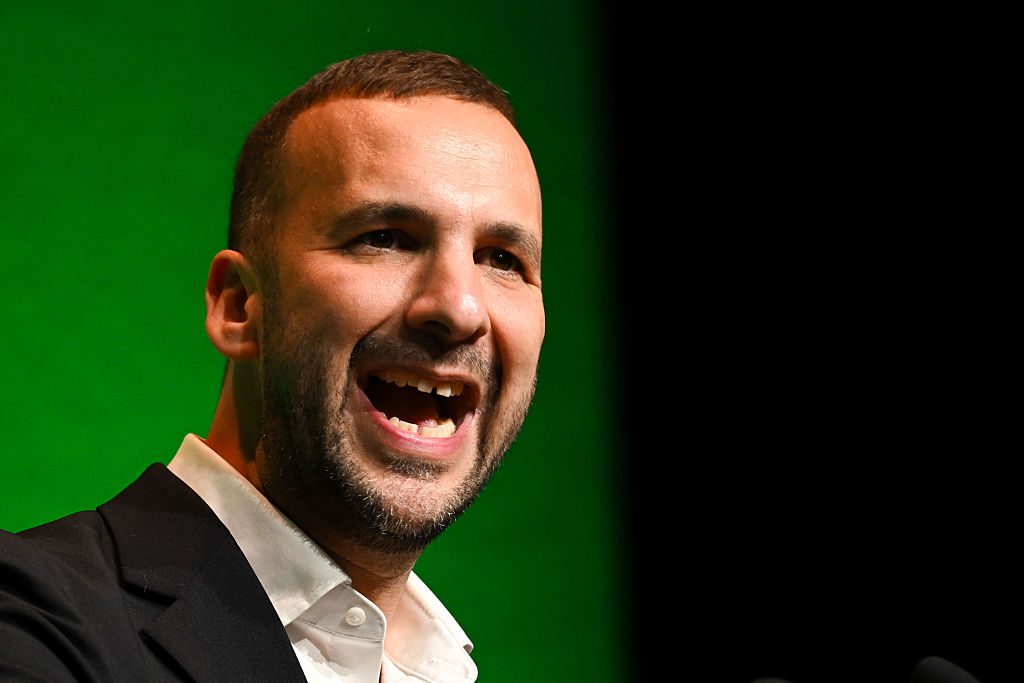
It seems Kenneth Waltz’s maxim applies as much in online politics, as in international relations: power begs to be balanced. To no one’s particular delight, the balance to Nigel Farage’s Reform turns out to have the same vibes-based quality as Reform, and be led by a figure every bit as virally Marmite: Zack Polanski.
But this is about more than internet virality. The displacement of “traditional” Left and Right politics by this louder, more polemical register reflects a reality no one wants to confront head-on: one that self-identified “Greens” used to talk about a great deal but have, under Yookay Mamdani, largely discarded. Namely: the prospect that never-ending growth might, one day, come to an end.
From the radicals of Deep Green Resistance to the less extremist small-farm advocacy of Chris Smaje, the post-growth economics of Tim Jackson or the “collapsonomics” of Dark Mountain, less optimistic environmental advocates always pointed the finger at growth itself, as the real villain of the story. For “degrowthers”, the natural order imposes its own, inherent limits — and these cannot, in the end, be evaded.
But at least, in Britain, degrowth isn’t a vague future threat. It’s a reality, some years in the rear-view mirror. In this unhappy context, Reform and the Greens are insurgent because they embody, respectively, Right- and Left-coded versions of the politics of scarcity. And if the erstwhile environmentalist party seems to be pivoting away from anything hitherto recognisable as environmentalism, this is for the same reason. The actual implications of degrowth are so horrible that even the erstwhile “green” party will do anything it can to keep the lights on a little longer, up to and including cannibalising everything that’s still remotely green, or indeed pleasant, about the British Isles.
Much has been made of Reform snapping at Starmer’s heels, from the Right. Farage’s party’s membership now outstrips Labour’s: 268,000 to a plummeting Labour membership, now below 250,000. But if Labour are hated by the Right for over-taxing ordinary Brits while failing to protect the borders, They’re also hated from the Left for not taxing enough, and being too fashy about foreigners. Now, especially since the failure of Corbyn’s “Your Party”, Polanski is mopping up those who embrace this view: he’s taken his party membership from 123,000 to 180,000 members since October. News broke on Monday that five Labour councillors in Brent, a Labour heartland, have defected to the Green Party. His thing is working.
How, and why, are these populisms now so, well, popular? Internet virality is a factor: poor Keith-GPT just doesn’t have what it takes to cut through. For viral engagement, in an attention economy, you need something of the carnival barker. You have to be box office. But at the risk of stating the obvious, it’s also the economy, stupid.
As Johnny Ball recently noted, in Britain the economy has been flatlining for almost two decades. After the crash QE bailed out the banks and inflated the price of assets, while Osbornomics deliberately let real-terms wages stagnate. Living standards for normal people haven’t really grown since the crash. For many they have palpably declined. Over the same period, as angry young people often point out, the once-negligible earnings gap between Britain and America has grown into a chasm. The Poles who flocked here to arbitrage thewage differential between our country and theirs in the 00s are all flooding the other way, as their economy booms and ours circles the drain.
This is a problem. For everything from Britain’s housing market to the NHS is predicated on growth. What, then, happens when the music stops? Perhaps the most prescient allegory for this was the 1973 dystopian sci-fi movie Soylent Green. Set in the year 2022, it depicted a world where environmental catastrophe has wrecked the food supply; then, a new source of nutrition is created and distributed, called “Soylent Green”.
“For “degrowthers”, the natural order imposes its own, inherent limits — and these cannot, in the end, be evaded.”
Over the course of the movie, the protagonist discovers that Soylent Green is produced by processing the corpses of humans killed via medically assisted suicide, into food for those still alive. It’s a potent metaphor for a society that no longer produces a surplus, and has resorted to maintaining the illusion of vitality by cannibalising itself.
In Britain, this is already at least figuratively true. (If “Skeletor” Leadbeater gets her way, perhaps it might yet be literally so, as well.) Years of Osbornomic synthetic growth, juiced with financial QE, have been further eked out through what has recently been dubbed “human quantitative easing”: that is, wage suppression via mass low-skilled migration. This was, tacitly, embraced as bipartisan orthodoxy: after Brexit forced Johnson’s Tories to close the EU route for human QE, Johnson averted a painful correction by opening the Commonwealth spigot in its place.
Whatever you think of this decision, it was pragmatic. Britain is so addicted to the high-migration model that short of painful structural change, keeping the Ponzi scheme afloat means Britain really does, as the patrician Left is fond of asserting, “need migrants”. Never mind the sociocultural side-effects or long-term fiscal consequences: these are managed through censorship and two-tier policing, or are simply a problem for some unfortunate future PM.
We should understand Farage’s Reform, and Polanski’s Green Party, as respectively Right-and Left-coded responses to the resulting national tinderbox. I hardly need rehash the obvious link between economic decline, mass migration, and nativism, in driving support for Reform. But it’s perhaps less obvious that Polanski’s call both for increased inward migration and also higher public spending is a response to the same politics of scarcity.
Polanski gestures toward the same observable stagnation, in tirades against the British wealth gap. But he suggests it’s not migrants we should resent, but “the billionaires” who hoover up wealth and leave nothing for the rest. It’s a mistake to blame migrants for our economic woes, he declaimed to rapturous applause at the recent Green Party conference. What’s needed, instead, is what he calls a “politics of hope”.
That seems to mean increased legal pathways for inward migration, allowing asylum-seekers to work immediately, and a fiscal programme shaped by modern monetary theory. This unorthodox banking theory argues that currency issuers (of which Britain is one) can’t default on government debt. Opponents retort that this approach creates asset bubbles, while any semblance of government control over inflation is illusory. But for MMT believers,the constraint isn’t debt but national productivity, and governments can and should spend more in order to stimulate productivity.
Put it all together, and you have a response to scarcity that’s coherent, on its own terms — but in a radically different way to that proposed by Farage. Reform’s politics of scarcity promises to save the day by stopping the boats, ending human QE, and restricting benefit entitlements to natives so we can afford to be generous to “our own”. However workable it is in practice, as a programme it implies that we can sustain solidarity by narrowing its scope. By contrast, the Green politics of scarcity rests on the hope that we can increase the size of the pie without any need to set boundaries, variously through taking more money from the hated super-rich, plus assorted forms of jiggery-pokery including opening the borders and printing lots more money.
Both the green and the turquoise versions of this politics of scarcity, in turn, appeal to different public sensibilities; in the vibes-based domain of online politics as self-expression, the Greens are now fittingly identified with “Santa” and Reform with “Scrooge”. But in different ways both gloss over inconvenient demographic challenges. Reform’s programme proposes to address demographic change by narrowing the scope of welfare entitlement — but is, at best, hopeful on native population decline. An initiative to bring back British babies is, to say the least, not a short-term solution to a dwindling tax base, and welfare commitments heavily tilted toward pensioners. Conversely, the inflate-everything approach by the Greens has little to say about the already-palpable rise in inter-ethnic hostilities as a consequence of mass migration, save bromides about “hate”, “division”, and those naughty Billionaires.
Nor is this Green programme particularly environmentalist. In a recent interview, Polanski remarked blithely that a mere 5% of Britain is built on and hence we can take loads more migrants. Lovers of British biodiversity may wish to look elsewhere for a party likely to represent ecological conservation. For Polanski’s Soylent Green Party, biodiversity is fair game for obliteration, if it keeps growth looking growthy.
The same goes for the issue that’s been the most visceral flashpoint between the old, limits-to-growth Green sensibility and the new Soylent Green one: gender ideology. Trans activism has, in recent years, driven the expulsion from the party of swathes of older Green stalwarts. And this makes sense, when you consider that this cohort was, and often still is, more likely to remember a time when environmentalists believed the core ecocidal issue is a refusal to countenance natural limits.
Greens of this subtype tend to be sceptical of gender ideology, viewing human sex dimorphism as an instance of such limits. By contrast, trans activism is premised on a categorical denial that such limits exist: it is, at heart, a Promethean vision, in which humans can literally be anything we want, given enough technology. The same attitude at scale dismisses the notion of ecological limits; allied to climate concern, it produces “ecomodernists” who see the solution to ecological crisis as pursuing more and better technology.
For this faction, the way forward might be geoengineering, or gene-editing humans, or feeding an ever-growing urban high-rise population with mould grown in vats. Should all else fail and temperatures go on rising, we can jam the whole planetary population into the world’s temperate zones, and somehow persuade everyone not to dissolve into tribal warfare.
This is the “green” paradigm that has now claimed Polanski’s Green Party. It rejects the critique of growth, in favour of every imaginable kind of quantitative easing, and assumes we can solve any problems which arise through more and better technology. Given the party’s authoritarian internal approach to the trans debate, we may reasonably wonder if “technology” would simply mean authoritarian crushing of dissent. If so, that would make Polanski’s Greens everything the Faragist end of the electorate already loathes about Starmer’s Labour party, but on globalist steroids and intentionally without any limiting Principle.
Is there any way out of the self-cannibalising predicament that produces two such unappealing political programmes? I do not know. But if we fail to find one, our choice will be one or the other of these approaches to scarcity: deflationary nativism plus authoritarianism at the borders, or inflationary borderlessness plus authoritarian management of the resulting tribal conflicts.
It is, in other words, a contest over which bit of the dead status quo becomes our Soylent Green. Do we husband scarce resources by grinding up our memories of a Britain that was generous, internationally through foreign aid and domestically through welfare? Or do we pursue growth by shoving the country’s demographic makeup in the blender? Either way, sustaining the social contract means destroying the social contract.
Perhaps it’s for the best, then, that all the anti-growth green doomers were marginalised, by the insurgent Soylent Green Party. No one wants to think about the possibility that they might have been right, about the end of growth. Not even as all of politics is consumed by the question of how — or if — we can live together in its aftermath.