OAN Staff Lillian Mann
2:33 PM – Thursday, April 23, 2026
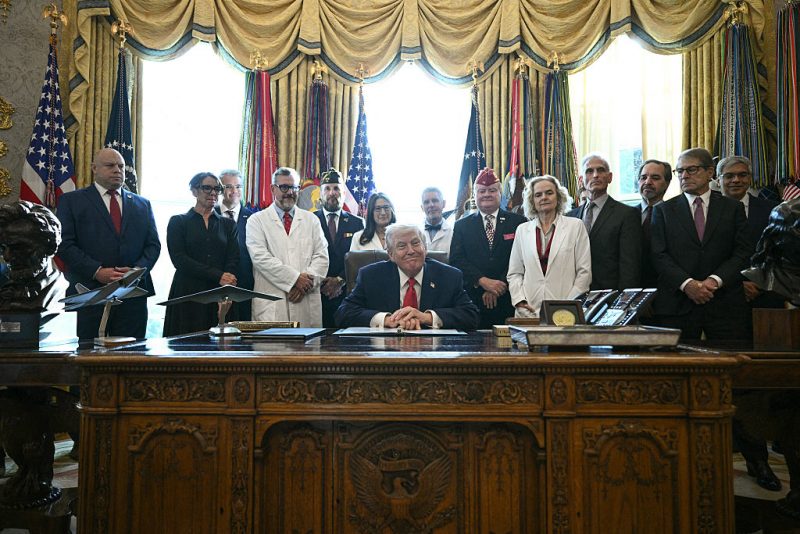
President Donald Trump’s acting attorney general of the Justice Department, Todd Blanche, signed an order on Thursday reclassifying state-licensed medical marijuana from Schedule I, alongside drugs like heroin, to Schedule III, recognizing it as having medicinal properties.
Reclassifying state-licensed medical marijuana as a less dangerous drug under federal law reflects growing recognition of marijuana’s accepted medical use, even providing a tax break to licensed medical marijuana operators.
Though the move does not completely legalize marijuana use under federal law, it does change how the drug is regulated, and impacts the 40 states that have approved medical marijuana programs.
“This action recognizes what Americans have long known, cannabis is medicine,” Blanche said in a written statement. “These actions will enable more targeted, rigorous research into marijuana’s safety and efficacy, expanding patients’ access to treatments and empowering doctors to make better-informed healthcare decisions.”
On Thursday, Blanche wrote in a X post that the order calls for an “expedited hearing” to reschedule marijuana and state-licensed marijuana, approved by the Food and Drug Administration (FDA).
“Today the vast majority of States maintain comprehensive licensing frameworks governing cultivation, processing, distribution, and dispensing of marijuana for medical purposes,” Blanche wrote.
“Taken as a whole, they demonstrate a sustained capacity to achieve the public-interest objectives … including protecting public health and safety and preventing the diversion of controlled substances into illicit channels,” he added.
The decision has faced pushback, however, with critics arguing that state-level legalization has led to increasingly potent cannabis products that warrant more extensive research before being placed in a less restrictive category.
Kevin Sabet, the chief executive of Smart Approaches to Marijuana (SAM), continues to oppose federal legalization, maintaining that the necessity of clinical research does not justify a broad policy shift. He contends that there are alternative methods for expanding scientific knowledge of the substance that avoid sending a contradictory message to the American public regarding the inherent harms of marijuana use.
While acknowledging the need for data, Sabet emphasizes that federal recognition should not come at the cost of weakening public health warnings or misrepresenting the risks associated with the drug.
“With this move, we are now confronted with the most pro-drug administration in our history,” Sabet said in a text message. “Policy is now being dictated by marijuana CEOs, psychedelics investors, and podcasters in active addiction.”
Nevertheless, Blanche said on Thursday that the Department of Justice was “delivering on President Trump’s promise” to expand Americans’ access to medical treatment options. “This rescheduling action allows for research on the safety and efficacy of this substance, ultimately providing patients with better care and doctors with more reliable information,” he added in a statement.
The Trump administration also announced that it is accelerating the broader reclassification of marijuana, with the Drug Enforcement Administration (DEA) scheduled to begin administrative hearings on June 29th to evaluate the formal rescheduling request.
“Under the direction of President Trump and Acting Attorney General Blanche, DEA is expeditiously moving forward with the administrative hearing process — bringing consistency and oversight to an area that has lacked both,” DEA Administrator Terry Cole said in a statement Thursday.
This historic change clarifies that cannabis researchers will not be penalized for obtaining state-licensed marijuana or related products for use in their work, and it also provides a financial boost to state-licensed medical marijuana companies by allowing them — for the first time — to deduct business expenses on their federal taxes.
Since 2015, Congress has barred the Justice Department from using federal resources to shut down state-licensed medical marijuana systems. Despite this, the order represents a significant shift in U.S. policy —which has long supported strict marijuana prohibitions dating back to the “Marihuana Tax Act of 1937” —regardless of the fact that many states have since approved cannabis use in some way.
Last December, President Trump signed an executive order directing officials to expedite the marijuana rescheduling process to expand cannabis research, while describing the effort as a step toward improving medical understanding. However, at the time, he also warned about the negative effects of recreational marijuana use and emphasized that he would not lift the federal ban in place.
The president of the American Trade Association for Cannabis and Hemp (ATACH), Michael Bronstein, called it “the most significant federal advancement in cannabis policy in over 50 years.”
Stay informed! Receive breaking news alerts directly to your inbox for free. Subscribe here. https://www.oann.com/alerts
What do YOU think? Click here to jump to the comments!
Sponsored Content Below