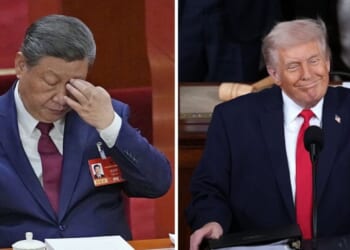
The Iran war, entering its seventh week, has upended the global economy, sparking energy crises worldwide. The United States received its first glimpse of how the conflict has impacted consumer inflation, past the initial shock of $100 crude oil and $4 gas. Beyond the headline reading, the underlying figures were not too bad, at least for now.
Inflation and the Iran War
President Donald Trump may have flown too close to the sun. After avoiding a devastating inflationary event with its sweeping global tariff plans last year, the administration now risks an oil price shock that could ripple through the US marketplace, raising costs for businesses and households across the country after enduring four years of Bidenflation.
March’s Consumer Price Index (CPI) was the first major inflation report since the beginning of the Iran war. Everyone anticipated a spike driven by higher oil and gas prices, so the initial glance was not particularly surprising, given what the financial markets had already priced in.
The US annual inflation rate rose to 3.3% from 2.4% in February, the highest level since May 2024, according to the Bureau of Labor Statistics. On a monthly basis, the CPI jumped 0.9%. The main factor was gasoline, which rocketed more than 21%, the biggest one-month jump since the federal government published this series in 1967.
Popping open the hood and digging deeper will reveal a more benign inflation report. For instance, the 12-month core CPI edged up to 2.6%, from 2.5% in February, and below the consensus forecast of 2.7%. From February to March, core inflation ticked up just 0.2%. This is critical because the core portion of the monthly CPI report represents underlying and structural inflation trends.
The biggest surprise was the food index, holding steady last month. But supermarket prices slipped 0.2%, with various protein-rich foods registering notable declines, from beef and veal to pork. Eggflation was also scrambled in March, tumbling another 3% month over month and tanking almost 45% year over year.
The other notable shocker was the lack of price pressures for tariff-sensitive goods. Outside of apparel, which surged 1%, various products prone to tarifflation posted significant declines or tepid changes. Appliances declined by 1.6%, followed by smartphones and televisions (negative 1%). New vehicles ticked up 0.1%, while canned fruits and vegetables were flat.
So, the Iran War edition of the March CPI was a case of the good, the bad, and the ugly.
Not Out of the Woods
Last month’s inflation numbers did not come out of nowhere. At the same time, economic observers and monetary policymakers are worried about what could come next. The April CPI should remain elevated, with the Cleveland Federal Reserve estimating a 3.6% reading. But what about May and June? This is the chief concern since the longer the conflict drags on, the worse it will be for prices and potentially the broader economic climate.
Kristalina Georgieva, the International Monetary Fund (IMF) director, warned ahead of the IMF-World Bank spring meetings on April 9 that even the rosiest outlook assumes downgraded growth due to the “scarring effects” of the conflict. From oil refinery disruptions to shortages of key inputs and consumer goods, the worldwide marketplace could be in store for some pain.
The war could stop tonight, but it would take several months for conditions to return to pre-war levels. Countries are imposing price controls, places are experiencing fuel shortages, energy producers are witnessing infrastructure damage, and businesses are still navigating tariffs. Plus, as Liberty Nation News recently noted, it could take several months for fuel prices to fall below $3 again due to the asymmetrical price transmission of oil and gasoline.

Another threat to growth prospects could be monetary policy. If the jump in inflation is a one-off, central banks will continue to sit on their hands. However, if the 2% target remains out of sight, the Federal Reserve and its counterparts could consider raising interest rates. All of these institutions have already expressed openness to tightening monetary policy, and Georgieva acknowledged this, given governments’ limited fiscal stimulus options.
How consumers respond to prolonged gas prices is another factor. Early data from Bank of America suggest household card spending remains solid, even after excluding gas purchases. Conversely, the University of Michigan’s preliminary April Consumer Sentiment Index cratered to a record low, and the one-year inflation outlook climbed to 4.8%.
Why, Trump? Why?
President Trump averted disaster with tariffs. He struck oil (literally!) when there was little fallout from the Venezuelan regime change operation. US stocks kept hitting record highs, inflation was heading toward 2%, and even the budget deficit was showing signs of improving. With a few months until the midterm elections, inflation headaches and a conflict in the Middle East threaten Trump’s Republicans and their chances in the House and Senate.