“I have always had an inner and unaccountable conviction that any religious expression of truth, however bizarre or uncouth, is more sufficing than any secular one, however elegant and intellectually brilliant.” So wrote the famous Christian apologist Malcolm Muggeridge in his autobiography. Luckily for him, he died before Russell Brand’s new book could test that belief. How To Become A Christian in Seven Days is the first work to emerge from Tucker Carlson’s new publishing imprint; and it’s the biggest stroke of luck atheism has had in a while.
The book purports to be a practical guide to conversion: self-help, except that the idea is to give your sinful self over to God, following the path Brand himself has purportedly trodden from debauchery to devotion. Conceptually — if one can use a word like that in this context without immediately collapsing into hysterics — the project is loosely based on the 12-step program of Alcoholics Anonymous, of which Brand is also a fan. This means there are tasks to complete at the end of each chapter, including some fearless and searching personal inventories. For instance: “One by one, go through the seven characteristics of God. Where are you clenching?”
There are also prayers composed by Brand for readers to recite, though fans of the Nunc Dimittus should not get their hopes up (“Almighty God, Beloved King. Dad. Dad. Alright Dad. You are everything that is and could be and you love me.”) There are arguments with ChatGPT about biblical interpretation; a comic dialog between the Old Testament’s David and Nathan; some blather about how Brand’s vision is of a cool hipster Jesus, not the dusty old geezer beloved of Songs of Praise (“They made the Son of God as appealing as a cat-tongue enema”). But really these aspects are window dressing, a desultory pretext for what Brand has always liked best — talking about himself.
In circuitous fashion, he describes the personal events that have drawn him to Christianity, from the genuinely harrowing (his baby son facing open heart surgery) to the relatively quotidian (the death of his dog). The writing gets most focused when explaining how accusations of rape and sexual assault have been rustled up against him by shadowy elites, putting the “demon” into demonetization in order to stop him talking truth to power about Covid jabs. And there are also a few enjoyably savage jibes about his ex-wife’s new globalist squeeze.
“To call this a stream of consciousness is an insult to consciousness.”
Most of the time, though, the prose style is so unbearable it eclipses every other consideration. To call this a stream of consciousness is an insult to consciousness — it feels more like a fugue state. There are attempts at ecstatic lyricism that could just as easily be diary entries of a teenage serial killer: “Consider that within you… there is a portion of the divine, shooting, roaming, spreading, and searching, and the function of the world is to entice, enchant, wrap, and shellac it, a new and choking womb”.
Other metaphors are similarly lunatic: “My wife bears some wound of the woman, some mythic anathema to me, the man. Yet, like the island of Japan, she knew that trouble would come if she opened up her shores.” Then, punctuating the grandiose drivel, come hairpin lurches into the old Nineties Britpop tweeness: feet as “tootsies”; food as “mouth munchy din dins”; the disciple John as “needy and queeny”. And it turns out Brand hasn’t even read the Bible at all, but only Nicky Gumbel’s The Bible in One Year.
There is also the disingenuity of the timeline. It may be traditional to take conversion stories at face value, but I’m afraid I’m calling it. Brand was charged in April 2025 with historical offenses of rape, oral rape, sexual assault, and indecent assault, said to have been committed between 1999-2005. The case has yet to come to court. The charges followed a year or two of newspaper allegations and civil suits from alleged victims, during which he had plenty of time to get a new spiritual story straight.
Having flirted with the wackier edges of the wellness movement for a while, his conversion to Christianity came in 2024, marked by an unassuming little baptism in the Thames, with celebrity survivalist Bear Grylls as the celebrant. Within three months, Brand was himself performing full immersive baptisms in his Y-fronts, again in front of cameras: “It might seem a bit soon to be baptizing people, but the Apostles did it on day one, so here we are.”
To call his new role as celebrity preacher brass-necked is an understatement. Even Jonathan Aitken waited 18 years before he dared become a vicar. Yet in Brand’s version, there is no need for circumspection because he is innocent. Though keen to play up his “broken” past, he says that he would never rape anyone, and besides, there was never any need; sinful fornication with willing “shopkeepers and realtors and masseuses and waitresses and photographers and doctors and lawyers and movie stars” was already available to him. Or as he also puts it, apparently unaware of events in Genesis: “If you own an orchard, you don’t steal apples”. Indeed, apart from Jesus, the biblical character Brand seems to identify most with is David and his “adulterous, exploitative, wrong, but consensual seduction of Bathsheba”.
Of course David was also famously a slayer of giants, an image to which Brand seems strangely drawn as he fights his own Goliaths: the powerful figures in the background who foisted vaccines upon the world, secretly engineered the destruction of the Twin Towers, want you to consume porn, don’t want you to read the Epstein files, and aspire to control “all trade, banking, communication, biometrics, attention, life itself”. And if that sounds potentially a bit antisemitic, I think you might be right. There’s a weird rant early on in the book about the “satanic” globalist message behind Yuval Harari’s Sapiens, said to be favored reading both of Obama and the “slobbering Santa Claus of the New Order”, WEF founder Klaus Schwab. (There are also disclaimers that do a bit too much protesting: the book is “admittedly excellent”; and “I’m not suggesting that Yuval Noah Harari is evil, by the way, or anything other than a nice man and a good writer”.)
As I watched Brand promote his book on the Tucker Carlson show this week — prefaced by another freeform prayer that certainly had me clenching — I wondered whether it was wise to have written it. The project seems quite risky. During one of his motormouth livestreams, viewers susceptible to Brand’s charms can mentally zone in and out while doing other things, and come away with a distracted impression of sincerity, humor, or cleverness. But when forced to concentrate on his words on the page, placed in consecutive order and shorn of the accompanying visual circus, the mirage disappears.
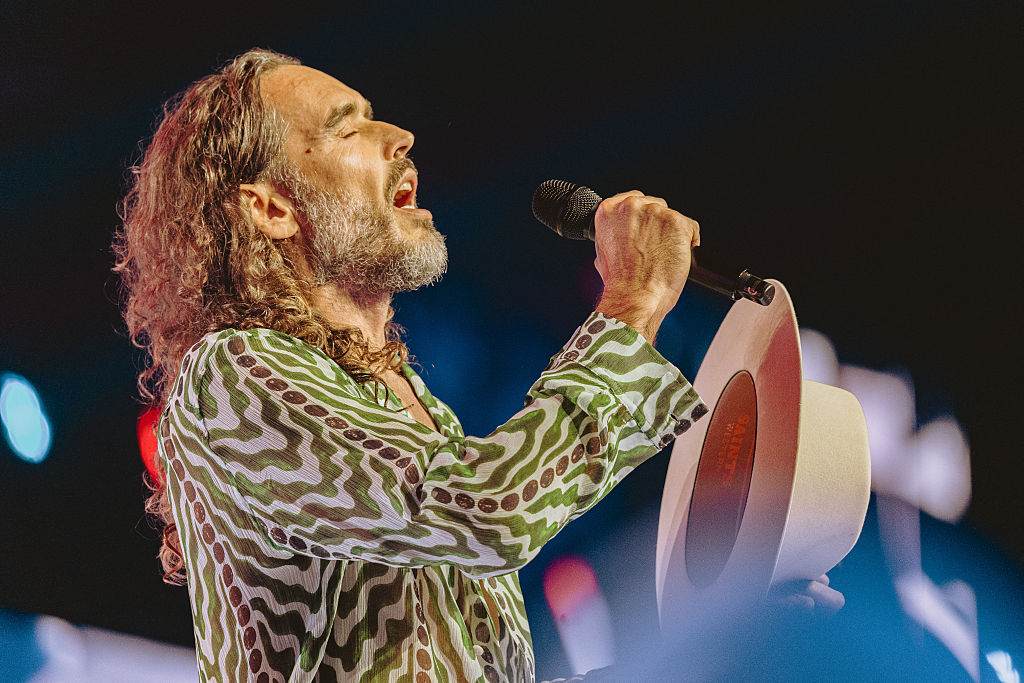
And I can’t think the book will sell many copies. The crunchy hippies and anarchists still in his audience, carried over from lockdown, will presumably remain unmoved; while the newer MAGA lot don’t need lessons on the Bible from a louche foreigner dressed in leopard print. It is impossible to imagine anyone being persuaded to attend church for the first time after reading this book.
But perhaps — along with atheism — more organized forms of Christianity still have something to gain from the spectacle. Shaped by the internet, narcissistic obsession is a spiritual blight on our times, the unsilent killer of meaningful lives. The norm for millions is now to spend life in a haze of self-fascination, curating social media outputs obsessively, trapped in fantasies of approval or disapproval from others and feeling like one’s entire worth depends on the fact. Brand seems vaguely aware of this in his book, calling his earlier self a “living endorsement of promiscuity and aspartame narcissism”, but then simply folds the convoluted insight into yet another round of compulsive peacocking, with the cross as a prop.
Organized Christianity contains many an antidote to this contemporary poison: the emphasis on humility and self-sacrifice, the call to private good works, the primary focus on the quality of one’s relationship with other people and with God. Whether or not the so-called quiet revival is real, it seems there is spiritual hunger abroad, and unexpected movement towards Catholicism and Orthodoxy, even amongst younger people. The reasons for this are unclear; but an underrated explanation is surely the relaxing absence of the self during participation in the ancient rite. You can empty your mind out, let the old words flow, and become part of something greater.
For anyone sickened by the constant mental pressure of the tawdry self — and the way that modern forms of Christianity so easily bend to it — it helps to have someone like Brand in the world as an object lesson: a living embodiment of what happens when self-obsession takes the wheel and calls it Jesus. The man himself won’t care, though; negative attention is still narcissistic supply. And anyway, he has other things to think about: not least, his newly-announced intention to run for the London mayoralty in 2028. If you’re thinking of a spiritual retreat in a monastery — perhaps somewhere with a strict no-internet policy — now might be a good time to plan it.