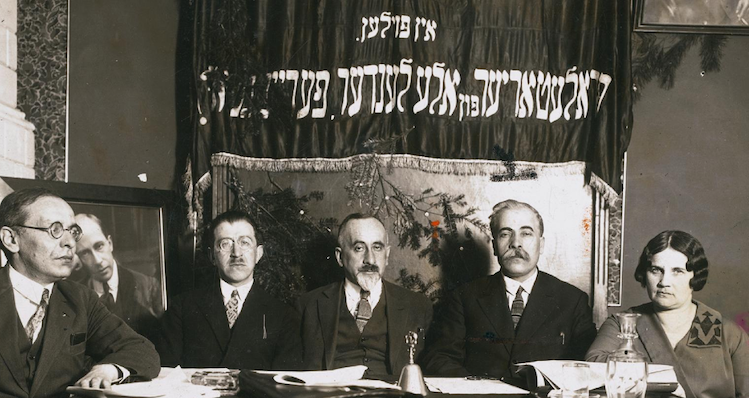
Yesterday, the New York Times review of Molly Crabapple’s forthcoming book on the Bundists and her family’s connection to them sparked a rare moment of Jewish agreement across the political spectrum. While certainly not unanimous, the prevailing (and correct) opinion among Jewish writers was that Crabapple’s book—and Max Strasser’s starstruck review of it—exhibited a heartfelt nostalgia for a time and place that never really existed.
This particular example of such misplaced nostalgia is unique to anti-Zionist Jews. The headline—which to be clear, isn’t Crabapple’s creation but is an accurate description of her work, as she readily shows in an interview with the Forward—is “What Does Judaism Look Like Without Zionism?”
What does Judaism look like without a past and nowhere to go? Pretty bleak, actually.
Crabapple’s book is called Here Where We Live Is Our Country, and it is framed as the story of the Jewish Labor Bund’s twin battles against Nazis and nationalism. It is, then, a fictional story. The idea behind the title is key to much of the commentary on the book and its subject: that Jews thought of their homeland as wherever they were.
What Bundists meant by this, however, is lost on the Bund’s modern-day admirers.
The Bund was not anti-nationalist; it was anti- what people conceived of as a particular kind of territory-based nationalism. In fact, I would be interested to know if those who long for a time of Bundist anti-nationalism would sign up for what Bundists claimed to want.
The most prominent theorist of the Bund was Vladimir Medem, a Jewish Marxist political figure in early the 20th-century Russian empire. Medem, and the Bundist line of thinkers who floated around him and who tried to carry his torch later on, believed that nations existed within larger polities, but that they had nothing to do with territory. He believed that peoples had specific cultures, and that such cultures crossed boundaries. Medem believed that territorial autonomy was simply not a solution to the problems of national minorities.
Enshrining the rights of minorities in law was insufficient to protect them from the majority. To Vladimir Jabotinsky, Zionism was the answer. To Medem—and to many others more associated with the socialist left—the answer was a different kind of Jewish autonomy. As one academic admirer of Medem wrote, “While the democratic, central institutions of the government would ensure equality of civil rights for all individuals, the autonomous institutions of national government would guarantee equal collective rights for all nations within the state.”
Equal collective rights for all nations within the state. That the advocates of this system didn’t call it “nationalism” is mostly irrelevant. Jewish autonomy as envisioned by Medem and others on the Jewish left would essentially mean the following, in practice: Jewish governing bodies running what they called cultural affairs and institutions. This included education.
In a world built around the ideas of Medem-like autonomists, either Yiddish schools would be publicly funded or Jewish governing bodies would be given the power to tax all the Jews, and only the Jews, to pay for these and other institutions.
Bundist theorists weren’t assimilationist—Medem himself seems to have conceived of assimilation as a nefarious capitalist plot of some sort. Jewish autonomy was a mainstream idea among Jewish leftists just as much as it was among those who eventually became known as “rightist.” Socialist Jewish writers and thinkers envisioned a sort of Zionism-lite—with the key difference being that it would apply in the Diaspora.
Let me simplify this. If I were to live under Jabotinsky’s idea of Jewish autonomy, I would be governed by Jews in the Land of Israel—if I chose to move there. But under Medem’s idea, I would be governed by Jews in America (though also by a secular national government). Rather than pay synagogue dues to the shul of my choice, I’d most likely be paying an annual Jew tax.
The triumph of Zionism over Bundism maximized Jewish freedom. But it also had the same effect on Jewish security. We’ll never know if the Holocaust would have happened as it happened had there been a State of Israel at the time. Instead, the Holocaust happened during the time of the Bundists. That isn’t to blame them, obviously, for what happened. It is merely to say that Bundism wasn’t a plan for Jewish survival.
Nor was it universalist and assimilationist, two terms that ironically describe the Bund’s biggest modern-day fans. If it was “anti-nationalist,” it was a very funny sort of anti-nationalist. I’ll close with Medem’s own words, translated by Lucy Dawidowicz and published in COMMENTARY in 1950:
“When did I clearly and definitely feel myself to be a Jew? I cannot say, but at the beginning of 1901, when I was arrested for clandestine political activity, the police gave me a form to fill in. In the column ‘Nationality,’ I wrote ‘Jew’.”