In the last 58 years, the Philadelphia 76ers have won exactly one NBA Championship. That was in 1983, when two forces of nature—center Moses Malone and small forward Julius Erving—converged, finally delivering a title to a starving fan base embittered by previous playoff heartbreaks to the legendary Boston Celtics, led by Larry Bird, and Magic Johnson’s “Showtime” Los Angeles Lakers. The Bird-Magic rivalry would go on to dominate most of 1980s basketball, their cross-coastal rivalry bringing in unprecedented television deals and millions of new fans.
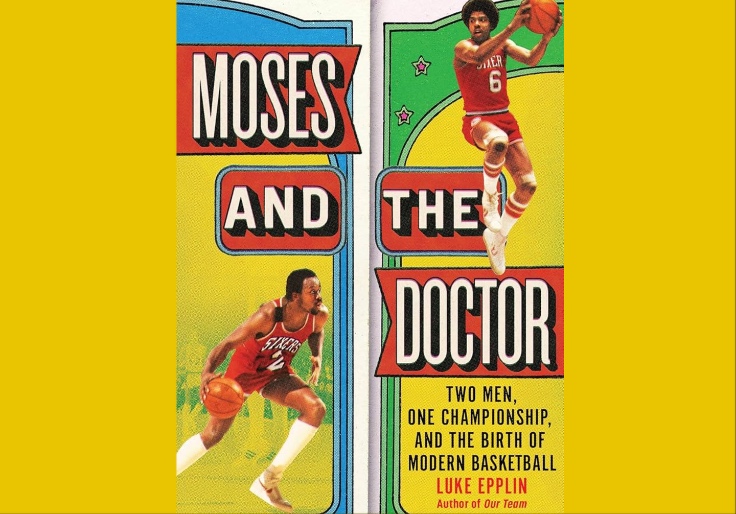
But the Bird/Magic story has been told in every medium available. What sports historian and basketball fanatic Luke Epplin does with his new book, Moses and the Doctor: Two Men, One Championship, and the Birth of Modern Basketball, is push you into an era often overlooked by writers. Epplin wants you to understand that the current state of the NBA wasn’t born simply because Magic and Bird “saved the NBA.” They were crucial, yes, but so too were Malone and Erving, two players whose careers orbited the other’s, even back when they were dribbling red-white-and-blue basketballs down the court for the American Basketball Association (ABA), a cash-strapped, spectacle-filled, slapdash hoopers league that launched in 1967 and crash landed in 1976, when most of its financially upright teams merged with the NBA.
You could make a strong case that the NBA, especially now, resembles those past ABA games more than its own history. The ABA made dunking a thing, with many teams, especially Erving’s Virginia Squires and New York Nets, giving fans a show by dunking during warm-ups. The ABA also held the first dunk contest in 1976, with Erving, sometimes called Doc or Dr. J, taking off from the foul line as he dunked. Eleven years later, in the NBA’s version of the dunk contest, Michael Jordan jumped from the foul line, an ode to the man who brought aerial artistry to the game of basketball. “In my mind,” said Jordan, shortly after winning the dunk contest, “I dedicated [the dunk] to Doc. He was the one who first made me dream about flying.”
The ABA was also the first league to use a 3-point line. Back then it was 25 feet away. The NBA, first believing the 3-point-line to be a “mockery” of the game, incorporated it into its rules in 1979, bringing it 15 inches closer to the basket. Now, decades later, the shot dominates the strategy of every game, arguably too much.
If you’re enjoying these nitty-gritty details, you’ll love this book. Epplin divides the narrative into three parts: ABA, NBA, and Merger, honing in on professional basketball during the transitional years of 1974-1983, when it wasn’t out of the ordinary for teams to fly commercial and rookies to drive to road games in nearby cities.
The first part of Moses and the Doctor is essential reading for any sports fan. Throughout, Epplin uses newspaper archives and interviews to delve into the origins of how Erving and Malone came into the sport and changed it. For Malone, it was his mother Mary, whose “meager paychecks that she brought home from her jobs as a nurse’s aide and a grocery bagger at Safeway” gave Moses just enough of a childhood in Petersburg, Va., to join local pick-up games. “If I got home at 3 or 4 in the morning, Mama didn’t worry. She knew where I was.”
Erving, meanwhile, picked up the game while living in the housing projects in Hempstead, on Long Island. “He dribbled through puddles and around sidewalk cracks until the ball became slick from overuse,” writes Epplin. “In winter, when snow blanketed the ground, Erving shoveled off a rectangle of asphalt so that he could continue launching jumpers at rims frosted with ice.”
For most basketball origin stories, there is of course the inevitable growth spurt. Malone’s came around 13, ending up around 6’10”. Erving’s came later, which meant developing guard skills, eventually reaching 6’7″.
Both men grew up poor and with absent fathers, but the similarities largely end there. Off the court, Malone had at times a gruff, terse personality. He hated speaking to reporters, but within his circle of trust he had a sharp wit and sense of humor. Erving wanted to captivate a crowd and lead with a diplomatic voice. On the court, Malone had a working-class mentality. He loved to “go to work,” sweat, and give his all, no artistry necessary. Erving was a high-flyer, electrifying crowds with his acrobatic-yet-carefully-planned dunks.
Fueled by at least 79 original interviews—including one with Erving (Malone passed away in 2015)—Epplin also resurrects the action-packed sports writing of the Philadelphia Inquirer‘s beat reporters George Shirk, Bill Livingston, and columnist Bill Lyon, who once described Erving as “the eternal Don Quixote in sneakers, all these years dunking over windmills.” If you’re a jaded Sixers fan over the age of 50, you should probably stop reading this review and go buy the book. You’ll be spellbound, and long-term memories will be jolted anew.
But if you’re only a fair-weather fan of basketball, allow me to direct you into this hypothetical…
It’s August 25, 1974. You’re 19 years old and have lived in poverty your entire childhood. Still, you have secured a full ride to play basketball at the University of Maryland. A college degree awaits. Days before school begins, a man named Morris “Bucky” Buckwalter comes to your home and sits across from you in your living room. Your coffee table is an orange crate, and Buckwalter begins slapping down hundred-dollar bills until he reaches $5,000. Buckwalter also brings out a picture of a green Lincoln Continental Mark IV and says the money and car would be yours if you sign the following professional basketball contract, worth hundreds of thousands of dollars. Do you sign the contract, or go to college?
It’s a moment that changed basketball history, and Epplin rightly renders as crucial to Malone, who chooses financial security for himself and his mother instead of attending Maryland. The story proved controversial, with Buckwalter depicted as a manipulator devaluing the academic experience, while others simply deemed him a clever salesman. Malone’s jump into professional basketball from high school paved the way for others, from backboard-breaking and walking soundbite Darryl “Chocolate Thunder” Dawkins, to Kevin Garnett, Kobe Bryant, LeBron James, and 36 other athletes, until the NBA set the age requirement at 19, or one year removed from high school.
Epplin’s book renewed my fascination with Malone, a complicated, enigmatic figure whose personal life is not fully explored here. For that, I recommend Paul Knepper’s enjoyable deep dive, Moses Malone: The Life of a Basketball Prophet, released in November 2025 by the University of Nebraska Press.
The title of Epplin’s book is misleading. I’d expected to learn about a meaningful, lifelong friendship between the two men—one I’d not known about. But even though Erving and Malone were teammates for several seasons and shared a magical championship run, I did not get the sense from Epplin’s book that the men were close friends. There are no moments of Erving and Malone smoking a cigar by the pool, ribbing each other, or staying over at each other’s house. Maybe that did happen, but it’s not here. Erving comes off as brilliant yet also distant, a detached professorial-like mind attempting to bridge the gaps between a fractured public. Malone, meanwhile, reminded me of current Denver Nuggets big man Nikola Jokic: modest but direct, humble yet intimidating. Right after winning the championship, Malone was asked what he’ll do next. “I’m gonna go to the parade, jump on a float, ride a float, jump on a plane and go home. Moses will be gone.”
“Malone,” writes Epplin, “remains the least known basketball superstar because he never cared about making himself knowable.”
With Moses and the Doctor, Epplin does indeed deliver Malone and Erving to a new generation of readers. His book, a masterful example of parallel biography and narrative juxtaposition, places the two athletes in accord. “For the Sixers, it was the promise of diametrically opposing personalities and styles of play—the balletic grace [of Erving] and [Malone’s] workmanlike grit, the eloquence and brusqueness—leading to harmony.”
Moses and the Doctor: Two Men, One Championship, and the Birth of Modern Basketball
by Luke Epplin
Grand Central, 320 pp., $30
Patrick Parr is the author of Malcolm Before X, One Week in America, and The Seminarian: Martin Luther King Jr. Comes of Age.